A kimchi bacterium binds nanoplastics in the gut -- and doubles their excretion in mice
World Institute of Kimchi / Bioresource Technology
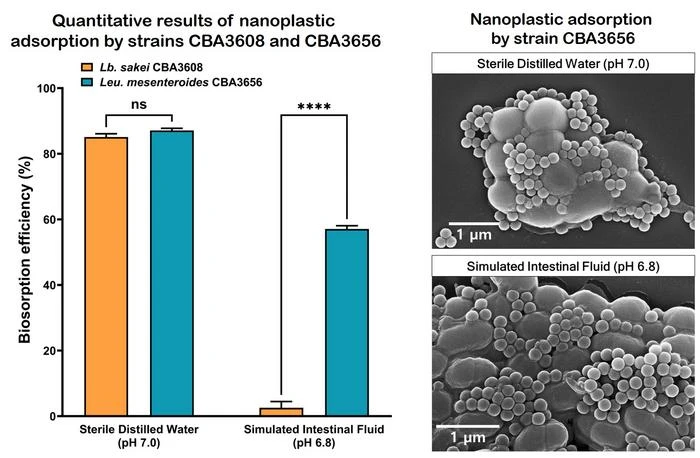
Most bacteria that can grab onto nanoplastics in a test tube lose that ability the moment they encounter the harsh chemistry of the human gut. A reference strain called Latilactobacillus sakei CBA3608, for instance, adsorbs 85% of polystyrene nanoplastics under standard laboratory conditions. Expose it to simulated intestinal fluid, and that number crashes to 3%. The difference between a lab result and a useful biological tool, in this case, is a 28-fold collapse in performance.
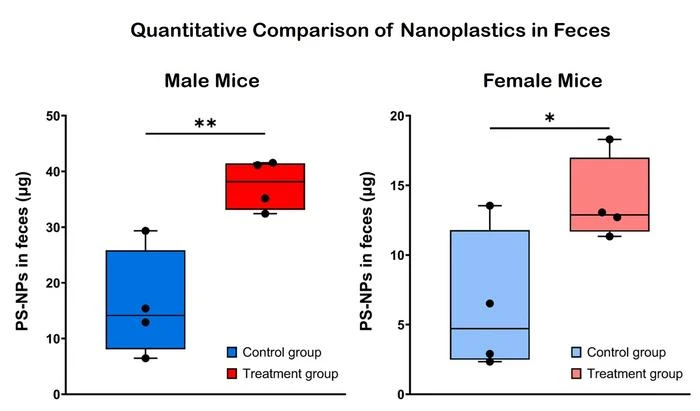
But a bacterium pulled from kimchi tells a different story. Leuconostoc mesenteroides CBA3656, isolated by researchers at South Korea's World Institute of Kimchi (WiKim), held onto 57% of its nanoplastic-binding capacity under the same intestinal conditions. And in germ-free mice fed the bacterium, nanoplastic excretion in feces more than doubled compared to controls. The study was published in Bioresource Technology.
Why nanoplastics are a gut problem
Nanoplastics --plastic particles smaller than 1 micrometer, roughly one-thousandth of a millimeter --enter the body through food and drinking water. Unlike larger microplastics, which tend to pass through the digestive tract, nanoplastics are small enough to cross the intestinal barrier. Research has detected them accumulating in organs including the kidneys and brain, though the health consequences of this accumulation are still poorly understood.
The challenge is that the body has no obvious mechanism for clearing nanoplastics once they're ingested. They're too small to be filtered out mechanically, and too chemically inert for most biological processes to break down. Strategies for reducing their absorption in the gut are essentially nonexistent in clinical practice.
From fermentation jar to nanoplastic sponge
The WiKim team, led by Drs. Se Hee Lee and Tae Woong Whon, screened kimchi-derived lactic acid bacteria for their ability to adsorb polystyrene nanoplastics (PS-NPs), one of the most common types found in food packaging and environmental contamination. The initial screen wasn't surprising --many bacteria can bind plastic particles in clean buffer solutions.
The critical test was what happened under conditions mimicking the human intestine: bile salts, digestive enzymes, acidic pH shifts. This is where most candidate strains fail. The surface properties that allow bacteria to grab nanoplastics in a test tube often change or degrade in the gut environment.
Strain CBA3656 didn't just survive the intestinal simulation --it maintained more than half its binding capacity. The researchers attribute this to the bacterium's surface characteristics, which appear to remain stable under the chemical stresses of digestion. The specific mechanisms --whether the binding involves surface proteins, polysaccharides, or charge interactions --are targets for future investigation.
The mouse evidence
The animal experiments used germ-free mice, animals raised without any intestinal bacteria, to isolate the effect of the probiotic strain. Both male and female mice that received CBA3656 showed more than a twofold increase in nanoplastics detected in their feces, compared to control animals that received no probiotic.
The implication is straightforward: the bacterium binds nanoplastics in the intestine and carries them out of the body before they can be absorbed. More nanoplastics in the feces means fewer nanoplastics crossing the intestinal wall.
But the germ-free mouse model, while useful for isolating a single variable, doesn't replicate the complexity of a human gut colonized by trillions of bacteria. How CBA3656 would perform in competition with an established microbiome --and whether the binding effect would hold at realistic nanoplastic exposure levels --are open questions.
Fermented foods meet environmental science
The study sits at an unusual intersection: traditional food microbiology and environmental toxicology. Lactic acid bacteria have been studied for decades for their roles in food preservation, flavor development, and gut health. Finding that one of these organisms can also interact with synthetic pollutants opens a line of research that didn't exist a few years ago.
"Plastic pollution is increasingly recognized not only as an environmental issue but also as a public health concern," said Dr. Se Hee Lee. "Our findings suggest that microorganisms derived from traditional fermented foods could represent a new biological approach to address this emerging challenge."
That's a measured claim, and appropriately so. We're a long way from a probiotic pill that scrubs nanoplastics from the body. The study demonstrates a mechanism --bacterial binding and fecal excretion --in controlled conditions. Whether that mechanism can be scaled into a practical intervention for humans will require clinical trials, dose-response studies, and a much better understanding of how nanoplastics behave in the real human gut.
Still, the 57% retention figure under intestinal conditions stands out. In a field where most candidate organisms lose nearly all their binding capacity in gut-like environments, this kimchi-derived strain holds its ground.