Americans know alcohol causes cancer — the new dietary guidelines just chose not to say so
Annenberg Public Policy Center, University of Pennsylvania
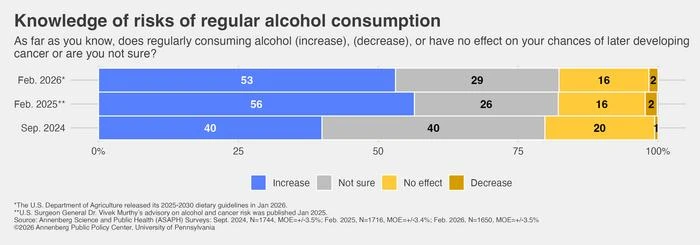
In September 2024, four in ten Americans knew that regular alcohol consumption raises cancer risk. By February 2025, that number had jumped to 56%. Then the U.S. Department of Agriculture released its 2025-2030 Dietary Guidelines — scrubbing every mention of alcohol's connection to cancer — and the number barely moved. It sits at 53% as of February 2026.
That sequence tells a story about what shapes public health knowledge and what doesn't. The awareness spike came after Surgeon General Vivek Murthy issued a January 2025 advisory explicitly linking alcohol to at least seven types of cancer and calling for updated warning labels on beverage containers. The silence that followed — the USDA's decision to remove the cancer language from its guidelines — did not erase the gains, but it didn't extend them either.
What the survey measured
The data comes from wave 28 of the Annenberg Science and Public Health (ASAPH) panel survey, conducted February 3-17, 2026, among 1,650 U.S. adults. The survey used a nationally representative probability sample with a margin of error of plus or minus 3.5 percentage points.
The numbers were remarkably stable compared to a year earlier. Fifty-three percent said regular alcohol consumption increases cancer risk, versus 56% in February 2025 — a statistically insignificant change. Sixteen percent said alcohol has no effect on cancer risk, unchanged. And 29% said they weren't sure, also unchanged from 26%.
The stability itself is the finding. One might have expected the USDA's omission to erode awareness. It did not. But one might equally have expected the dietary guidelines to reinforce and amplify the Surgeon General's message. That didn't happen either.
A missed amplification
The previous dietary guidelines, covering 2020-2025, stated explicitly that alcohol increases cancer risk even at low consumption levels. The new guidelines call for limiting alcoholic beverages for better health but contain no mention of cancer.
The scientific evidence has not changed in the interim. The International Agency for Research on Cancer classifies alcohol as a Group 1 carcinogen. The link to breast, colon, liver, esophageal, and other cancers is well established across multiple large studies.
"When it removed the warning linking alcohol consumption to cancer from the guidelines, the USDA turned its back on a substantial body of research," said Kathleen Hall Jamieson, director of the Annenberg Public Policy Center. She noted that a clear statement in the dietary guidelines could have amplified the Surgeon General's finding and helped save lives.
The awareness plateau
The trajectory is worth examining closely. In September 2024, before the Surgeon General's advisory, only 40% of Americans recognized the alcohol-cancer link. That 16-percentage-point jump to 56% in just a few months was substantial, driven by media coverage of Murthy's advisory and his call for new warning labels.
But the number has since plateaued. Without continued reinforcement — through policy action, updated labels, or consistent messaging in federal guidelines — awareness appears to have settled at roughly half the adult population. That means nearly half of Americans either believe alcohol doesn't affect cancer risk or aren't sure.
The survey cannot determine why individual respondents hold the views they do. It cannot say whether people who are aware of the risk have changed their behavior. And it cannot isolate the effect of the dietary guidelines' omission from other factors that might have influenced awareness over the past year.
The warning label that hasn't arrived
Murthy's advisory called for updating the warning labels on alcoholic beverage containers — labels that have not been changed since 1988. As of March 2026, no new labels have been mandated. The current labels warn about drinking during pregnancy and operating machinery but say nothing about cancer.
Whether updated labels would push awareness beyond the current 53% is an open question. Research on tobacco warning labels suggests that visible, specific health warnings do influence behavior over time. But the political dynamics around alcohol labeling — involving a large industry with substantial lobbying capacity — are different from those that shaped tobacco regulation.
For now, the data presents a mixed picture. The Surgeon General's advisory moved the needle in a way that few public health communications manage. But a single advisory, without follow-through in policy and labeling, appears to have reached a ceiling. The roughly half of Americans who know that their evening glass of wine carries a cancer risk learned it despite the system, not because of it.