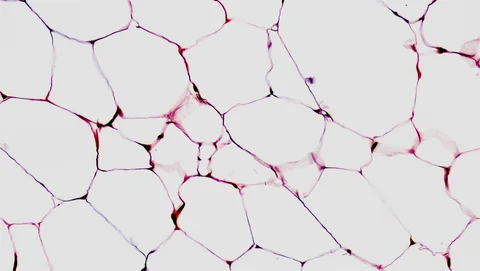
The same genetic change can look favourable in one setting and costly in another. A study of brown fat in male mice offers an unusually clear reason to ask what an animal was eating and whether it was challenged by cold.
- Retain sex, tissue and feeding state when describing the result.
- Fat accumulation and mitochondrial function are different measurements.
- Protection from weight gain does not settle the cost under energetic stress.
- Paper date
- 17 October 2026
- Model
- Male mice; brown-fat-specific AnkB deletion
- Question
- Fuel availability across metabolic settings
Original publication: 17 Oct 2026 · The date above refers to this brief.
A state-dependent result
Name the state
Fed, cold-fasted or high-fat-diet challenge.
Name the outcome
Temperature, lipid handling or body weight response.
Test the link
Distinguish an accompanying marker from a necessary mediator.
What the experiment shows
Aguillard and colleagues remove ankyrin-B specifically from brown adipose tissue. Male mice accumulate more brown-fat lipid but retain fed-state thermogenesis. With fasting and cold exposure, temperature regulation deteriorates. Under a high-fat diet, the deletion instead protects against weight gain and several metabolic abnormalities. The study links AnkB to recruitment of hormone-sensitive lipase at lipid droplets.
Source 1 ↗Read it as a condition-by-outcome table
Our comparison avoids compressing those findings into a single good-or-bad label. Put feeding state on one axis and outcome on the other: temperature, stored lipid, respiration and body weight answer different questions. A favourable weight trajectory need not predict performance during a fuel shortage.
This structure is useful beyond metabolism. Whenever a perturbation appears beneficial, ask whether the same experiment deliberately challenged the system under a second condition. An absent stress test is an open question; an observed trade-off should remain in the summary.
The cold experiment has its own denominator
The fasted cold comparison used a seven-hour exposure at 4°C. Figure 2 reports seven control and five knockout mice for panels g–k. Counts of microscopic images elsewhere in that figure are different units and should not be substituted for animals.
Source 1 ↗Why the mitochondrial story needs a second column
Our proposed reading note separates the machinery that can oxidise fuel from access to that fuel in a particular state. It records a direct measurement beside each explanation and leaves a blank where a causal link still needs a test.
That also guards against overreading a circulating marker. If a candidate messenger accompanies a protected phenotype, an informative follow-up would perturb that messenger independently and ask whether protection changes. This is an evaluation proposal, not evidence that we have established the cause of the whole-body result.
The connection to other brown-fat research
Our earlier DUSP4 guide concerns another perturbation and rescue question. Reading the two side by side is useful for identifying what differs:intervention, target tissue, experimental state and outcome. Their effects should not be added or ranked as if they came from a shared trial.
The future value is a more precise account of metabolic flexibility:which fuel sources can support a tissue under which demands? Replication in additional biological settings would clarify that boundary. This mouse study does not establish that blocking ANK2 in people is safe or useful, and it supplies no reason to try fasting or cold exposure as treatment.
A benefit and a cost in different states
Selected accepted primary PDF: initial Results pp.2–5 and Fig. 2 caption p.4; high-fat-diet Results and Discussion on pp.8–15. Fig. 2 visually inspected. Accepted version may receive edits. Publisher HTML metadata and abstract also checked. Supplements, source-data files, code and clinical records were not audited. No publisher figure reproduced.
01Is the deletion beneficial under every condition?
- What was observed
- High-fat-diet protection coexists with impaired fasted cold tolerance.
- Where the conclusion stops
- Different challenges answer different questions; male mouse model.
Source 1 · PDF initial Results pp.2–5; high-fat-diet Results; Discussion
02Are all Figure 2 observations independent animals?
- What was observed
- The caption separately lists animal counts and image counts.
- Where the conclusion stops
- A field of view is not an extra mouse.
Source 1 · Accepted PDF p.4; Fig. 2 caption
Numbers you can inspect
| Measure | Value & unit | Origin & method |
|---|---|---|
| Cold-test temperature | 4 degrees Celsius | Reported Experimental condition, not a recommendation. Source 1 · PDF p.2 Results; Fig. 2 |
| Fasted cold-test duration | 7 hours | Reported Acute fasted comparison. Source 1 · PDF p.2 Results |
| Fasted cold controls | 7 mice | Reported Fig. 2g–k, not every assay. Source 1 · PDF p.4 Fig. 2 caption |
| Fasted cold knockout group | 5 mice | Reported Fig. 2g–k animal denominator. Source 1 · PDF p.4 Fig. 2 caption |
Compare the actual experiments
These studies answer different questions. Read the unit and endpoint before comparing results.
| Study | Unit & setting | Readout | Interpretation boundary |
|---|---|---|---|
| Fed versus fasted cold challenge Source 1 · PDF pp.2–4; Fig. 2 | Male mice | Temperature regulation | Fuel state matters; distinct experimental comparisons. |
| High-fat-diet challenge Source 1 · High-fat-diet Results; Discussion | Tissue-specific knockout model | Metabolic phenotype | Not a test of systemic ANK2 inhibition in people. |
The export includes claims, available numbers, methods and source locations. It contains our reading notes and published summaries; it is not raw participant data or an independent reanalysis.
Evidence update · 19 Oct 2026
First publication. Reported observations, our calculations and proposed follow-up questions are distinguished. No raw data reanalysis. AI source check; no human editorial or clinical review.
Keep the experimental state in the headline
| Observation | Keep beside it | Next useful question |
|---|---|---|
| Fed-state heat production | Fuel can come from outside the lipid droplet | Does the same outcome hold during fasting? |
| Fasted cold response | Temperature and available fuel | Which source becomes limiting? |
| High-fat-diet protection | Weight and metabolic endpoints | Which adaptation is necessary for protection? |
| A candidate mediator rises | A separate perturbation test | Does changing it alter the phenotype? |
Original Press-News comparison framework. Proposed checks are our interpretation, not additional experiments reported by the authors.
Your questions, answered
Did the experiment test an obesity medicine in people?
No. It used a tissue-specific genetic model in male mice.
Is more brown-fat lipid automatically evidence of failed mitochondria?
No. The stored lipid and the functional measurements need separate assessment.
Why retain the fasting result?
It reveals an experimental cost that a weight-gain headline alone would omit.
Can this be compared directly with DUSP4?
The papers can inform related questions, but their interventions and settings do not form a head-to-head comparison.
Limits of this interpretation
- The reported genetic model and central outcomes concern male mice.
- Tissue-specific deletion differs from an intervention throughout the body.
- Fed, cold-fasted and high-fat-diet experiments have different conditions and denominators.
- A metabolic association does not prove every proposed mediator is necessary.
Sources & transparency
- Aguillard, Ferrer, Chen et al. (2026): Brown adipose tissue ankyrin-B cell-autonomously modulates lipid content and its deletion protects male mice against diet-induced obesity
Selected accepted primary PDF: initial Results pp.2–5 and Fig. 2 caption p.4; high-fat-diet Results and Discussion on pp.8–15. Fig. 2 visually inspected. Accepted version may receive edits. Publisher HTML metadata and abstract also checked. Supplements, source-data files, code and clinical records were not audited. No publisher figure reproduced. · Accessed 19 Oct 2026
DOI: 10.1038/s41467-026-78907-w
Prepared and source-checked with AI. Press-news Team is a collective publication byline, not a medical reviewer. No human editorial or clinical review has taken place. This educational explainer examines experimental methods and basic or preclinical research; it does not provide individual diagnosis or treatment advice. We did not conduct these experiments or reanalyse raw data. Findings, interpretation and proposed future tests are separated. Source-access limits are recorded below. Photographs are illustrative.
Source check: AI source check — selected primary PDF results, captions and experimental boundaries
Clinical review: Not applicable to this educational guide
Suggest a correction