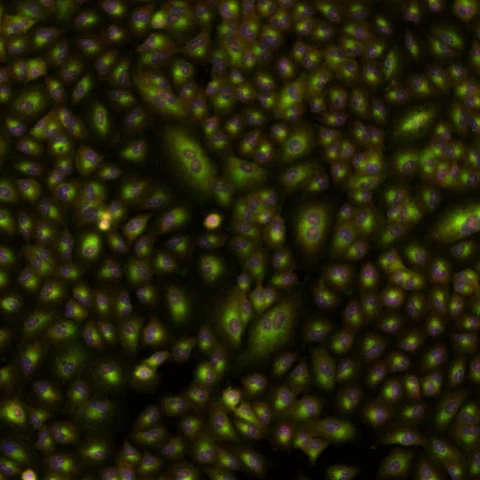
Knowing that an editing guide was present is not the same as knowing what happened to a cell’s DNA. Researchers report a way to examine detected edits alongside gene activity in single cells.
- The study reports 35,000 cells across three cell lines and a separate 10,000-cell analysis using seven guides.
- In the 10,000-cell library, the authors detected 5,761 edited cells and 36 unintended edit sites across 2,098 cells.
- These are results for selected research models and guides; they are not a safety rate for gene-editing treatments.
- Paper date
- 16 November 2026
- Method
- Superb-seq
- Selected library
- 10,000 cells
Original publication: 16 Nov 2026 · The date above refers to this brief.
Cells in one selected library
cells
From a detected edit to a research question
Detect
Identify editing events in selected individual cells.
Compare
Read gene activity and compare selected findings with another assay.
Interpret
Separate a laboratory association from a clinical safety conclusion.
The gap between a guide and an edit
Research tools can use a guide to direct a DNA-editing enzyme, but detecting the guide does not establish that the intended edit happened. The authors describe Superb-seq, which connects detected editing events with gene-expression measurements in individual cells. Our report covers the research question and results, not a protocol.
Source 1 ↗Different counts answer different questions
The abstract describes 35,000 cells across three cell lines. One selected library contained 10,000 K562 cells and used seven guides targeting four genes. In that library the authors report 5,761 cells with detected edits, plus 36 detected off-target sites across 2,098 cells. Sites, cells and guides are different units; the counts should not be added together.
Source 1 ↗A signal is not a universal error rate
An off-target site is an unintended location where an edit was detected in the studied setup. Detectability depends on the guides, cells and assay. The reported counts do not mean every gene-editing procedure has the same off-target rate, and the study did not follow treated patients for safety outcomes.
Source 1 ↗Checking an observation another way
The team compared selected detections with another sequencing assay. They report a correlation between methods at the evaluated sites, but correlation does not establish that every possible edit was found. The paper also compares predictions with observed sites: a predicted candidate and an experimentally detected event are different kinds of evidence.
Source 1 ↗What can gene activity tell us?
The authors report associations between 19 off-target edits and differences in gene expression, nine described as cell-type-specific. An association in these experimental cells suggests a question for further investigation; it does not by itself establish a clinical harm or explain every molecular cause.
Source 1 ↗Disclosure and a useful next test
Independent work with other cell types, guides and analytical pipelines would help define the method’s detection limits. Several authors report a patent application and commercial interests connected to the technology. Our earlier article on barcode errors addresses another reason that counting a molecular event requires careful measurement.
Cells and edit sites are not interchangeable
Primary PDF: abstract, Results pp. 3–5, Fig. 2 p. 3 and author competing-interest statement. The Fig. 2 page was visually inspected. Publisher metadata and abstract also checked. Supplements, source-data files, code and clinical records were not independently audited. No publisher figure reproduced.
01Were 36 patients affected?
- What was observed
- The paper reports 36 detected off-target sites in a 10,000-cell library.
- Where the conclusion stops
- Sites and cells are different units; this is not a clinical patient cohort.
Source 1 · Primary PDF abstract and Results pp. 1, 4
02Does a gene-expression association prove clinical harm?
- What was observed
- Nineteen off-target edits were associated with differences in gene expression in the reported experiments.
- Where the conclusion stops
- The study did not establish clinical outcomes or universal edit safety.
Source 1 · Primary PDF abstract p. 1
Numbers you can inspect
| Measure | Value & unit | Origin & method |
|---|---|---|
| Cells across three cell lines | 35000 cells | Reported Study-wide count, not the selected library alone. Source 1 · Primary PDF abstract p. 1 |
| Selected K562 library | 10000 cells | Reported Cell-library size for the reported screen. Source 1 · Primary PDF abstract p. 1 |
| Detected edited cells | 5761 cells | Reported Cells with detected edits in the selected library analysis. Source 1 · Primary PDF abstract and Results pp. 1, 4 |
| Detected off-target sites | 36 sites | Reported Distinct detected sites in the selected library. Source 1 · Primary PDF Results p. 4 |
| Cells with detected off-targets | 2098 cells | Reported Cells in which the reported off-targets occurred. Source 1 · Primary PDF Results p. 4 |
Compare the actual experiments
These studies answer different questions. Read the unit and endpoint before comparing results.
| Study | Unit & setting | Readout | Interpretation boundary |
|---|---|---|---|
| Single-cell edit and expression analysis Source 1 · Primary PDF Results pp. 3–4 | Selected library cells | Detected edits and gene expression | Associations are not patient outcomes. |
| Alternative sequencing check Source 1 · Primary PDF Fig. 3 and Results p. 5 | Selected candidate sites | Independent assay comparison | A check of selected sites cannot prove every possible edit was detected. |
The export includes claims, available numbers, methods and source locations. It contains our reading notes and published summaries; it is not raw participant data or an independent reanalysis.
Evidence update · 17 Nov 2026
First publication. Reported observations, arithmetic and proposed follow-up questions are separated. No raw-data reanalysis. AI source check; no human editorial or clinical review.
Do not mix cells, sites and guides
| Reading question | What the paper reports | What remains open |
|---|---|---|
| Study total | 35,000 cells from three cell lines | A study-wide count |
| Selected library | 10,000 K562 cells using seven guides | Not 10,000 patients |
| Detected edited cells | 5,761 cells in the selected analysis | Detection is assay-dependent |
| Off-target sites | 36 sites across 2,098 cells in that library | Sites and cells are different units |
Original Press-News reading framework. Follow-up questions are our interpretation, not experiments performed by the authors.
Your questions, answered
Were 35,000 patients studied?
No. The number refers to cells from three laboratory cell lines.
Are the 36 off-target sites the number of affected people?
No. They are detected genome locations in a selected cell-library analysis.
Does the method prove an edit caused disease?
No. The work reports laboratory measurements and associations, not clinical outcomes.
Are commercial interests disclosed?
Yes. The paper reports a patent application and commercial ties involving several authors.
Limits of this interpretation
- Results depend on the chosen cell lines, guides, assay and detection thresholds.
- Detected sites are not necessarily all edits and should not be interpreted as a treatment safety rate.
- Expression associations do not by themselves establish clinical harm or causation.
- Some authors disclose a patent application and commercial interests.
Sources & transparency
- Lorenzini, Balderson, Lavalle et al. (2026): Joint single-cell capture of Cas9 edits and transcriptomes reveals on- and off-target effects on gene expression
Primary PDF: abstract, Results pp. 3–5, Fig. 2 p. 3 and author competing-interest statement. The Fig. 2 page was visually inspected. Publisher metadata and abstract also checked. Supplements, source-data files, code and clinical records were not independently audited. No publisher figure reproduced. · Accessed 17 Nov 2026
DOI: 10.1038/s41592-026-03319-z
Prepared and source-checked with AI. Press-news Team is the collective publication byline, not a medical reviewer. No human editorial or clinical review has taken place. This educational article examines research methods and laboratory or observational findings, not individual diagnosis or treatment. We did not conduct these experiments or reanalyse raw data. Reported results, our interpretation and proposed future tests are separated. Source-access limits are recorded below. Photographs are illustrative.
Source check: AI source check — selected primary PDF results, captions and study boundaries
Clinical review: Not applicable to this educational guide
Suggest a correction