A close genetic match can prompt an important public-health question: where might related bacteria have come from? The answer requires more than a match between two genomes.
- The study compares bacterial isolates collected from food, animals and human clinical cases across Japan.
- The three reported sequence counts add to 2,367 isolates, not 2,367 people or a representative sample of all food.
- Genetic similarity can identify potential links; it does not by itself establish the direction or route of transmission.
- Paper date
- 30 October 2026
- Setting
- Samples from sectors across Japan
- Focus
- Sequenced isolates and possible links
Original publication: 30 Oct 2026 · The date above refers to this brief.
The sequenced isolates came from three bacterial groups
isolates in the described analysis
Three steps in reading a potential link
Sample
Name the sector, organism and collection context.
Compare
Describe the genetic similarity in the tested isolates.
Investigate
Seek time, location and exposure evidence before attributing a route.
What is One Health surveillance?
One Health considers connections among human, animal and environmental systems. In this study, researchers compare genome sequences from food-derived, animal-derived and human-derived bacterial isolates. The samples are a selected surveillance dataset, not a complete census of food, farms or infections.
Source 1 ↗Add the isolates, not the people
The abstract reports 1,613 non-typhoidal Salmonella isolates, 682 Campylobacter isolates and 72 Enterococcus isolates. Adding those three numbers gives 2,367 sequenced isolates in the described analysis. This is our arithmetic; it is not a count of people, contamination events or independent transmission chains.
Source 1 ↗What a close match can suggest
The authors report examples of closely related bacterial genomes from food and human sectors. That similarity supports further investigation of potential links. Genome comparisons alone generally cannot say who was exposed to which source, establish direction of transmission, or rule out an unsampled common source.
Source 1 ↗Why the collection method matters
Food, animal and human isolates may be collected for different purposes, in different places and at different times. A larger number for one bacterial group can reflect the sampling design and does not directly measure which food is riskier or how common resistance is in the population.
Source 1 ↗What extra evidence would help?
A stronger investigation of a specific suspected event would pair the genomic result with collection dates, locations, exposure information and other epidemiological evidence. Those are general questions for interpreting a possible link; we have not investigated any individual case or reconstructed a transmission route.
How this connects to other work
Our earlier guide to livestock viromes also separates a detected genetic feature from proof of movement between hosts. The organisms and datasets differ, but the reading question is the same: what was actually sampled, and what alternative explanations remain?
A genomic link needs a sampling context
Selected accepted primary PDF: abstract and sector descriptions on pp. 1–2, Salmonella genomic tree and Fig. 1 caption on p. 3, and cross-sector comparison Results. Fig. 1 page was visually inspected. The accepted version may be edited. Publisher HTML metadata and abstract also checked. Supplements, source-data files, code and clinical records were not independently audited. No publisher figure reproduced.
01What does the total of 2,367 count?
- What was observed
- It is the sum of the three reported bacterial-isolate counts.
- Where the conclusion stops
- An isolate is not necessarily a person, meal or transmission event.
Source 1 · Accepted PDF p. 1; abstract and arithmetic
02What does a close genome comparison establish?
- What was observed
- The authors identify examples of related isolates from different sectors.
- Where the conclusion stops
- Genetic similarity alone does not establish a particular exposure or direction of spread.
Source 1 · Accepted PDF pp. 1–3; abstract and cross-sector Results
Numbers you can inspect
| Measure | Value & unit | Origin & method |
|---|---|---|
| Salmonella isolates | 1613 isolates | Reported Non-typhoidal Salmonella in the described sequence comparison. Source 1 · PDF p. 1; abstract |
| Campylobacter isolates | 682 isolates | Reported Campylobacter in the described sequence comparison. Source 1 · PDF p. 1; abstract |
| Enterococcus isolates | 72 isolates | Reported Enterococcus in the described sequence comparison. Source 1 · PDF p. 1; abstract |
| Total across three groups | 2367 isolates | Calculated 1,613 + 682 + 72; a sum of reported isolate counts. Source 1 · PDF p. 1; arithmetic |
Compare the actual experiments
These studies answer different questions. Read the unit and endpoint before comparing results.
| Study | Unit & setting | Readout | Interpretation boundary |
|---|---|---|---|
| Within-study genome comparison Source 1 · PDF pp. 1–3 | Selected bacterial isolates from three sectors | Genetic relatedness in the sampled organisms | Differences in sampling do not establish prevalence. |
| Investigation of a possible link Source 1 · PDF pp. 1–3 | Genomes plus external epidemiological context | Potential evidence about time, place and exposure | The study comparison alone is not a completed case investigation. |
The export includes claims, available numbers, methods and source locations. It contains our reading notes and published summaries; it is not raw participant data or an independent reanalysis.
Evidence update · 31 Oct 2026
First publication. Reported observations, arithmetic and proposed follow-up questions are separated. No raw-data reanalysis. AI source check; no human editorial or clinical review.
From a genome match to a public-health question
| Reading question | Evidence to retain | What remains open |
|---|---|---|
| What was counted? | Bacterial isolates submitted to the described analysis | The number of exposed people or contaminated meals |
| What was compared? | Genome sequences across selected sectors | A complete history of every transmission event |
| What can similarity suggest? | A possible genetic link worth investigating | Proof of the direction or source of infection |
| What strengthens inference? | Dates, locations and exposure evidence | A conclusion from sequencing alone |
Original Press-News reading framework. Follow-up questions are our interpretation, not experiments performed by the authors.
Your questions, answered
Were 2,367 people studied?
No. That is our sum of the three reported counts of bacterial isolates.
Does a genome match prove food caused a particular infection?
No. It can motivate investigation, but genetic similarity alone does not establish a specific exposure or direction.
Does the largest bar mean the highest food risk?
No. The bars show counts in the selected analysis and can be affected by sampling design.
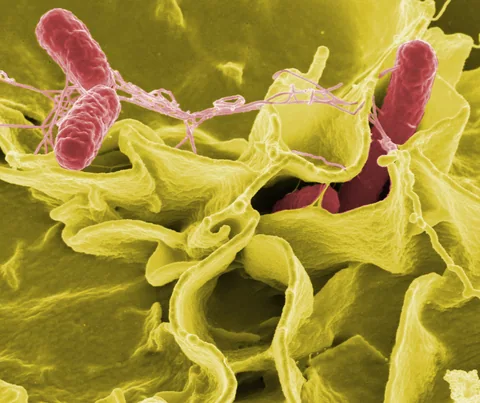
Is the Salmonella photograph a sample from this study?
No. It is an illustrative image of a different Salmonella specimen, credited separately from the paper.
Limits of this interpretation
- The isolate counts are not population prevalence, individual patient counts or measures of food risk.
- Similar genomes suggest possible links but do not by themselves establish a transmission direction.
- Collection procedures and coverage differ by sector and organism.
- We did not independently analyse the sequences, raw metadata or supplementary files.
Sources & transparency
- Kitamura, Shinomiya, Kawanishi et al. (2026): One Health genomic surveillance identifies potential genetic links of antimicrobial-resistant foodborne pathogens across sectors
Selected accepted primary PDF: abstract and sector descriptions on pp. 1–2, Salmonella genomic tree and Fig. 1 caption on p. 3, and cross-sector comparison Results. Fig. 1 page was visually inspected. The accepted version may be edited. Publisher HTML metadata and abstract also checked. Supplements, source-data files, code and clinical records were not independently audited. No publisher figure reproduced. · Accessed 31 Oct 2026
DOI: 10.1038/s41467-026-78530-9
Prepared and source-checked with AI. Press-news Team is the collective publication byline, not a medical reviewer. No human editorial or clinical review has taken place. This educational article examines research methods and laboratory or observational findings, not individual diagnosis or treatment. We did not conduct these experiments or reanalyse raw data. Reported results, our interpretation and proposed future tests are separated. Source-access limits are recorded below. Photographs are illustrative.
Source check: AI source check — selected primary PDF results, captions and study boundaries
Clinical review: Not applicable to this educational guide
Suggest a correction