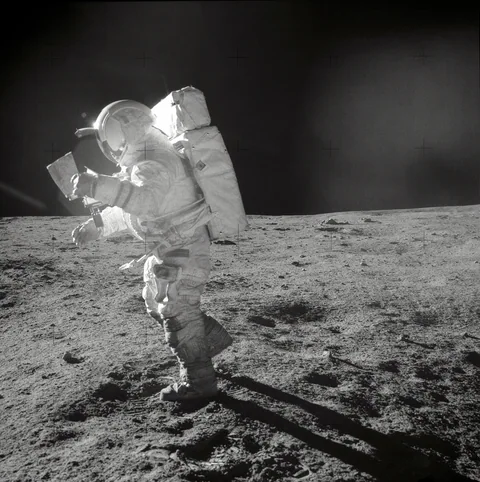
Dust is a familiar problem on Earth and a potential concern in space. A laboratory study asks how materials designed to resemble lunar and Martian dust affect airway-related models.
- The material was made on Earth to simulate aspects of lunar and Martian regolith; it was not dust collected from those worlds.
- The researchers studied several cell systems and a mouse model, measuring barrier and inflammatory responses.
- The findings cannot quantify the health risk to an astronaut on a future mission.
- Paper date
- 6 November 2026
- Material
- Three regolith simulants
- Focus
- Airway barrier and inflammation
Original publication: 6 Nov 2026 · The date above refers to this brief.
Follow the evidence across models
Simulate
Use Earth-made materials as proxies for selected dust properties.
Observe
Measure cell and mouse responses in separate experiments.
Translate
Identify what further exposure and health evidence would be needed for people.
What is a regolith simulant?
Regolith is loose surface material made of dust and rock fragments. The study used three Earth-made reference materials intended to imitate selected features of planetary material: two Martian simulants and one lunar simulant. A terrestrial silica material served as a comparison in several experiments. A simulant is a research proxy, not an actual lunar or Martian sample.
Source 1 ↗Several models, different questions
The researchers examined human immune cells, airway cell lines and primary bronchial epithelial cultures, then used a mouse exposure model. The paper reports inflammatory signals and changes in airway-barrier measures. These readouts describe responses under the specified experimental conditions; they are not diagnoses or a forecast of a person’s illness.
Source 1 ↗The barrier is one part of the story
In the bronchial culture experiment, the researchers measured indicators of barrier function and inflammatory activity after repeated exposures. The lunar and one Martian simulant affected barrier measures, while responses differed by material and readout. A change in a laboratory barrier measure cannot be converted directly into the probability of disease in space.
Source 1 ↗The mouse experiments were a separate test
The authors selected one lunar and one Martian simulant for mouse experiments, alongside comparison groups. They report changes in airway-associated inflammation and markers of barrier disruption. Mice are whole-animal models, but their exposure, physiology and environment are not identical to those of astronauts.
Source 1 ↗What remains unknown?
The study did not expose astronauts to planetary dust or reproduce every condition of a mission. Actual surface materials can vary, and real exposure depends on the environment and protective systems. This paper does not estimate a safe or unsafe exposure level for people.
Source 1 ↗How to connect the evidence
Our guide to bacterial-genome surveillance asks whether a pattern in samples is enough to establish what happened to a person. Here the key boundary is different but related: a response in a model can motivate further research without measuring the real-world frequency or severity of harm.
A simulant is not a planetary sample
Accepted primary PDF: abstract p. 1 and Results describing material, cell and mouse models. The abstract page was visually inspected; the accepted version may be edited. Publisher metadata and abstract also checked. Supplements, source-data files, code and clinical records were not independently audited. No publisher figure reproduced.
01Was this a study of actual lunar and Martian dust?
- What was observed
- The paper studied Earth-made lunar and Martian regolith simulants.
- Where the conclusion stops
- Composition and behaviour of real planetary dust may vary.
Source 1 · Accepted PDF abstract and Results pp. 1–2
02Was astronaut disease risk measured?
- What was observed
- The study reports responses in human cell systems and mice.
- Where the conclusion stops
- It did not measure astronauts or estimate a human exposure threshold.
Source 1 · Accepted PDF abstract and Results
Numbers you can inspect
| Measure | Value & unit | Origin & method |
|---|---|---|
| Planetary simulants | 3 materials | Reported Two Martian and one lunar simulant in the broader laboratory study. Source 1 · Accepted PDF Results p. 2 |
| Martian simulants | 2 materials | Reported Two Mars analogues, with one selected for the mouse experiments. Source 1 · Accepted PDF Results pp. 2–4 |
| Lunar simulants | 1 material | Reported One lunar analogue, made on Earth. Source 1 · Accepted PDF Results p. 2 |
Compare the actual experiments
These studies answer different questions. Read the unit and endpoint before comparing results.
| Study | Unit & setting | Readout | Interpretation boundary |
|---|---|---|---|
| Airway cell systems Source 1 · Accepted PDF abstract and Results | Human-derived immune and epithelial cell models | Barrier and inflammatory readouts | Cell responses under study conditions are not a personal risk estimate. |
| Mouse experiment Source 1 · Accepted PDF abstract and Results | Mice exposed to selected simulants | Airway and inflammatory measures | A mouse model is not the environment or physiology of a space mission. |
The export includes claims, available numbers, methods and source locations. It contains our reading notes and published summaries; it is not raw participant data or an independent reanalysis.
Evidence update · 8 Nov 2026
First publication. Reported observations, arithmetic and proposed follow-up questions are separated. No raw-data reanalysis. AI source check; no human editorial or clinical review.
From simulant to health question
| Reading question | What the paper reports | What remains open |
|---|---|---|
| Material | Two Mars and one Moon simulant, plus comparison material | Actual planetary dust can differ |
| Cell experiments | Human immune and airway-related cell systems | Laboratory responses do not establish disease in an astronaut |
| Mouse experiment | Selected lunar and Martian simulants in mice | Mouse exposures and physiology do not reproduce a space mission |
| Future question | How material properties and exposure conditions affect responses | Human risk needs separate exposure and health evidence |
Original Press-News reading framework. Follow-up questions are our interpretation, not experiments performed by the authors.
Your questions, answered
Was actual lunar or Martian dust used?
No. The tested planetary materials were Earth-made simulants.
Did the study measure astronauts’ health?
No. It investigated cell systems and mice under laboratory conditions.
Were all three simulants tested in mice?
The mouse experiment used selected lunar and Martian simulants, not every material tested in cells.
Does the paper establish a safe exposure level?
No. It does not determine a human exposure threshold for a mission.
Limits of this interpretation
- All three planetary materials were terrestrial simulants, not samples returned from the Moon or Mars.
- Different cell and mouse experiments assessed different readouts and do not represent the same population.
- The mouse experiment did not include every simulant in the cell experiments.
- The accepted paper may change in the final version; astronaut risk and exposure thresholds were not measured.
Sources & transparency
- Bulut, Pérez-Diego, Zaccaria et al. (2026): Lunar and Martian regolith simulants compromise airway barrier function and trigger inflammation
Accepted primary PDF: abstract p. 1 and Results describing material, cell and mouse models. The abstract page was visually inspected; the accepted version may be edited. Publisher metadata and abstract also checked. Supplements, source-data files, code and clinical records were not independently audited. No publisher figure reproduced. · Accessed 8 Nov 2026
DOI: 10.1038/s42003-026-11300-x
Prepared and source-checked with AI. Press-news Team is the collective publication byline, not a medical reviewer. No human editorial or clinical review has taken place. This educational article examines research methods and laboratory or observational findings, not individual diagnosis or treatment. We did not conduct these experiments or reanalyse raw data. Reported results, our interpretation and proposed future tests are separated. Source-access limits are recorded below. Photographs are illustrative.
Source check: AI source check — selected primary PDF results, captions and study boundaries
Clinical review: Not applicable to this educational guide
Suggest a correction