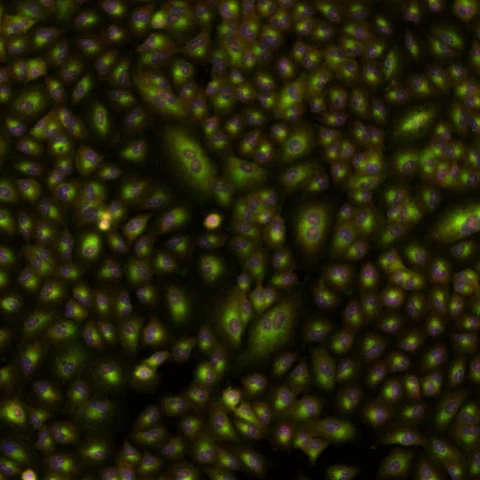
Can a peptide coating help a lipid particle carry messenger RNA into cultured cells? A newly published laboratory report suggests a possible research direction, but its accessible abstract is only a first look.
- The authors compared an experimental PAS-peptide coating with PEG coatings in lipid nanoparticles.
- The abstract reports roughly 50% RNA encapsulation and cell-culture protein expression; those are laboratory measurements, not vaccine efficacy.
- The accessible source was the abstract and disclosure statement, not the full methods. Safety and performance in people remain unestablished.
- Paper date
- 17 November 2026
- Available for this check
- Abstract and disclosures
- Test setting reported
- Cultured cells
Original publication: 17 Nov 2026 · The date above refers to this brief.
From a coating to a possible application
Make
Investigate a peptide-coated nanoparticle in the laboratory.
Measure
Compare packaging, particle properties and cell-culture readouts.
Test further
Independently evaluate formulation performance and safety in appropriate models before clinical use.
The idea in plain English
Lipid nanoparticles can carry messenger RNA, and their surface coating influences how the particles behave. This paper describes an experimental coating built from a peptide containing proline, alanine and serine, and compares it with polyethylene glycol, commonly called PEG. A change in one part of a particle does not establish that the complete formulation is equivalent to an existing medicine.
Source 1 ↗What the accessible abstract reports
The authors report approximately 50% RNA encapsulation for the compared formulations and particle diameters in an 85–120 nanometer range. They also describe protein production in cultured HepG2 and HEK293E cells after using the experimental particles. Encapsulation measures how much RNA is packaged, not how well a vaccine prevents disease.
Source 1 ↗A result in a dish is an early step
The abstract describes a side-by-side comparison of secreted protein in cultured cells. It does not report a clinical trial of the experimental coating. It mentions earlier mouse work involving a related protein, but that is not evidence that the new formulation was tested in patients or prevents infection.
Source 1 ↗What could not be checked
At the time of this check, we could inspect the publisher’s abstract and conflict-of-interest statement but not the full methods, figure data or supplementary material. We therefore cannot independently assess replicate counts, precision, comparative statistics, long-term stability or whether all relevant safety tests were performed.
Source 1 ↗Why disclosures and follow-up matter
Two authors are listed as inventors on a related patent application; two are cofounders and shareholders of a company connected with the technology. Independent replication and animal and clinical studies would be needed to assess any practical role. This report does not show that a PAS coating is safer for people or that an existing vaccine should be changed.
Source 1 ↗What can be checked from the abstract
Publisher abstract, publication details and competing-interest statement only. Full methods, figures and experimental details were not accessible for this check; the accepted manuscript may be edited. Publisher metadata and abstract also checked. Supplements, source-data files, code and clinical records were not independently audited. No publisher figure reproduced.
01Does 50% measure protection against infection?
- What was observed
- The abstract reports approximately 50% RNA encapsulation in the compared particles.
- Where the conclusion stops
- Encapsulation is a laboratory property, not vaccine efficacy.
Source 1 · Publisher abstract
02Does this study establish superior safety in people?
- What was observed
- The accessible abstract reports cell-culture observations and does not report a human trial of the experimental coating.
- Where the conclusion stops
- Comparative human safety remains unestablished; full methods were not available for this check.
Source 1 · Publisher abstract and source-access limitation
Numbers you can inspect
| Measure | Value & unit | Origin & method |
|---|---|---|
| Reported approximate RNA encapsulation | 50 percent | Reported Approximate encapsulation in the compared nanoparticle formulations, not clinical efficacy. Source 1 · Publisher abstract |
| Lower reported particle diameter | 85 nanometers | Reported Lower end of the reported diameter range across formulations. Source 1 · Publisher abstract |
| Upper reported particle diameter | 120 nanometers | Reported Upper end of the reported diameter range across formulations. Source 1 · Publisher abstract |
Compare the actual experiments
These studies answer different questions. Read the unit and endpoint before comparing results.
| Study | Unit & setting | Readout | Interpretation boundary |
|---|---|---|---|
| Nanoparticle characterization Source 1 · Publisher abstract | Formulations and packaged RNA | Encapsulation and particle diameter | Physical measurements do not establish clinical protection. |
| Cell-culture expression Source 1 · Publisher abstract | HepG2 and HEK293E cell models | Expression of encoded proteins | Culture results do not establish safety or efficacy in people. |
The export includes claims, available numbers, methods and source locations. It contains our reading notes and published summaries; it is not raw participant data or an independent reanalysis.
Evidence update · 17 Nov 2026
First publication. Reported observations, arithmetic and proposed follow-up questions are separated. No raw-data reanalysis. AI source check; no human editorial or clinical review.
What the abstract does and does not measure
| Reading question | What the paper reports | What remains open |
|---|---|---|
| RNA encapsulation | Approximately 50% in compared formulations | Not the percentage of people protected |
| Particle diameter | Reported range 85–120 nanometers | Size alone does not establish delivery or safety |
| Cultured cells | Protein expression reported in cell lines | Not a human treatment outcome |
| Evidence access | Abstract and disclosures checked | Replicates and uncertainty could not be independently checked |
Original Press-News reading framework. Follow-up questions are our interpretation, not experiments performed by the authors.
Your questions, answered
Is this a new approved vaccine?
No. The paper describes an experimental nanoparticle coating in a laboratory context.
Does 50% mean a vaccine is 50% effective?
No. It refers to reported RNA encapsulation in the tested formulations.
Was the full paper checked?
Only the publisher abstract and competing-interest statement were accessible for this check; full methods and figures were not reviewed.
Does this prove the coating is safer than PEG for people?
No. The accessible abstract does not establish comparative safety in people.
Limits of this interpretation
- Only the publisher abstract and competing-interest statement were accessible for this check; full methods and figures were not independently reviewed.
- RNA encapsulation and protein output in culture are not measures of protection from disease.
- The accessible abstract does not report a human trial of the experimental formulation.
- The authors disclose related patent and company interests.
Sources & transparency
- Makbul, Friedrich, Binder et al. (2026): Pro/Ala/Ser (PAS) peptides as an alternative to polyethylene glycol (PEG) for the surface shielding of lipid nanoparticles (LNPs) carrying therapeutic mRNA
Publisher abstract, publication details and competing-interest statement only. Full methods, figures and experimental details were not accessible for this check; the accepted manuscript may be edited. Publisher metadata and abstract also checked. Supplements, source-data files, code and clinical records were not independently audited. No publisher figure reproduced. · Accessed 17 Nov 2026
DOI: 10.1038/s41598-026-80364-w
Prepared and source-checked with AI. Press-news Team is the collective publication byline, not a medical reviewer. No human editorial or clinical review has taken place. This educational article examines research methods and laboratory or observational findings, not individual diagnosis or treatment. We did not conduct these experiments or reanalyse raw data. Reported results, our interpretation and proposed future tests are separated. Source-access limits are recorded below. Photographs are illustrative.
Source check: AI source check — publisher abstract and competing-interest statement only
Clinical review: Not applicable to this educational guide
Suggest a correction