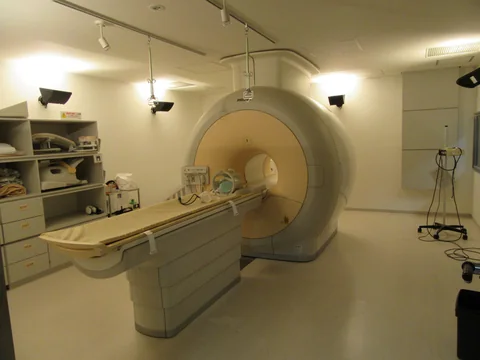
Muscles change their energy use while they work. A small feasibility study tests whether two magnetic-resonance methods can observe different parts of that process while a person exercises.
- Eleven healthy men were recruited: four endurance-trained and seven untrained.
- One participant was excluded from the carbon-13 analysis because the tracer was not adequately delivered, leaving ten for that analysis.
- A scanner measurement is non-invasive, but the carbon-13 experiment involved an intravenous tracer.
- Paper date
- 30 October 2026
- Participants
- 11 healthy men recruited
- Focus
- Exercise measurements and analysis denominators
Original publication: 30 Oct 2026 · The date above refers to this brief.
The carbon-13 analysis used ten of the eleven recruits
participants included in each carbon-13 condition
From a volunteer to an interpretable signal
Assign
Identify training status and the stated workload condition.
Measure
Separate the tracer-based carbon signal from phosphorus measurements.
Count
Use the denominator that belongs to each analysis.
Two measurements, different questions
Torchi and colleagues combined carbon-13 and phosphorus-31 magnetic-resonance spectroscopy to study calf muscle during a controlled ankle-movement task. Carbon-13 signals were used to follow labelled pyruvate and downstream compounds; phosphorus-31 measurements described high-energy phosphate changes and intracellular acidity. These signals are related, but they are not interchangeable.
Source 1 ↗The scanner did not make the whole procedure needle-free
The magnetic-resonance measurement itself does not require a muscle biopsy. For the carbon-13 experiment, however, the paper states that hyperpolarised labelled pyruvate was administered intravenously. Describing the measurement as non-invasive should not be confused with saying that every part of the study avoided an injection.
Source 1 ↗Who was included?
The researchers recruited eleven healthy men: four endurance-trained and seven untrained. The design compared trained and untrained groups at 40% of the relevant maximum workload, and untrained groups at 40% versus 70%. These percentages describe the experimental workload relative to a measured maximum, not a recommended exercise prescription.
Source 1 ↗Why eleven becomes ten
Table 1 lists groups of four, three and four participants. For the carbon-13 analysis, Fig. 3 and Table 2 report groups of four, three and three: one person in the untrained higher-workload group was excluded because of poor pyruvate delivery. Our chart uses the analysis counts, while retaining the recruited count in the study card.
Source 1 ↗What the comparison can and cannot tell us
The authors observed differences in labelled metabolite ratios between the small groups under the study conditions. The trained and untrained groups were selected by existing training status rather than randomly assigned to a new training programme. The experiment therefore informs feasibility and physiological hypotheses; it does not isolate the effect of a specific workout on a randomly assigned person.
Source 1 ↗Where the evidence stops
The study included healthy young men, small groups and no trained group at the higher workload. Results cannot automatically be generalised to women, older adults, people with illness or different exercise tasks. A useful next study would prespecify larger groups, report missing measurements and compare repeated observations over time. That is our proposed follow-up, not an additional experiment.
A denominator follows its own measurement
Selected accepted primary PDF: study design and Fig. 1 on p. 2, participant Table 1 and Results on p. 3, Fig. 3 on p. 5, Table 2 on p. 6 and recruitment Methods. Fig. 1 and Table 1 pages were visually inspected. The accepted version may be edited. Publisher HTML metadata and abstract also checked. Supplements, source-data files, code and clinical records were not independently audited. No publisher figure reproduced.
01Why are there ten rather than eleven carbon-13 results?
- What was observed
- One untrained participant in the higher-workload group was excluded for poor pyruvate delivery.
- Where the conclusion stops
- This exclusion applies to the carbon-13 analysis; do not assume all analyses use the same denominator.
Source 1 · Accepted PDF pp. 3, 5–6; Table 1, Fig. 3 and Table 2
02Was the full procedure non-invasive?
- What was observed
- Magnetic-resonance acquisition did not require a muscle biopsy; labelled pyruvate was given intravenously.
- Where the conclusion stops
- An imaging method without a biopsy is not necessarily a study without an injection.
Source 1 · Accepted PDF p. 3; carbon-13 measurement Results
Numbers you can inspect
| Measure | Value & unit | Origin & method |
|---|---|---|
| Recruited participants | 11 people | Reported Four trained and seven untrained healthy men. Source 1 · PDF recruitment Methods and Table 1 |
| Carbon-13 analysis participants | 10 people | Reported One participant excluded for poor tracer delivery. Source 1 · PDF p. 5; Fig. 3 caption |
| Trained, 40% carbon-13 group | 4 people | Reported Analysis count at the stated workload. Source 1 · PDF p. 5; Fig. 3 caption |
| Untrained, 40% carbon-13 group | 3 people | Reported Analysis count at the stated workload. Source 1 · PDF p. 5; Fig. 3 caption |
| Untrained, 70% carbon-13 group | 3 people | Reported Four recruited; one excluded from this analysis. Source 1 · PDF pp. 3 and 5; Table 1 and Fig. 3 |
Compare the actual experiments
These studies answer different questions. Read the unit and endpoint before comparing results.
| Study | Unit & setting | Readout | Interpretation boundary |
|---|---|---|---|
| Training-status comparison Source 1 · PDF pp. 2–3 | Trained and untrained men at 40% of maximum workload | Selected carbon-13 and phosphorus-31 signals | Existing training status was not randomly assigned. |
| Workload comparison Source 1 · PDF pp. 2–3 and 5 | Untrained groups at 40% and 70% of maximum workload | Selected spectroscopy measures | Different groups and small analysis counts limit individual inference. |
The export includes claims, available numbers, methods and source locations. It contains our reading notes and published summaries; it is not raw participant data or an independent reanalysis.
Evidence update · 31 Oct 2026
First publication. Reported observations, arithmetic and proposed follow-up questions are separated. No raw-data reanalysis. AI source check; no human editorial or clinical review.
Keep the comparisons separate
| Reading question | Evidence to retain | What remains open |
|---|---|---|
| Who was recruited? | Four trained and seven untrained healthy men | How the results apply to other populations |
| Who entered the carbon-13 analysis? | Four, three and three across the stated conditions | Why one person is absent from that analysis |
| What was measured? | Labelled metabolite signals and phosphorus-31 measures | A clinical outcome or treatment response |
| What did the workload mean? | 40% or 70% of a measured maximum workload | A general exercise recommendation |
Original Press-News reading framework. Follow-up questions are our interpretation, not experiments performed by the authors.
Your questions, answered
Were eleven people included in every analysis?
No. The carbon-13 analysis excluded one participant because pyruvate delivery was poor; Fig. 3 reports ten across the three groups.
Was the study entirely needle-free?
No. The carbon-13 experiment involved intravenous labelled pyruvate, although the magnetic-resonance measurement did not require a muscle biopsy.
Does 70% mean everyone should exercise at that intensity?
No. It is one experimental workload relative to a measured maximum, not an individual training recommendation.
Does this prove a particular training programme caused the differences?
No. The comparison used groups with different existing training status; it was not a randomised training intervention.
Limits of this interpretation
- The study is a small feasibility experiment involving healthy men, not a trial of a treatment or training programme.
- One carbon-13 result was excluded for tracer-delivery reasons; other analyses can have different denominators.
- Existing training status and experimental workload are different comparison dimensions.
- We did not inspect individual records, independently reanalyse spectra or audit supplementary data.
Sources & transparency
- Torchi, Mallinson, Bawden et al. (2026): Real-time quantification of skeletal muscle metabolism in healthy men using hyperpolarised [1-¹³C]pyruvate reveals training-dependent adaptation
Selected accepted primary PDF: study design and Fig. 1 on p. 2, participant Table 1 and Results on p. 3, Fig. 3 on p. 5, Table 2 on p. 6 and recruitment Methods. Fig. 1 and Table 1 pages were visually inspected. The accepted version may be edited. Publisher HTML metadata and abstract also checked. Supplements, source-data files, code and clinical records were not independently audited. No publisher figure reproduced. · Accessed 31 Oct 2026
DOI: 10.1038/s41467-026-79053-z
Prepared and source-checked with AI. Press-news Team is the collective publication byline, not a medical reviewer. No human editorial or clinical review has taken place. This educational article examines research methods and laboratory or observational findings, not individual diagnosis or treatment. We did not conduct these experiments or reanalyse raw data. Reported results, our interpretation and proposed future tests are separated. Source-access limits are recorded below. Photographs are illustrative.
Source check: AI source check — selected primary PDF results, captions and study boundaries
Clinical review: Not applicable to this educational guide
Suggest a correction