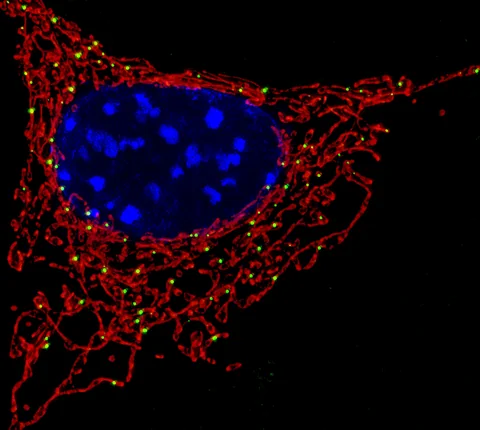
A still image can locate a protein without showing its full movement. A new study of mitochondrial translation combines captured structures with computational models to ask how a flexible regulator can help a ribosome continue making a protein.
- A structural class is not a percentage of functioning cells.
- Predicted movement and directly observed density have different evidential roles.
- Prior mutational evidence should retain its provenance.
- Paper date
- 21 October 2026
- System
- Human mitochondrial translation machinery
- Evidence
- Cryo-EM, AlphaFold analysis and molecular simulations
Original publication: 21 Oct 2026 · The date above refers to this brief.
Different evidence, one testable explanation
Observe
State what the structural data resolve.
Model
Name the proposed motion and its assumptions.
Challenge
Specify a measurement that could contradict it.
What the new work adds
Singh and colleagues locate TACO1 near the mitoribosome’s A site and analyse how its flexible first domain could engage A-site tRNA. The work combines cryo-EM classification, AlphaFold analysis and molecular dynamics, interpreted alongside earlier biochemical evidence. It proposes a different arrangement from factors that act at the ribosomal E site.
Source 1 ↗Why a rare captured pose is not a failure rate
The authors describe ordered first-domain density in about 10% of monosome-derived particles. That is a structural-class observation. It does not mean that only 10% of mitochondria work, or that the remaining cells are defective.
Source 1 ↗Our evidence ledger has three verbs
Observed belongs beside density and the classification that produced it. Predicted belongs beside model assumptions and the conformations generated by a computational method. Supported belongs beside an independent perturbation or a prior measurement used to challenge the explanation.
A strong account can combine all three without making them interchangeable. For a reader, the useful question is which observation would be surprising if the proposed motion were wrong. That question turns an appealing animation into an explanation that can be challenged.
A simulation clock has a model attached
Our suggested reading note records the representation, constraints and sampled transitions before reporting a simulation duration. A trajectory can explore plausible contacts without measuring a cellular rate. More simulated frames do not automatically create more independent biological observations.
Likewise, a high-confidence local fold does not guarantee confidence in how two domains are positioned together. A useful follow-up would compare specific predicted contacts against separately measured functional changes, retaining negative results as well as supportive ones. These are evaluation proposals, not experiments we performed.
Keep earlier experiments attached to their source
This paper uses earlier mutational and biochemical evidence when interpreting its flexible-domain model. We assessed how that evidence is described here; we did not independently audit those earlier datasets. That boundary matters when a mechanism appears to be supported by several methods.
A useful next study would connect a prespecified contact perturbation to translation behaviour under a relevant difficult sequence, while checking that the protein remains properly assembled. Such a test could distinguish a contact-specific explanation from general disruption.
Where the finding connects
The PRMT5 article in this collection asks about the supply of DNA-packaging proteins; this study asks about continued production of mitochondrial proteins. Their connection is a reading principle: identify the step in production that the measurement actually resolves.
The earlier mRNA-frame guide adds another level of that chain. Sequence, translation and downstream function require distinct evidence. The opportunity here is a more testable account of mitochondrial protein synthesis, not a finding that a supplement, diet or existing medicine improves it.
Do not exchange observed, predicted and previously measured
Selected accepted primary PDF: structural classification Results on p.2; domain flexibility and modelling on pp.4–6; Fig. 3 caption on p.6; Discussion. Fig. 3 caption visually inspected. Earlier mutational studies are discussed through this paper, not independently audited. Publisher HTML metadata and abstract also checked. Supplements, source-data files, code and clinical records were not independently audited. No publisher figure reproduced. This accepted version may receive further edits.
01What does the structure locate?
- What was observed
- TACO1 near the A site with flexible domain arrangements.
- Where the conclusion stops
- A captured class is not a movie of every transition.
Source 1 · Primary PDF structural Results and Figs. 1–3
02What supports the proposed movement?
- What was observed
- Structural observations, modelling and simulations interpreted alongside earlier biochemical work.
- Where the conclusion stops
- Earlier datasets and raw particles were not independently reanalysed here.
Source 1 · Primary PDF domain-flexibility Results; Fig. 3
Numbers you can inspect
| Measure | Value & unit | Origin & method |
|---|---|---|
| Ordered first-domain particle fraction | 10 percent | Reported Approximate monosome-derived structural-class fraction, not healthy-cell frequency or efficacy. Source 1 · Primary PDF domain-flexibility Results |
Compare the actual experiments
These studies answer different questions. Read the unit and endpoint before comparing results.
| Study | Unit & setting | Readout | Interpretation boundary |
|---|---|---|---|
| Cryo-EM classification Source 1 · Primary PDF structural Results | Mitoribosome particles | Resolved structural arrangements | Classification frequency is not cellular success rate. |
| Predictions and simulations Source 1 · Primary PDF Fig. 3 and associated Results | Computational protein/ribosome representations | Plausible conformations and contacts | Model assumptions and prior evidence retain distinct provenance. |
The export includes claims, available numbers, methods and source locations. It contains our reading notes and published summaries; it is not raw participant data or an independent reanalysis.
Evidence update · 22 Oct 2026
First publication. Reported observations, calculations and proposed follow-up questions are separated. No raw-data reanalysis. AI source check; no human editorial or clinical review.
An observation ledger for a moving protein
| Reading question | Evidence to retain | What remains open |
|---|---|---|
| Where is it? | Cryo-EM density and classification | Which regions are resolved in each class |
| How might it move? | Predicted conformations and model assumptions | Which proposed transition is experimentally testable |
| Does a contact matter? | A specific perturbation with assembly controls | Whether function depends on that interaction |
| Does the explanation generalise? | Additional sequences and independent systems | Which boundary conditions limit the mechanism |
Original Press-News framework. Proposed checks are our assessment questions, not extra experiments performed by the authors.
Your questions, answered
Does 10% describe healthy cells?
No. It refers to a reported structural-particle class.
Is an AlphaFold prediction a direct movie of a protein?
No. Predictions and simulations have roles distinct from direct observation.
Did Press-News reanalyse the cryo-EM particles?
No. We assessed selected published Results and captions.
What would strengthen the proposed motion?
Independent tests linking a specific predicted interaction to function while controlling for general disruption.
Limits of this interpretation
- A captured structural class is not a whole-cell functional frequency.
- Computational dynamics depend on the chosen representation and assumptions.
- Earlier biochemical datasets were not independently audited for this article.
- Molecular mechanism does not establish a clinical intervention.
Sources & transparency
- Singh, Gallenstein, Wanes et al. (2026): Structural basis of TACO1 function in mitochondrial translation elongation
Selected accepted primary PDF: structural classification Results on p.2; domain flexibility and modelling on pp.4–6; Fig. 3 caption on p.6; Discussion. Fig. 3 caption visually inspected. Earlier mutational studies are discussed through this paper, not independently audited. Publisher HTML metadata and abstract also checked. Supplements, source-data files, code and clinical records were not independently audited. No publisher figure reproduced. This accepted version may receive further edits. · Accessed 22 Oct 2026
DOI: 10.1038/s41467-026-78692-6
Prepared and source-checked with AI. Press-news Team is the collective publication byline, not a medical reviewer. No human editorial or clinical review has taken place. This educational article examines research methods and laboratory or observational findings, not individual diagnosis or treatment. We did not conduct these experiments or reanalyse raw data. Reported results, our interpretation and suggested future tests are separated. Source-access limits are recorded below. Photographs are illustrative.
Source check: AI source check — selected primary PDF results, captions and experimental boundaries
Clinical review: Not applicable to this educational guide
Suggest a correction