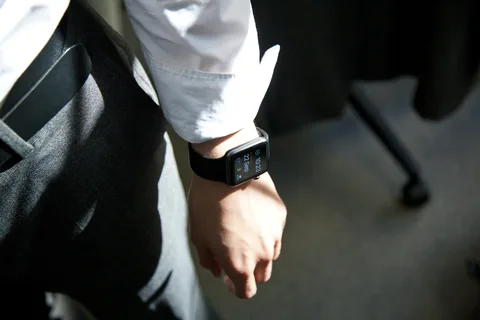
A smartwatch-sized sensor can generate thousands of readings while its wearer does the same task. Those readings may all get the same fatigue label from a single questionnaire. Split that recording at random and an algorithm can learn from one fragment of the session before being tested on another. A new study put the same models through progressively stricter tests to see what held up.
- MEFAR used recordings from 23 employees. FatigueSet contributed 12 participants in a separate study design.
- Across ten models on MEFAR, median ROC-AUC went from 0.92 with a random sample split to 0.59 with workers held out.
- The researchers also asked whether the signals could tell morning from evening or early from late task blocks. These comparisons help identify what a seemingly successful fatigue model may be picking up.
- Publication date
- 27 November 2026
- MEFAR
- 23 workers with morning and evening recordings
- FatigueSet
- 12 participants with ratings attached to task blocks
- Readout
- Median test ROC-AUC across ten evaluated models
Original publication: 27 Nov 2026 · The date above refers to this brief.
Median ROC-AUC falls as the MEFAR test becomes more independent
median ROC-AUC across ten models, scale 0–1
Decide what a wearable model has to generalise to
Identify the label
A questionnaire can give one label to a whole session.
Keep observations together
Withhold the whole session or participant for the test in question.
Check competing signals
Compare fatigue prediction with time-of-day or task-phase prediction.
The label belongs to a session
MEFAR recorded workers in the morning and evening using a wrist sensor and an EEG headset. It used fatigue questionnaire responses at the session level. Thousands of signal readings can carry one label, so the number of readings tells you little about the number of distinct fatigue assessments. FatigueSet used scores by task block. In both designs, the authors could keep readings with the same label together and test on whole labelled units.
Source 1 ↗Source 2 ↗The largest drop happened before testing new workers
On MEFAR, median ROC-AUC was 0.92 for randomly split readings and 0.89 for randomly split one-minute chunks. It fell to 0.63 when whole sessions were withheld and to 0.59 when whole workers were withheld. The change from random chunks to whole sessions was 0.26 AUC units, compared with 0.04 for the next step. On FatigueSet, the corresponding progression was 0.86, 0.57, 0.52 and 0.49. Holding out task blocks made the largest difference there.
Source 1 ↗Time can supply a shortcut on a fairer test too
MEFAR had seven sessions labelled fatigued in the morning and seventeen in the evening, out of twenty-three for each time of day. That changes the share from 30.4% to 73.9%. A model that recognises signals associated with the time of day can therefore look like it learned fatigue. The paper tested time-of-day prediction and comparisons within time periods. The balance of labels makes this check relevant even after the test set excludes all recordings from training participants.
Source 1 ↗Source 2 ↗What an independent evaluation would show
A useful follow-up would enrol new participants, collect different fatigue ratings within the same part of a shift and report results for whole recording sessions as well as for individual readings. It could also repeat the evaluation in another type of workplace. The studies here show how an evaluation can inflate a performance claim and how harder tests reduce that advantage. They leave open whether different sensors, labels and recruitment could support better generalisation.
Source 1 ↗The split to ask for when someone quotes an AUC
Publisher full text. Checked the two dataset designs, the split definitions, Figure 2 and Table 7, the time-of-day checks and the limitations. Press-News compared published summary metrics without re-running the classifiers.
01How high was the median AUC on new workers?
- What was observed
- On MEFAR the participant-held-out median was 0.59, compared with 0.92 for random readings.
- Where the conclusion stops
- These are retrospective analyses of the same dataset under different partitions.
Source 1 · Results, Figure 2 and Table 7
02Could time of day contribute to the score?
- What was observed
- The fatigue label was assigned to seven morning and seventeen evening sessions. The authors checked whether the model’s inputs could predict time of day.
- Where the conclusion stops
- A participant holdout does not remove links between fatigue labels and time of day.
Source 1 · Methods, statistical analysis and results on competing signals
Numbers you can inspect
| Measure | Value & unit | Origin & method |
|---|---|---|
| MEFAR workers | 23 people | Reported Occupational dataset. Source 1 · Methods, dataset description |
| FatigueSet participants | 12 people | Reported Separate recording design. Source 1 · Methods, dataset description |
| MEFAR with randomly split readings | 0.92 median ROC-AUC | Reported Ten models. Source 1 · Results, Figure 2 |
| MEFAR with randomly split chunks | 0.89 median ROC-AUC | Reported Ten models. Source 1 · Results, Figure 2 |
| MEFAR with whole sessions held out | 0.63 median ROC-AUC | Reported Ten models. Source 1 · Results, Figure 2 |
| MEFAR with whole people held out | 0.59 median ROC-AUC | Reported Ten models. Source 1 · Results, Figure 2 |
| Drop from random chunks to held-out sessions | 0.26 AUC units | Calculated 0.89 minus 0.63. Source 1 · Results, Figure 2 |
| Drop from held-out sessions to held-out participants | 0.04 AUC units | Calculated 0.63 minus 0.59. Source 1 · Results, Figure 2 |
| Morning sessions labelled fatigued | 7 sessions | Reported Of 23 morning sessions. Source 1 · Methods, time-stratified AUC |
| Evening sessions labelled fatigued | 17 sessions | Reported Of 23 evening sessions. Source 1 · Methods, time-stratified AUC |
Compare the actual experiments
These studies answer different questions. Read the unit and endpoint before comparing results.
| Study | Unit & setting | Readout | Interpretation boundary |
|---|---|---|---|
| Original MEFAR data descriptor Source 2 · MEFAR, Abstract and Experimental Design | One worker recorded morning and evening | Wearable signals and Chalder Fatigue Scale responses | The labels and recording schedule come from the dataset creators. |
| FatigueSet comparison Source 1 · Methods and Results, FatigueSet | One task block with its own rating | ROC-AUC under held-out blocks and new participants | Holding out a task block keeps its readings together in one set. |
The export includes claims, available numbers, methods and source locations. It contains our reading notes and published summaries; it is not raw participant data or an independent reanalysis.
Evidence update · 27 Nov 2026
First publication. Any calculations in this brief use reported figures. The reading notes identify possible follow-up questions. AI source check; no human editorial or clinical review.
The test unit changed, and so did the apparent performance
| What stayed out of training | MEFAR median ROC-AUC | FatigueSet median ROC-AUC |
|---|---|---|
| Random readings or windows | 0.92 | 0.86 |
| Random one-minute chunks / whole task blocks | 0.89 | 0.57 |
| Whole sessions | 0.63 | 0.52 |
| Whole participants | 0.59 | 0.49 |
Figure 2 and Section 3.3. The second split differs by dataset. FatigueSet holds out entire labelled task blocks at that step.
Your questions, answered
Is ROC-AUC 0.59 the same as 59% accuracy?
ROC-AUC measures how well scores rank examples with and without the label across thresholds. Accuracy requires a specific threshold and counts the resulting correct classifications.
Why is splitting a test into minutes still a weak test?
Time chunks from one recording can stay on both sides of the split. Those chunks may share a person, a sensor setup, the time of day and a single label.
Does a test on new participants account for time of day?
It prevents sharing participants between training and test. Time of day can still be related to the fatigue label in both groups. The authors ran separate checks for that.
Were employers helped to detect workplace errors?
The reported comparisons used recorded signals and fatigue labels. A separate real-world study would be needed to link model performance to safety outcomes.
Limits of this interpretation
- Two small datasets and ten evaluated models are a limited test of the broader field.
- The labels come from fatigue ratings. They do not measure errors at work or clinical outcomes.
- The medians summarise different partitions of each existing dataset. They provide no external validation at a new workplace.
Sources & transparency
- Jeribi and Khubrani (2026) — FATE: a novel leakage- and confound-aware evaluation framework for trustworthy wearable mental-fatigue detection
Publisher full text. Checked the two dataset designs, the split definitions, Figure 2 and Table 7, the time-of-day checks and the limitations. Press-News compared published summary metrics without re-running the classifiers. · Accessed 27 Nov 2026
DOI: 10.3389/fpubh.2026.2011960 - MEFAR investigators — Neurophysiological and biosignal data for investigating occupational mental fatigue
Original data descriptor. Checked the 23-worker sample, questionnaire, device types and morning and evening recording design. · Accessed 27 Nov 2026
DOI: 10.1016/j.dib.2023.109896
Prepared and source-checked with AI for Press-news Team. The source notes identify the material available during preparation. The article received no human editorial or clinical review. The source list supports the reported results and the calculations shown.
Source check: AI source check — primary research and stated source limits
Clinical review: Not applicable to this educational guide
Suggest a correction