Optical scanner design for adaptive driving beam systems can lead to safer night driving
Scientists couple adaptive driving beam technology with an electronically controllable optical scanner, enabling better road safety for drivers and pedestrians
Published 2021-01-27 · Original archive entry · Explore research explainers
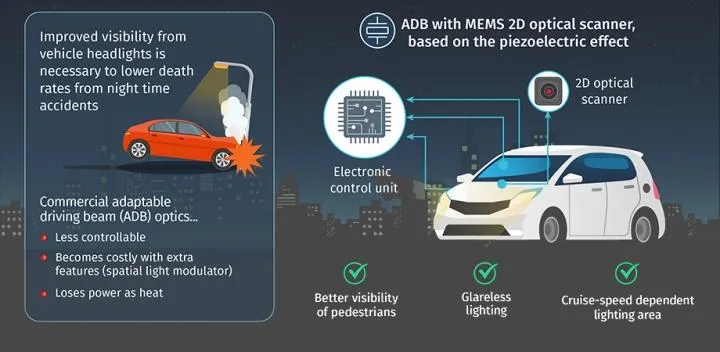
Car accidents are responsible for approximately a million deaths each year globally. Among the many causes, driving at night, when vision is most limited, leads to accidents with higher mortality rates than accidents during the day. Therefore, improving visibility during night driving is critical for reducing the number of fatal car accidents.
An adaptive driving beam (ADB) can help to some extent. This advanced drive-assist technology for vehicle headlights can automatically adjust the driver's visibility based on the car speed and traffic environment. ADB systems that exist commercially are a marked improvement over manually controlled headlights, but they suffer from limited controllability. Whereas spatial light modulators, like liquid crystal pixels or digital micromirrors, can alleviate this problem, they are often expensive to implement and lead to heat loss from unutilized light power.
In a recent study published in the END
An adaptive driving beam (ADB) can help to some extent. This advanced drive-assist technology for vehicle headlights can automatically adjust the driver's visibility based on the car speed and traffic environment. ADB systems that exist commercially are a marked improvement over manually controlled headlights, but they suffer from limited controllability. Whereas spatial light modulators, like liquid crystal pixels or digital micromirrors, can alleviate this problem, they are often expensive to implement and lead to heat loss from unutilized light power.
In a recent study published in the END