PRESS-NEWS.org - Press Release Distribution
PRESS RELEASES DISTRIBUTION

Tunable smart materials
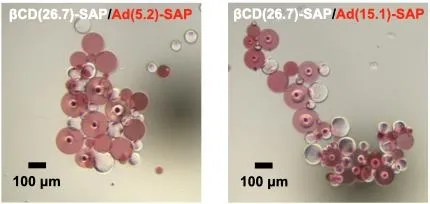
Researchers at Osaka University invent tunable microparticles that can assemble into larger structures based on the content of attached chemical groups, which may lead to the development of smart sensors or self-healing materials

Tunable smart materials
2021-03-22
(Press-News.org) Osaka, Japan - Scientists from the Graduate School of Science at Osaka University created superabsorbent polymer (SAP) microparticles that self-assemble into structures that can be modified by adjusting the proportion of particle type. This research may lead to new tunable biomimetic "smart materials" that can sense and respond to specific chemicals.

Biological molecules in living organisms have a remarkable ability to form self-assembled structures when triggered by an external molecule. This has led scientists to try to create other "smart materials" that respond to their environment. Now, a team of researchers at Osaka University has come up with a tunable system involving poly(sodium acrylate) microparticles that can have one of two types of chemical groups attached. The adjustable parameters x and y refer to the molar percent of microparticles with β-cyclodextrin (βCD) and adamantyl (Ad) residues, respectively.

"We found that the macroscopic shape of assemblies formed by microparticles was dependent on the residue content," co-senior author Akihito Hashidzume says. In order for assemblies to form, x needed to be at least 22.3; however, the shape of assemblies could be controlled by varying y. As the value of y increased, the clusters became more and more elongated. The team hypothesized that at higher values of y, small clusters could form early and stick together, leading to elongated aggregates. Conversely, when y was small, clusters would only stick together after many collisions, resulting in more spherical aggregates. This provides a way to tune to the shape of the resulting clusters. The team measured the aggregates under a microscope to determine the shapes of assemblies using a statistical analysis.

"On the basis of these findings, we hope to help reveal the origin of the diverse shape of living organisms, which are macroscopic assemblies controlled by molecular recognition," co-senior author Akira Harada says. This research may also lead to the development of new smart sensors that can form clusters large enough to be seen with the naked eye.

INFORMATION:

The article, "The macroscopic shape of assemblies formed from microparticles based on host-guest interaction dependent on the guest content," was published in Scientific Reports at DOI: https://doi.org/10.1038/s41598-021-85816-z

About Osaka University Osaka University was founded in 1931 as one of the seven imperial universities of Japan and is now one of Japan's leading comprehensive universities with a broad disciplinary spectrum. This strength is coupled with a singular drive for innovation that extends throughout the scientific process, from fundamental research to the creation of applied technology with positive economic impacts. Its commitment to innovation has been recognized in Japan and around the world, being named Japan's most innovative university in 2015 (Reuters 2015 Top 100) and one of the most innovative institutions in the world in 2017 (Innovative Universities and the Nature Index Innovation 2017). Now, Osaka University is leveraging its role as a Designated National University Corporation selected by the Ministry of Education, Culture, Sports, Science and Technology to contribute to innovation for human welfare, sustainable development of society, and social transformation. Website: https://resou.osaka-u.ac.jp/en


[Attachments] See images for this press release:
Tunable smart materials

ELSE PRESS RELEASES FROM THIS DATE:

Cyber security experts launch guidelines to help police crackdown on organised crime

Cyber security experts launch guidelines to help police crackdown on organised crime
2021-03-22
The white paper, published today (March 22) by REPHRAIN, the National Research Centre on Privacy, Harm Reduction and Adversarial Influence Online in collaboration with the Dutch National Police, offers a solution to big data problems that tend to hamper police probes into this type of law-breaking. The practice of attribution - who did what - is becoming increasingly complex as organised crimes incorporate deception, deletion and encryption in today's Information Age. Even when law enforcement are able to retrieve evidence via digital forensics, the complexities of the collected data mean it cannot be easily processed into factual police reports. ...

New porous material promising for making renewable energy from water

New porous material promising for making renewable energy from water
2021-03-22
One prospective source of renewable energy is hydrogen gas produced from water with the aid of sunlight. Researchers at Linköping University, Sweden, have developed a material, nanoporous cubic silicon carbide, that exhibits promising properties to capture solar energy and split water for hydrogen gas production. The study has been published in the journal ACS Nano. "New sustainable energy systems are needed to meet global energy and environmental challenges, such as increasing carbon dioxide emissions and climate change", says Jianwu Sun, senior lecturer in the ...

One in 10 older adults have gotten a "pandemic pet," poll finds

2021-03-22
A lot of the attention around "pandemic pets" has focused on families with children getting a cat, dog or other pet in 2020, during a time when many people were learning or working from home. But a new poll shows that older adults also got in on the trend. According to the National Poll on Healthy Aging, 10% of all people between the ages of 50 and 80 got a new pet between March 2020 and January 2021. The percentage was indeed higher - 16% -- among the people in this age range who have at least one child or teen living with them. But the vast majority of people between the ages of 50 and 80 don't live with someone under age 18 -- and nearly 9% of them also got a pet during the pandemic. All told, 59% of people age 50 to 80 who completed the poll in January 2021 are pet owners. ...

Covid-19 pandemic severely impacts mental health of young people

2021-03-22
The Covid-19 pandemic severely impacted the mental health of young people, with increased levels of clinical depression being identified, a new study published in the journal Psychiatry Research reports. A decrease in alcohol consumption was also identified amongst young people during the pandemic. During this unique study researchers from the University of Surrey surveyed 259 young people pre- pandemic (autumn 2019) and in the midst of initial lockdown measures (May/June 2020) on their levels of depression, anxiety, wellbeing, alcohol use and sleep quality. Researchers found evidence of a substantial impact on the mental health of these young adults due ...

No connection between proximity to Stockholm terrorist attack and attitudes to terrorism

2021-03-22
Research has found that experiencing a traumatic event at close quarters changes people's political attitudes. However, in the case of the 2017 terrorist attack in Stockholm, proximity to the attack had no additional political significance. Research from the University of Gothenburg shows that Swedes' attitudes toward terrorism-related questions were affected equally, regardless of whether they happened to be close to the attack. On 7 April 2017, Rakhmat Akilov stole a truck and ran down multiple people on Drottninggatan, a street in central Stockholm. Five people died, fifteen were injured and many people witnessed ...

Move your body for five minutes every hour to counteract lockdown inactivity

2021-03-22
A study which looked at activity levels before and during the COVID-19 pandemic has found lockdown restrictions significantly reduced light activity associated with socialising and work. The study, published recently in BMJ Neurology and led by King's College London, examined how activity levels changed in study participants with muscular dystrophy and other inheritable myopathies. The sample included people with a range of physical abilities, from highly independent to assisted mobility, including 41 wheelchair users, who are often underrepresented in research. However, the authors say the findings are likely to be relevant to adults of various ...

Shell middens rewrite history of submerged coastal landscapes in North America & Europe

2021-03-22
The excavation of shell middens off two sites in the Gulf of Mexico and Northern Europe dating back to when the seabed was dry land thousands of years ago, reveal how they can offer new ground-breaking insights into the hidden history of submerged landscapes. An international team of archaeologists from Moesgaard Museum (Denmark), the University Of Georgia (USA), the University of York (UK) Flinders University and James Cook University partnered to excavate two sites containing shell middens in the Gulf of Mexico and Eastern Jutland in Denmark in 2018, showing that middens can be ...

Superconductivity from buckled-honeycomb-vacancy ordering

Superconductivity from buckled-honeycomb-vacancy ordering
2021-03-22
Crystals inherently possess imperfections. Vacancies, as the simplest form of point defects, significantly alter the optical, thermal, and electrical properties of materials. Well-known examples include colour centres in many gemstones, the nitrogen-vacancy centre in diamond, vacancy migration in solid-state batteries, and the metal-insulator transition in phase-change materials. The vacancies in these cases are in frame-works with no or weak interactions. However, the role of vacancies in strongly correlated materials is thus far unclear due to the lack of an ideal prototype. Strongly ...

Drought over the southwestern Tibetan Plateau triggered by ocean warming more than ten thousand miles away

Drought over the southwestern Tibetan Plateau triggered by ocean warming more than ten thousand miles away
2021-03-22
El Nino-Southern Oscillation (ENSO) is a recurring climate phenomenon involving changes in the temperature of waters in the central and eastern tropical Pacific Ocean. It is one of the most important climate perturbations on Earth because it can change the global atmospheric circulation, which in turn, influences temperature and precipitation across the globe. Scientists have found ENSO has an impact on hydroclimate over the Tibetan Plateau but how it works, or its physical mechanism, remains unclear. In a recently published research article in Journal of Climate, Shuai Hu, Tianjun Zhou and Bo Wu from the Institute of Atmospheric Physics, Chinese Academy of Sciences, explored the dynamical processes that ...

Antioxidant-primed stem cells show promise in repairing bone damaged by radiation

Antioxidant-primed stem cells show promise in repairing bone damaged by radiation
2021-03-22
Durham, NC - The standard of treatment for bone tumors is often two-fold: surgery to remove the cancerous section followed by radiation therapy to ensure all the cancerous cells have been killed off. This is an effective way to defeat bone tumors; however, it often results in large bone defects and hampers wound healing because of extensive tissue cutoff and irradiation-induced tissue damage. A new study published in STEM CELLS Translational Medicine demonstrates how stem cells primed with ferulic acid can repair such bone damage and how this occurs. The information this study provides could aid in the development of new treatments for irradiated bone injuries. Heng Zhu, M.D., Ph.D., of the Beijing Institute of ...

LAST 30 PRESS RELEASES:

Making lighter work of calculating fluid and heat flow

Normalizing blood sugar can halve heart attack risk

Lowering blood sugar cuts heart attack risk in people with prediabetes

Study links genetic variants to risk of blinding eye disease in premature infants

Non-opioid ‘pain sponge’ therapy halts cartilage degeneration and relieves chronic pain

AI can pick up cultural values by mimicking how kids learn

China’s ecological redlines offer fast track to 30 x 30 global conservation goal

Invisible indoor threats: emerging household contaminants and their growing risks to human health

Adding antibody treatment to chemo boosts outcomes for children with rare cancer

Germline pathogenic variants among women without a history of breast cancer

Tanning beds triple melanoma risk, potentially causing broad DNA damage

Unique bond identified as key to viral infection speed

Indoor tanning makes youthful skin much older on a genetic level

Mouse model sheds new light on the causes and potential solutions to human GI problems linked to muscular dystrophy

The Journal of Nuclear Medicine ahead-of-print tip sheet: December 12, 2025

Smarter tools for peering into the microscopic world

Applications open for funding to conduct research in the Kinsey Institute archives

Global measure underestimates the severity of food insecurity

Child survivors of critical illness are missing out on timely follow up care

Risk-based vs annual breast cancer screening / the WISDOM randomized clinical trial

University of Toronto launches Electric Vehicle Innovation Ontario to accelerate advanced EV technologies and build Canada’s innovation advantage

Early relapse predicts poor outcomes in aggressive blood cancer

American College of Lifestyle Medicine applauds two CMS models aligned with lifestyle medicine practice and reimbursement

Clinical trial finds cannabis use not a barrier to quitting nicotine vaping

Supplemental nutrition assistance program policies and food insecurity

Switching immune cells to “night mode” could limit damage after a heart attack, study suggests

URI-based Global RIghts Project report spotlights continued troubling trends in worldwide inhumane treatment

Neutrophils are less aggressive at night, explaining why nighttime heart attacks cause less damage than daytime events

Menopausal hormone therapy may not pose breast cancer risk for women with BRCA mutations

Mobile health tool may improve quality of life for adolescent and young adult breast cancer survivors

[Press-News.org] Tunable smart materials
Researchers at Osaka University invent tunable microparticles that can assemble into larger structures based on the content of attached chemical groups, which may lead to the development of smart sensors or self-healing materials