UTEP joins project to 3D print batteries from lunar and Martian soil
Part of $2.5 million initiative led by NASA
Published 2023-03-23 · Original archive entry · Explore research explainers
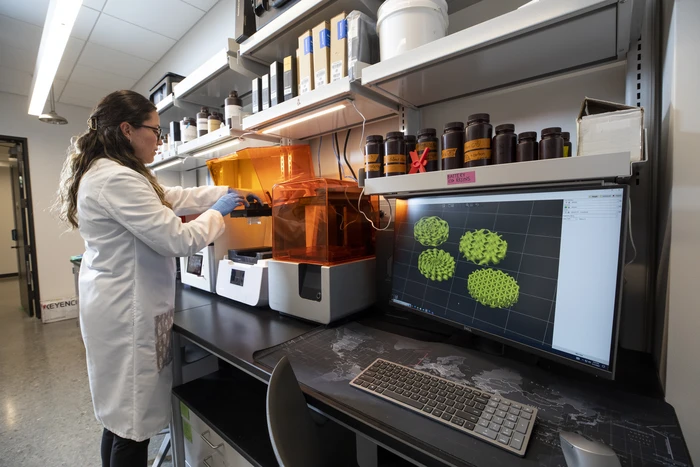
EL PASO, Texas (March 23, 2023) – The University of Texas at El Paso has joined a project led by NASA to leverage 3D-printing processes with the aim of manufacturing rechargeable batteries using lunar and Martian regolith, which is the top layer of materials that covers the surface of the moon and Mars.
“UTEP is a national leader in additive manufacturing for space applications,” said Kenith Meissner, Ph.D., dean of the UTEP College of Engineering. “I congratulate the team of UTEP researchers involved in this important work. I am confident their work will add significant value to this project, getting us closer to a return to the moon and our first forays beyond.”
UTEP’s $615,000 grant is part of a $2.5 million project that includes Youngstown State University (YSU), 3D printer manufacturer Formlabs, as well as ICON, the private sector company currently leading the NASA Mars Dune Alpha project aiming to 3D print future habitats on Mars.
The long-term goal of the project is to maximize the sustainability of astronauts' future lunar and Martian missions by reducing payload weight and dead volume. The utilization of local resources widely available on the moon or Mars is crucial to develop infrastructure such as habitation modules, power generation and energy storage facilities.
“UTEP is a seminal partner in this NASA-led project with our long and deep heritage in additive manufacturing,” said Eric MacDonald, Ph.D., professor of aerospace and mechanical engineering and associate dean in the UTEP College of Engineering. “UTEP’s reputation in 3D printing, material science and our state-of-the-art facilities were important factors in convincing our NASA partners to pursue this potentially transformative research – for space exploration but for terrestrial applications of batteries as well.”
ACS Energy Letters, a peer-reviewed journal from the American Chemical Society, published an article titled “What Would Battery Manufacturing on the Moon and Mars Look Like?” in January, detailing the progress UTEP and NASA researchers have already made on this project.
The published work highlights two types of 3D-printing processes – material extrusion (ME) and vat photopolymerization (VPP) – to produce shape-conformable batteries on the moon and Mars.
Shape-conformable batteries are complex 3D battery designs that outperform existing commercial batteries because of their ability to fill the dimensions of objects. Such tailored batteries are especially well-suited for applications in small spacecraft, portable power devices, robots, and large-scale power systems for moon and Mars habitat missions.
Another potential outcome of this work is the development of shape-conformable batteries that can be used on Earth. These batteries could be embedded in 3D-printed concrete walls and connected to solar power generation to create compact, self-sustaining homes for disaster response and in developing countries.
While commercial lithium-ion batteries can be found in most of today’s applications, manufacturing lithium-ion batteries from lunar and Martian soil is not a viable option since lithium is scarcely available on the moon. For this project, the UTEP research team is currently focusing their work on sodium-ion battery chemistry, based on the greater abundance of sodium.
“This project with NASA is an opportunity to demonstrate UTEP’s expertise in both energy storage and 3D printing,” said Alexis Maurel, Ph.D., French Fulbright Scholar in the UTEP Department of Aerospace and Mechanical Engineering. “Additive manufacturing appears as a unique approach to manufacture shape-conformable batteries to support human operations in space and on the surface of the moon or Mars, where cargo resupply is not as readily available.”
In addition to MacDonald and Maurel, the UTEP team also includes Ana C. Martinez, Ph.D., postdoctoral researcher in the UTEP Department of Aerospace and Mechanical Engineering, and Sreeprasad Sreenivasan, Ph.D., assistant professor in the Department of Chemistry and Biochemistry.
In the project’s initial phase, NASA, UTEP and YSU will identify and work on the extraction of battery materials and precursors from lunar and Martian regolith. The UTEP/YSU team has already developed and VPP 3D printed composite resin feedstocks for each part of the sodium-ion battery (i.e., electrodes, electrolyte, current collector). The team at NASA Marshall Space Flight Center and Ames Research Center developed and ME 3D printed composite inks for the different battery components. UTEP and NASA’s Glenn Research Center are then electrochemically testing the completed 3D-printed sodium-ion battery components.
About the University of Texas at El Paso
The University of Texas at El Paso is America’s leading Hispanic-serving university. Located at the westernmost tip of Texas, where three states and two countries converge along the Rio Grande, 84% of our 24,000 students are Hispanic, and half are the first in their families to go to college. UTEP offers 169 bachelor’s, master’s, and doctoral degree programs at the only open-access, top-tier research university in America.
END
“UTEP is a national leader in additive manufacturing for space applications,” said Kenith Meissner, Ph.D., dean of the UTEP College of Engineering. “I congratulate the team of UTEP researchers involved in this important work. I am confident their work will add significant value to this project, getting us closer to a return to the moon and our first forays beyond.”
UTEP’s $615,000 grant is part of a $2.5 million project that includes Youngstown State University (YSU), 3D printer manufacturer Formlabs, as well as ICON, the private sector company currently leading the NASA Mars Dune Alpha project aiming to 3D print future habitats on Mars.
The long-term goal of the project is to maximize the sustainability of astronauts' future lunar and Martian missions by reducing payload weight and dead volume. The utilization of local resources widely available on the moon or Mars is crucial to develop infrastructure such as habitation modules, power generation and energy storage facilities.
“UTEP is a seminal partner in this NASA-led project with our long and deep heritage in additive manufacturing,” said Eric MacDonald, Ph.D., professor of aerospace and mechanical engineering and associate dean in the UTEP College of Engineering. “UTEP’s reputation in 3D printing, material science and our state-of-the-art facilities were important factors in convincing our NASA partners to pursue this potentially transformative research – for space exploration but for terrestrial applications of batteries as well.”
ACS Energy Letters, a peer-reviewed journal from the American Chemical Society, published an article titled “What Would Battery Manufacturing on the Moon and Mars Look Like?” in January, detailing the progress UTEP and NASA researchers have already made on this project.
The published work highlights two types of 3D-printing processes – material extrusion (ME) and vat photopolymerization (VPP) – to produce shape-conformable batteries on the moon and Mars.
Shape-conformable batteries are complex 3D battery designs that outperform existing commercial batteries because of their ability to fill the dimensions of objects. Such tailored batteries are especially well-suited for applications in small spacecraft, portable power devices, robots, and large-scale power systems for moon and Mars habitat missions.
Another potential outcome of this work is the development of shape-conformable batteries that can be used on Earth. These batteries could be embedded in 3D-printed concrete walls and connected to solar power generation to create compact, self-sustaining homes for disaster response and in developing countries.
While commercial lithium-ion batteries can be found in most of today’s applications, manufacturing lithium-ion batteries from lunar and Martian soil is not a viable option since lithium is scarcely available on the moon. For this project, the UTEP research team is currently focusing their work on sodium-ion battery chemistry, based on the greater abundance of sodium.
“This project with NASA is an opportunity to demonstrate UTEP’s expertise in both energy storage and 3D printing,” said Alexis Maurel, Ph.D., French Fulbright Scholar in the UTEP Department of Aerospace and Mechanical Engineering. “Additive manufacturing appears as a unique approach to manufacture shape-conformable batteries to support human operations in space and on the surface of the moon or Mars, where cargo resupply is not as readily available.”
In addition to MacDonald and Maurel, the UTEP team also includes Ana C. Martinez, Ph.D., postdoctoral researcher in the UTEP Department of Aerospace and Mechanical Engineering, and Sreeprasad Sreenivasan, Ph.D., assistant professor in the Department of Chemistry and Biochemistry.
In the project’s initial phase, NASA, UTEP and YSU will identify and work on the extraction of battery materials and precursors from lunar and Martian regolith. The UTEP/YSU team has already developed and VPP 3D printed composite resin feedstocks for each part of the sodium-ion battery (i.e., electrodes, electrolyte, current collector). The team at NASA Marshall Space Flight Center and Ames Research Center developed and ME 3D printed composite inks for the different battery components. UTEP and NASA’s Glenn Research Center are then electrochemically testing the completed 3D-printed sodium-ion battery components.
About the University of Texas at El Paso
The University of Texas at El Paso is America’s leading Hispanic-serving university. Located at the westernmost tip of Texas, where three states and two countries converge along the Rio Grande, 84% of our 24,000 students are Hispanic, and half are the first in their families to go to college. UTEP offers 169 bachelor’s, master’s, and doctoral degree programs at the only open-access, top-tier research university in America.
END
Attachments