Awareness of alcohol-cancer link holds steady despite omission from new US dietary guidelines
Over half of US adults know regular consumption of alcohol raises cancer risk
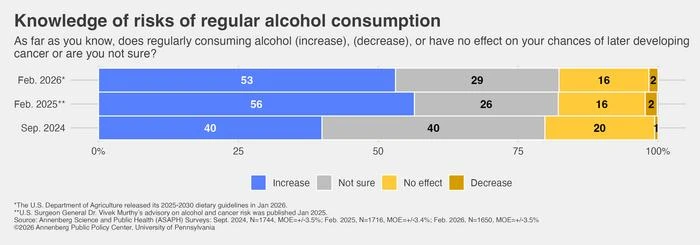
Public awareness of the link between drinking alcohol and elevated cancer risk remains unchanged since February 2025, with over half of Americans saying that regularly consuming alcohol increases your chances of later developing cancer, according to a new survey by the Annenberg Public Policy Center (APPC) of the University of Pennsylvania.
APPC’s February 2026 survey was conducted about a month after the U.S. Department of Agriculture (USDA) unveiled its 2025-2030 Dietary Guidelines for Americans on Jan. 7, 2026.
The earlier, 2020-2025 guidelines explicitly warned that “Alcohol has been found to increase risk for cancer, and for some types of cancer, the risk increases even at low levels of alcohol consumption (less than 1 drink in a day).” (p. 49) While the new 2025-2030 guidelines call for limiting alcoholic beverages for better health, they contain no mention of a link between alcohol consumption and cancer risk.
“When it removed the warning linking alcohol consumption to cancer from the guidelines, the USDA turned its back on a substantial body of research,” said Kathleen Hall Jamieson, director of the Annenberg Public Policy Center. “The Surgeon General’s finding that alcohol consumption raises cancer risk gained attention. A clear, strong statement in the dietary guidelines could have amplified that impact – and helped to save lives.”
Download the topline and methodology report.
The policy center has been tracking the American public’s knowledge, beliefs, and behaviors regarding vaccination, Covid-19, flu, RSV, and other consequential health issues through the Annenberg Science and Public Health (ASAPH) survey and separate national samples since April 2021. APPC’s health survey team includes Ken Winneg, managing director of survey research, research analyst Laura A. Gibson, and Patrick E. Jamieson, director of the Annenberg Health and Risk Communication Institute.
See other recent Annenberg health survey news releases:
END
APPC’s February 2026 survey was conducted about a month after the U.S. Department of Agriculture (USDA) unveiled its 2025-2030 Dietary Guidelines for Americans on Jan. 7, 2026.
The earlier, 2020-2025 guidelines explicitly warned that “Alcohol has been found to increase risk for cancer, and for some types of cancer, the risk increases even at low levels of alcohol consumption (less than 1 drink in a day).” (p. 49) While the new 2025-2030 guidelines call for limiting alcoholic beverages for better health, they contain no mention of a link between alcohol consumption and cancer risk.
Findings
In the survey, conducted Feb. 3-17, 2026, with 1,650 U.S. adults:- Over half (53%) say that regularly consuming alcohol increases your chances of later developing cancer – statistically unchanged from 56% who said this in February 2025;
- 16% say alcohol consumption has no effect on cancer risk, also statistically unchanged from February 2025;
- Over a quarter (29%) are not sure how alcohol consumption affects cancer risk, statistically unchanged from 26% in February 2025.
“When it removed the warning linking alcohol consumption to cancer from the guidelines, the USDA turned its back on a substantial body of research,” said Kathleen Hall Jamieson, director of the Annenberg Public Policy Center. “The Surgeon General’s finding that alcohol consumption raises cancer risk gained attention. A clear, strong statement in the dietary guidelines could have amplified that impact – and helped to save lives.”
ASAPH survey
Wave 28 of the Annenberg Science and Public Health (ASAPH) panel survey was conducted Feb. 3-17, 2026, among 1,650 U.S. adults. Data were collected by SSRS, an independent research company, via web and telephone using a nationally representative probability sample from SSRS’s Opinion Panel. The margin of error is ±3.5 percentage points. The panelists are quarantined from other survey panel membership to avoid response bias from other surveys. The ASAPH panel has been fielded continuously since April 2021 across 28 waves.Download the topline and methodology report.
The policy center has been tracking the American public’s knowledge, beliefs, and behaviors regarding vaccination, Covid-19, flu, RSV, and other consequential health issues through the Annenberg Science and Public Health (ASAPH) survey and separate national samples since April 2021. APPC’s health survey team includes Ken Winneg, managing director of survey research, research analyst Laura A. Gibson, and Patrick E. Jamieson, director of the Annenberg Health and Risk Communication Institute.
See other recent Annenberg health survey news releases:
- Trust in health leaders: Stark divide: Americans more confident in career scientists at U.S. health agencies than leaders (March 5, 2026)
- RSV: Most would recommend RSV immunizations for infants, older adults, and during pregnancy (Jan. 21, 2026)
- Shared decision-making: CDC urges “shared decision-making” on some childhood vaccines; many unclear about what that means (Jan. 5, 2026)
- MMR vaccine: As measles cases rise, views of MMR vaccine safety and effectiveness and willingness to recommend it drop (Dec. 22, 2025)
- Whooping cough: Cases of whooping cough remain high, but knowledge about the disease still low (Dec. 18, 2025)
END