Long-term road surveys reveal widespread declines in South African birds of prey
A comprehensive study has revealed substantial declines in many of South Africa’s birds of prey (raptors) over the past 16 years, raising fresh concerns about the conservation status of several iconic and threatened species. Researchers assessed population trends for 18 raptor and 8 large terrestrial bird species across central South Africa between 2009 and 2025. Half of the species experienced significant declines, many exceeding 50%, while only three showed clear increases.
“These results point to widespread and often severe population declines across South Africa’s raptor community,” said Dr Santiago Zuluaga, lead author of the study and a researcher at the University of Cape Town and National Museum of Natural Sciences of Spain. “What is particularly concerning is that some of the steepest declines were detected in species that play key ecological roles and are already considered conservation priorities.”
DECLINES IN THREATENED AND ICONIC RAPTORS
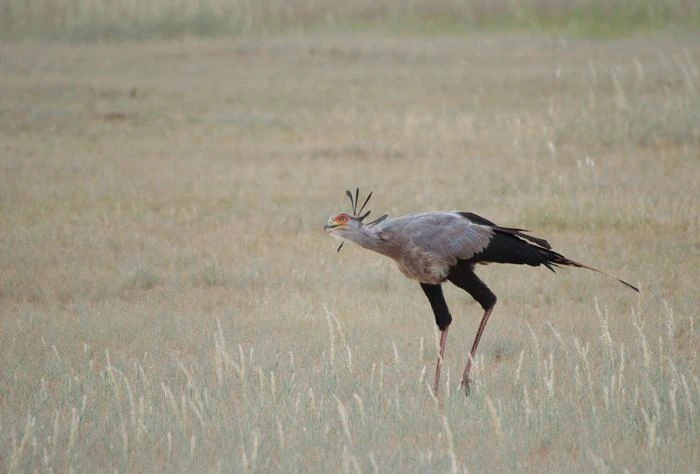
Several globally threatened raptors showed steep declines, including the Endangered Secretarybird, which dropped 68% over 16 years. “The declines detected in species such as Secretarybirds are especially worrying,” said Dr Megan Murgatroyd, International Programs Director at HawkWatch International and a co-author on the study. “These birds require vast areas to survive and reproduce, so sustained population losses at this scale suggest that pressures across the landscape are having real and lasting impacts.”
The study also found strong declines in migratory raptors such as Lesser Kestrel, Amur Falcon, and Steppe Buzzard, highlighting the vulnerability of species dependent on multiple regions. Sharp declines were also detected in species currently listed as Least Concern, including Spotted Eagle-Owl and Jackal Buzzard, suggesting population changes may occur before they are reflected in formal conservation assessments.
THE VALUE OF LONG-TERM MONITORING
The road count data underpinning the study were collected over more than 15 years, largely through repeated surveys conducted across central South Africa.
“When I started these road counts over 15 years ago, I never expected that they would reveal such severe declines across so many species,” said Ronelle Visagie of the Endangered Wildlife Trust, who carried out the fieldwork. “It involved a huge amount of time on the road, counting birds year after year, but it is reassuring to see that all that effort has produced something meaningful that can genuinely inform conservation.”
STRENGTHENING THE EVIDENCE BASE FOR CONSERVATION
To place these findings in a broader context, researchers compared their road-survey results with trends from the Southern African Bird Atlas Project (SABAP2), a key citizen-science initiative. While atlas data remain invaluable for mapping species distributions and supporting biodiversity monitoring, the comparison showed that different survey approaches can sometimes produce contrasting signals of population change. “Citizen science atlas projects like SABAP2 are absolutely vital for bird conservation in Africa,” said Associate Professor Arjun Amar, senior author of the study from the University of Cape Town. “Our findings underline the importance of combining multiple monitoring approaches, particularly for wide-ranging species such as raptors, to ensure we have the most accurate picture possible of how populations are changing.”
WHY IT MATTERS
Raptors are vital as top predators and scavengers, indicators of environmental health, yet across Africa they are among the fastest-declining bird groups, pressured by land-use change, infrastructure, illegal killing, and climate change. “With human populations in Africa projected to increase sharply over the coming decades, pressures on biodiversity are only likely to intensify,” said Zuluaga. “Robust, long-term monitoring is essential if we are to detect declines early and implement conservation actions before populations reach critical levels.
END
“These results point to widespread and often severe population declines across South Africa’s raptor community,” said Dr Santiago Zuluaga, lead author of the study and a researcher at the University of Cape Town and National Museum of Natural Sciences of Spain. “What is particularly concerning is that some of the steepest declines were detected in species that play key ecological roles and are already considered conservation priorities.”
DECLINES IN THREATENED AND ICONIC RAPTORS
Several globally threatened raptors showed steep declines, including the Endangered Secretarybird, which dropped 68% over 16 years. “The declines detected in species such as Secretarybirds are especially worrying,” said Dr Megan Murgatroyd, International Programs Director at HawkWatch International and a co-author on the study. “These birds require vast areas to survive and reproduce, so sustained population losses at this scale suggest that pressures across the landscape are having real and lasting impacts.”
The study also found strong declines in migratory raptors such as Lesser Kestrel, Amur Falcon, and Steppe Buzzard, highlighting the vulnerability of species dependent on multiple regions. Sharp declines were also detected in species currently listed as Least Concern, including Spotted Eagle-Owl and Jackal Buzzard, suggesting population changes may occur before they are reflected in formal conservation assessments.
THE VALUE OF LONG-TERM MONITORING
The road count data underpinning the study were collected over more than 15 years, largely through repeated surveys conducted across central South Africa.
“When I started these road counts over 15 years ago, I never expected that they would reveal such severe declines across so many species,” said Ronelle Visagie of the Endangered Wildlife Trust, who carried out the fieldwork. “It involved a huge amount of time on the road, counting birds year after year, but it is reassuring to see that all that effort has produced something meaningful that can genuinely inform conservation.”
STRENGTHENING THE EVIDENCE BASE FOR CONSERVATION
To place these findings in a broader context, researchers compared their road-survey results with trends from the Southern African Bird Atlas Project (SABAP2), a key citizen-science initiative. While atlas data remain invaluable for mapping species distributions and supporting biodiversity monitoring, the comparison showed that different survey approaches can sometimes produce contrasting signals of population change. “Citizen science atlas projects like SABAP2 are absolutely vital for bird conservation in Africa,” said Associate Professor Arjun Amar, senior author of the study from the University of Cape Town. “Our findings underline the importance of combining multiple monitoring approaches, particularly for wide-ranging species such as raptors, to ensure we have the most accurate picture possible of how populations are changing.”
WHY IT MATTERS
Raptors are vital as top predators and scavengers, indicators of environmental health, yet across Africa they are among the fastest-declining bird groups, pressured by land-use change, infrastructure, illegal killing, and climate change. “With human populations in Africa projected to increase sharply over the coming decades, pressures on biodiversity are only likely to intensify,” said Zuluaga. “Robust, long-term monitoring is essential if we are to detect declines early and implement conservation actions before populations reach critical levels.
END