Researchers demonstrate how magnets influence behavior of metamaterials
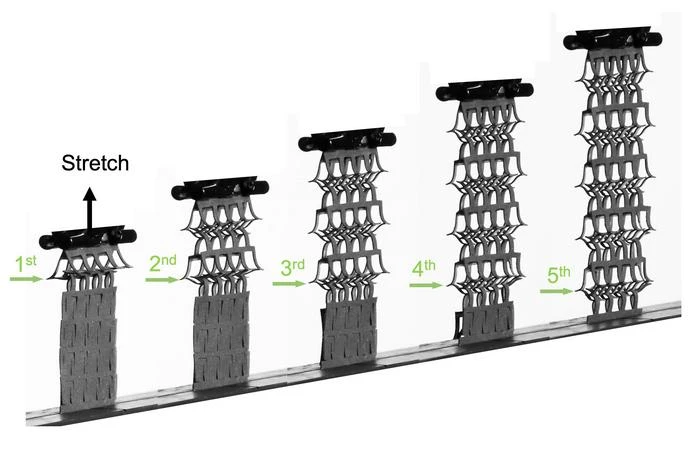
Cutting patterns into elastic materials allows you to unfold those materials into new shapes, and researchers have now demonstrated the ability to control the sequence in which that unfolding happens by magnetizing the materials. The work represents a fundamental advance in our understanding of metamaterial behavior and has also demonstrated its utility in applications focused on absorbing kinetic energy.
“If you cut a T-pattern into a polymer sheet you’ve created a metamaterial, because you’ve changed the properties of the material,” says Haoze Sun, first author of a paper on the work and a Ph.D. student at North Carolina State University. “If you pull the metamaterial sheet, all the cuts essentially pop open at once. These openings create a mesh-like pattern and extend the length of the sheet.
“We were curious about what would happen if we incorporated magnetic materials into the polymer and magnetized the sheet. Would this ‘snapping’ behavior change? And what we found was surprising.”
“We found that instead of snapping open all at once, the rows in the pattern snapped open one at a time, because the magnetic force is trying to hold the pieces of the sheet together while the force of gravity is trying to pull them apart,” says Jie Yin, corresponding author of the paper and a professor of mechanical and aerospace engineering at NC State. “But this was just the beginning.”
The researchers found that the rows in each sheet snapped open in a random order. However, each sheet would repeat that same order every time. So, if Sheet A’s rows opened in order 1-2-3, its rows would always open 1-2-3. And if Sheet B’s rows opened in order 3-1-2, they would always open in order 3-1-2.
“We found that small, unavoidable defects were responsible for dictating the order in which each row snapped open,” says Sun. “And, because those defects don’t change, the order doesn’t change. That, in itself, was interesting.”
The researchers then experimented with placing multiple magnetized sheets next to each other, clamping them together at top and bottom.
They found that connecting two sheets back-to-back so that their magnetic fields repulsed each other resulted in the rows snapping open in an ordered fashion, from top to bottom, 90% of the time.
“So, there are two interesting observations here,” says Yin. “First, we can make the metamaterial snap open sequentially, rather than all at once, by magnetizing the sheet. Second, we can drastically reduce randomness in that behavior by aligning these metamaterials properly.”
The researchers also found that this phenomenon has utility in the context of energy absorption applications.
“We found that the magnetized elastic metamaterial could absorb 30% more kinetic energy than the unmagnetized metamaterial,” says Sun. “And we can control how much energy is absorbed by controlling how strong the internal magnetic attraction is. The stronger the magnetism, the more energy the metamaterial can absorb.”
The researchers demonstrated this by dropping a ball onto the metamaterial. The ball bounces off the unmagnetized metamaterial but simply comes to rest in the magnetized metamaterial.
“We’re excited about future directions for this work,” says Yin. “The ordered snapping sequence can find potential applications in guiding wave propagation, reconfigurable robotics, and biomedical devices.”
The paper, “Magnetic coupling transforms random snapping into ordered sequences in soft metamaterials,” will be published open access March 20 in the journal Science Advances. The paper was co-authored by Yinding Chi, a Ph.D. graduate from NC State who is now a postdoctoral researcher at the University of Pennsylvania; Haitao Qing, a Ph.D. graduate of NC State who is now a postdoctoral researcher at the University of California, Berkeley; Gabriel Alkuino and Teng Zhang of Syracuse University; and Yevhen Zabila and Denys Makarov of the Helmholtz-Zentrum Dresden-Rossendorf laboratory in Germany.
This work was done with support from the National Science Foundation under grants 2126072, 2329674, 1847149 and 2020476; from the European Union via the REGO project, under grant 101070066; and the European Research Council under grant 101141331.
END
“If you cut a T-pattern into a polymer sheet you’ve created a metamaterial, because you’ve changed the properties of the material,” says Haoze Sun, first author of a paper on the work and a Ph.D. student at North Carolina State University. “If you pull the metamaterial sheet, all the cuts essentially pop open at once. These openings create a mesh-like pattern and extend the length of the sheet.
“We were curious about what would happen if we incorporated magnetic materials into the polymer and magnetized the sheet. Would this ‘snapping’ behavior change? And what we found was surprising.”
“We found that instead of snapping open all at once, the rows in the pattern snapped open one at a time, because the magnetic force is trying to hold the pieces of the sheet together while the force of gravity is trying to pull them apart,” says Jie Yin, corresponding author of the paper and a professor of mechanical and aerospace engineering at NC State. “But this was just the beginning.”
The researchers found that the rows in each sheet snapped open in a random order. However, each sheet would repeat that same order every time. So, if Sheet A’s rows opened in order 1-2-3, its rows would always open 1-2-3. And if Sheet B’s rows opened in order 3-1-2, they would always open in order 3-1-2.
“We found that small, unavoidable defects were responsible for dictating the order in which each row snapped open,” says Sun. “And, because those defects don’t change, the order doesn’t change. That, in itself, was interesting.”
The researchers then experimented with placing multiple magnetized sheets next to each other, clamping them together at top and bottom.
They found that connecting two sheets back-to-back so that their magnetic fields repulsed each other resulted in the rows snapping open in an ordered fashion, from top to bottom, 90% of the time.
“So, there are two interesting observations here,” says Yin. “First, we can make the metamaterial snap open sequentially, rather than all at once, by magnetizing the sheet. Second, we can drastically reduce randomness in that behavior by aligning these metamaterials properly.”
The researchers also found that this phenomenon has utility in the context of energy absorption applications.
“We found that the magnetized elastic metamaterial could absorb 30% more kinetic energy than the unmagnetized metamaterial,” says Sun. “And we can control how much energy is absorbed by controlling how strong the internal magnetic attraction is. The stronger the magnetism, the more energy the metamaterial can absorb.”
The researchers demonstrated this by dropping a ball onto the metamaterial. The ball bounces off the unmagnetized metamaterial but simply comes to rest in the magnetized metamaterial.
“We’re excited about future directions for this work,” says Yin. “The ordered snapping sequence can find potential applications in guiding wave propagation, reconfigurable robotics, and biomedical devices.”
The paper, “Magnetic coupling transforms random snapping into ordered sequences in soft metamaterials,” will be published open access March 20 in the journal Science Advances. The paper was co-authored by Yinding Chi, a Ph.D. graduate from NC State who is now a postdoctoral researcher at the University of Pennsylvania; Haitao Qing, a Ph.D. graduate of NC State who is now a postdoctoral researcher at the University of California, Berkeley; Gabriel Alkuino and Teng Zhang of Syracuse University; and Yevhen Zabila and Denys Makarov of the Helmholtz-Zentrum Dresden-Rossendorf laboratory in Germany.
This work was done with support from the National Science Foundation under grants 2126072, 2329674, 1847149 and 2020476; from the European Union via the REGO project, under grant 101070066; and the European Research Council under grant 101141331.
END