FAU discovery of tiny cell ‘tunnels’ finds new path to slow Huntington’s disease
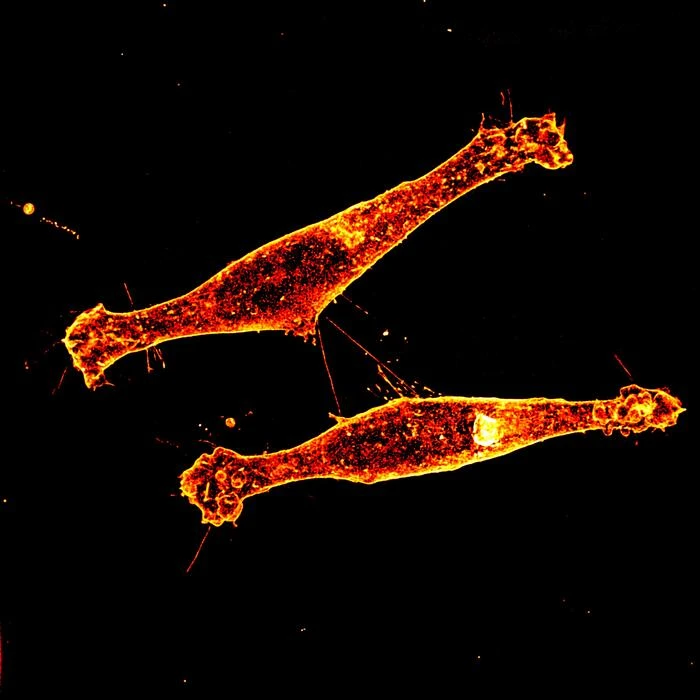
Huntington’s disease is a devastating brain disorder that slowly robs people of movement, memory and personality. It is caused by a toxic protein that builds in brain cells and ultimately kills them. For years, scientists have known that this harmful protein doesn’t stay put – it spreads from one brain cell to another. However, exactly how that spread happens and how to stop it has remained a mystery.
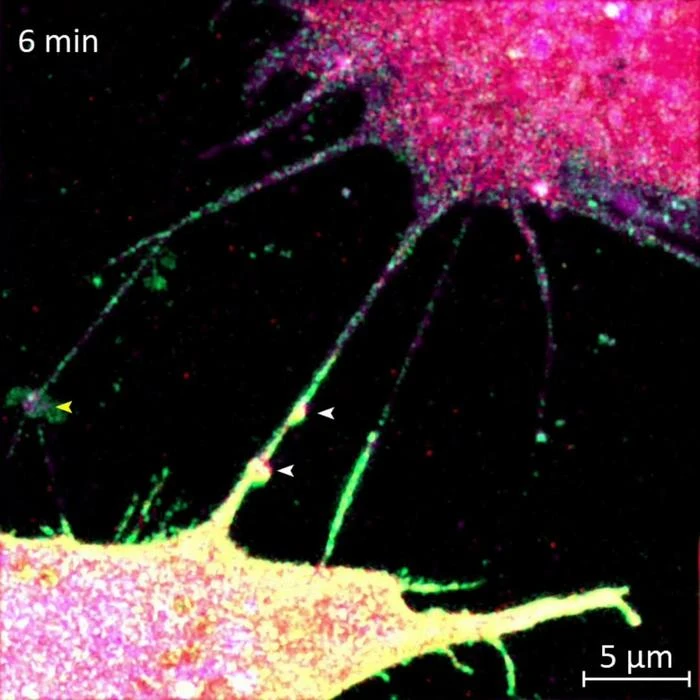
In a major breakthrough, researchers from Florida Atlantic University and collaborators have identified a previously unknown cellular pathway that allows brain cells to pass toxic material directly to their neighbors through tiny, tube-like structures. Importantly, the study published in Science Advances, shows that disrupting this pathway dramatically reduces the spread of the disease-causing protein in the brain.
These microscopic structures, called “tunneling nanotubes,” act like direct bridges between cells. Unlike chemical signals that diffuse through space, nanotubes allow cells to share proteins and other materials by hand-delivery. While this kind of sharing may sometimes help healthy cells respond to stress or injury, it can also become dangerous when it spreads harmful proteins, like the mutant huntingtin protein responsible for Huntington’s disease.
The new research reveals that a protein called Rhes – already known to play a key role in Huntington’s disease – partners with an unexpected collaborator: a bicarbonate transporter called SLC4A7, a protein best known for helping cells regulate their internal acidity. Together, these two proteins help build tunneling nanotubes, creating highways that allow toxic huntingtin protein to move from one neuron to another.
“This work fundamentally changes how we think about disease progression in Huntington’s,” said Srinivasa Subramaniam, Ph.D., senior author, associate professor in the Department of Chemistry and Biochemistry within FAU’s Charles E. Schmidt College of Science, and a member of FAU’s Stiles-Nicholson Brain Institute, David and Lynn Nicholson Center for Neuroscience Research, and the Center for Molecular Biology and Biotechnology. “We’ve known that neurons somehow pass toxic proteins to one another, but now we can see the machinery that makes that possible. By identifying SLC4A7 as a key partner of Rhes, we’ve uncovered a new and potentially druggable target to stop that spread at its source.”
Using advanced protein-mapping techniques, the researchers discovered that Rhes physically binds to SLC4A7 at the cell membrane. When this partnership forms, it triggers changes inside the cell that promote the growth of nanotubes. When the team blocked SLC4A7 – either genetically or with drugs – the nanotubes failed to form, and the toxic huntingtin protein was largely unable to spread.
Significantly, this effect wasn’t just seen in isolated cells. In mouse models of Huntington’s disease, mice lacking SLC4A7 showed a dramatic reduction in the transfer of toxic protein between neurons in the brain’s striatum, the region most affected in the disease. This suggests that interfering with this newly discovered pathway could slow the progression of Huntington’s disease by containing the damage before it spreads.
The implications from this study extend far beyond Huntington’s disease. Tunneling nanotubes have been implicated in other neurodegenerative disorders, including conditions involving tau protein, as well as in cancer, where tumor cells use similar structures to share signals, energy and even drug resistance. Because both Rhes and SLC4A7 are involved in fundamental cellular processes, the newly identified pathway may represent a common mechanism underlying the spread of damage in many diseases.
“This research shines a spotlight on an entirely new way cells communicate in health and disease,” said Randy Blakely, Ph.D., executive director of the FAU Stiles-Nicholson Brain Institute, the David J.S. Nicholson Distinguished Professor in Neuroscience, and a professor of biomedical science in the FAU Charles E. Schmidt College of Medicine. “By learning how harmful proteins physically move from cell to cell, we gain powerful new leverage points for therapy. The idea that we could slow or even halt disease progression by blocking these microscopic tunnels opens an exciting frontier for treating not only Huntington’s disease, but a wide range of neurological disorders and cancers in the future.”
As scientists continue to unravel how cells share information – and how that sharing can go wrong – this discovery offers new hope that stopping disease may one day be as simple as closing the door between cells.
Huntington’s disease is a rare, inherited brain disorder that affects about three to seven people per 100,000 worldwide and strikes men and women equally. Symptoms usually appear between the ages of 30 and 50 and worsen over time, causing uncontrolled movements, cognitive decline, and serious psychiatric symptoms. Each child of an affected parent has a 50 percent chance of inheriting the disease. There is no cure, and current treatments only help manage symptoms without stopping progression. After symptoms begin, people typically live 10 to 20 years, often facing increasing disability and loss of independence.
Co-authors of the study represent the Facultad de Ciencias, National Autonomous University of Mexico; Institute of Cellular Physiology, National Autonomous University of Mexico; Max Planck Florida Institute for Neuroscience; and The Herbert Wertheim UF Scripps Institute for Biomedical Innovation and Technology.
About Florida Atlantic University:
Florida Atlantic University serves more than 32,000 undergraduate and graduate students across six campuses along Florida’s Southeast coast. Recognized as one of only 13 intstitutions nationwide to achieve three Carnegie Foundation designations - R1: Very High Research Spending and Doctorate Production,” “Opportunity College and University,” and Carnegie Community Engagement Classification - FAU stands at the intersection of academic excellence and social mobility. Ranked among the Top 100 Public Universities by U.S. News & World Report, FAU is also nationally recognized as a Top 25 Best-In-Class College and cited by Washington Monthly as “one of the country’s most effective engines of upward mobility.” To learn more, visit www.fau.edu.
- FAU -
END
In a major breakthrough, researchers from Florida Atlantic University and collaborators have identified a previously unknown cellular pathway that allows brain cells to pass toxic material directly to their neighbors through tiny, tube-like structures. Importantly, the study published in Science Advances, shows that disrupting this pathway dramatically reduces the spread of the disease-causing protein in the brain.
These microscopic structures, called “tunneling nanotubes,” act like direct bridges between cells. Unlike chemical signals that diffuse through space, nanotubes allow cells to share proteins and other materials by hand-delivery. While this kind of sharing may sometimes help healthy cells respond to stress or injury, it can also become dangerous when it spreads harmful proteins, like the mutant huntingtin protein responsible for Huntington’s disease.
The new research reveals that a protein called Rhes – already known to play a key role in Huntington’s disease – partners with an unexpected collaborator: a bicarbonate transporter called SLC4A7, a protein best known for helping cells regulate their internal acidity. Together, these two proteins help build tunneling nanotubes, creating highways that allow toxic huntingtin protein to move from one neuron to another.
“This work fundamentally changes how we think about disease progression in Huntington’s,” said Srinivasa Subramaniam, Ph.D., senior author, associate professor in the Department of Chemistry and Biochemistry within FAU’s Charles E. Schmidt College of Science, and a member of FAU’s Stiles-Nicholson Brain Institute, David and Lynn Nicholson Center for Neuroscience Research, and the Center for Molecular Biology and Biotechnology. “We’ve known that neurons somehow pass toxic proteins to one another, but now we can see the machinery that makes that possible. By identifying SLC4A7 as a key partner of Rhes, we’ve uncovered a new and potentially druggable target to stop that spread at its source.”
Using advanced protein-mapping techniques, the researchers discovered that Rhes physically binds to SLC4A7 at the cell membrane. When this partnership forms, it triggers changes inside the cell that promote the growth of nanotubes. When the team blocked SLC4A7 – either genetically or with drugs – the nanotubes failed to form, and the toxic huntingtin protein was largely unable to spread.
Significantly, this effect wasn’t just seen in isolated cells. In mouse models of Huntington’s disease, mice lacking SLC4A7 showed a dramatic reduction in the transfer of toxic protein between neurons in the brain’s striatum, the region most affected in the disease. This suggests that interfering with this newly discovered pathway could slow the progression of Huntington’s disease by containing the damage before it spreads.
The implications from this study extend far beyond Huntington’s disease. Tunneling nanotubes have been implicated in other neurodegenerative disorders, including conditions involving tau protein, as well as in cancer, where tumor cells use similar structures to share signals, energy and even drug resistance. Because both Rhes and SLC4A7 are involved in fundamental cellular processes, the newly identified pathway may represent a common mechanism underlying the spread of damage in many diseases.
“This research shines a spotlight on an entirely new way cells communicate in health and disease,” said Randy Blakely, Ph.D., executive director of the FAU Stiles-Nicholson Brain Institute, the David J.S. Nicholson Distinguished Professor in Neuroscience, and a professor of biomedical science in the FAU Charles E. Schmidt College of Medicine. “By learning how harmful proteins physically move from cell to cell, we gain powerful new leverage points for therapy. The idea that we could slow or even halt disease progression by blocking these microscopic tunnels opens an exciting frontier for treating not only Huntington’s disease, but a wide range of neurological disorders and cancers in the future.”
As scientists continue to unravel how cells share information – and how that sharing can go wrong – this discovery offers new hope that stopping disease may one day be as simple as closing the door between cells.
Huntington’s disease is a rare, inherited brain disorder that affects about three to seven people per 100,000 worldwide and strikes men and women equally. Symptoms usually appear between the ages of 30 and 50 and worsen over time, causing uncontrolled movements, cognitive decline, and serious psychiatric symptoms. Each child of an affected parent has a 50 percent chance of inheriting the disease. There is no cure, and current treatments only help manage symptoms without stopping progression. After symptoms begin, people typically live 10 to 20 years, often facing increasing disability and loss of independence.
Co-authors of the study represent the Facultad de Ciencias, National Autonomous University of Mexico; Institute of Cellular Physiology, National Autonomous University of Mexico; Max Planck Florida Institute for Neuroscience; and The Herbert Wertheim UF Scripps Institute for Biomedical Innovation and Technology.
About Florida Atlantic University:
Florida Atlantic University serves more than 32,000 undergraduate and graduate students across six campuses along Florida’s Southeast coast. Recognized as one of only 13 intstitutions nationwide to achieve three Carnegie Foundation designations - R1: Very High Research Spending and Doctorate Production,” “Opportunity College and University,” and Carnegie Community Engagement Classification - FAU stands at the intersection of academic excellence and social mobility. Ranked among the Top 100 Public Universities by U.S. News & World Report, FAU is also nationally recognized as a Top 25 Best-In-Class College and cited by Washington Monthly as “one of the country’s most effective engines of upward mobility.” To learn more, visit www.fau.edu.
- FAU -
END
Attachments