PRESS-NEWS.org - Press Release Distribution
PRESS RELEASES DISTRIBUTION

Researchers discover workings of brain's 'GPS system'

Researchers discover workings of brain's 'GPS system'
2013-03-07
(Press-News.org) Just as a global posi­tion­ing sys­tem (GPS) helps find your loca­tion, the brain has an inter­nal sys­tem for help­ing deter­mine the body's loca­tion as it moves through its surroundings.

A new study from researchers at Prince­ton Uni­ver­sity pro­vides evi­dence for how the brain per­forms this feat. The study, pub­lished in the jour­nal Nature, indi­cates that cer­tain position-tracking neu­rons — called grid cells — ramp their activ­ity up and down by work­ing together in a col­lec­tive way to deter­mine loca­tion, rather than each cell act­ing on its own as was pro­posed by a com­pet­ing theory.

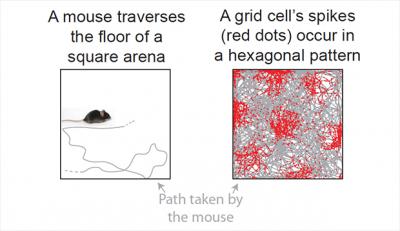
Grid cells are neu­rons that become elec­tri­cally active, or "fire," as ani­mals travel in an envi­ron­ment. First dis­cov­ered in the mid-2000s, each cell fires when the body moves to spe­cific loca­tions, for exam­ple in a room. Amaz­ingly, these loca­tions are arranged in a hexag­o­nal pat­tern like spaces on a Chi­nese checker board.

"Together, the grid cells form a rep­re­sen­ta­tion of space," said David Tank, Princeton's Henry L. Hill­man Pro­fes­sor in Mol­e­c­u­lar Biol­ogy and leader of the study. "Our research focused on the mech­a­nisms at work in the neural sys­tem that forms these hexag­o­nal pat­terns," he said. The first author on the paper was grad­u­ate stu­dent Cristina Dom­nisoru, who con­ducted the exper­i­ments together with post­doc­toral researcher Amina Kinkhabwala.

Dom­nisoru mea­sured the elec­tri­cal sig­nals inside indi­vid­ual grid cells in mouse brains while the ani­mals tra­versed a computer-generated vir­tual envi­ron­ment, devel­oped pre­vi­ously in the Tank lab. The ani­mals moved on a mouse-sized tread­mill while watch­ing a video screen in a set-up that is sim­i­lar to video-game vir­tual real­ity sys­tems used by humans.

She found that the cell's elec­tri­cal activ­ity, mea­sured as the dif­fer­ence in volt­age between the inside and out­side of the cell, started low and then ramped up, grow­ing larger as the mouse reached each point on the hexag­o­nal grid and then falling off as the mouse moved away from that point.

This ramp­ing pat­tern cor­re­sponded with a pro­posed mech­a­nism of neural com­pu­ta­tion called an attrac­tor net­work. The brain is made up of vast num­bers of neu­rons con­nected together into net­works, and the attrac­tor net­work is a the­o­ret­i­cal model of how pat­terns of con­nected neu­rons can give rise to brain activ­ity by col­lec­tively work­ing together. The attrac­tor net­work the­ory was first pro­posed 30 years ago by John Hop­field, Princeton's Howard A. Prior Pro­fes­sor in the Life Sci­ences, Emeritus.

The team found that their mea­sure­ments of grid cell activ­ity cor­re­sponded with the attrac­tor net­work model but not a com­pet­ing the­ory, the oscil­la­tory inter­fer­ence model. This com­pet­ing the­ory pro­posed that grid cells use rhyth­mic activ­ity pat­terns, or oscil­la­tions, which can be thought of as many fast clocks tick­ing in syn­chrony, to cal­cu­late where ani­mals are located. Although the Prince­ton researchers detected rhyth­mic activ­ity inside most neu­rons, the activ­ity pat­terns did not appear to par­tic­i­pate in posi­tion calculations.


INFORMATION:

Domnisoru, Cristina, Amina A. Kinkhab­wala & David W. Tank. 2013. Mem­brane poten­tial dynam­ics of grid cells. Nature. doi:10.1038/nature11973. Pub­lished online Feb. 10, 2013.


[Attachments] See images for this press release:
Researchers discover workings of brain's 'GPS system'

ELSE PRESS RELEASES FROM THIS DATE:

Governors of Ancient Egypt suffered from malnutrition dying before they were 30 years old

Governors of Ancient Egypt suffered from malnutrition dying before they were 30 years old
2013-03-07
The ancient Egyptians did not live in such good conditions and were not surrounded by such opulence as was thought up to now, but, rather, suffered from hunger and malnutrition, a whole range of infectious diseases and an extremely high infant mortality rate. Furthermore, the governors of Aswan, on the border with Sudan, as well as their families, interbred with the black peoples of the neighbouring country. These are some of the conclusions drawn from the Qubbet el-Hawa research project, carried out by the University of Jaen, in which anthropologists from the University ...

Killing cancer cells with acid reflux

Killing cancer cells with acid reflux
2013-03-07
A University of Central Florida chemist has come up with a unique way to kill certain cancer cells – give them acid reflux. Chemistry professor Kevin Belfield used a special salt to make cancer cells more acidic – similar to the way greasy foods cause acid reflux in some people. He used a light-activated, acid-generating molecule to make the cells more acidic when exposed to specific wavelengths of light, which in turn kills the bad cells. The surrounding healthy cells stay intact. The technique is a simple way around a problem that has frustrated researchers for years. ...

Pancakes with a side of math

2013-03-07
Philadelphia, PA—For many of us, maple syrup is an essential part of breakfast—a staple accompaniment to pancakes and waffles—but rarely do we think about the complicated and little-understood physiological aspects of syrup production. Each spring, maple growers in temperate regions around the world collect sap from sugar maple trees, which is one of the first steps in producing this delicious condiment. However, the mechanisms behind sap exudation—processes that trigger pressure differences causing sap to flow— in maple trees are a topic of much debate. In a paper ...

HIV therapy just got easier: Fewer drugs may be needed for treatment-experienced patients

2013-03-07
VIDEO: Karen Tashima, MD, director of the HIV Clinical Trials Program at The Miriam Hospital, led a study to look at new treatment regimens for patients with drug-resistant HIV. ... Click here for more information. PROVIDENCE, R.I. – A new multi-site study reveals patients with drug-resistant HIV can safely achieve viral suppression – the primary goal of HIV therapy – without incorporating the traditional class of HIV medications into their treatment regimen. Karen Tashima, M.D., ...

Majority of Albertans support assisted suicide: UAlberta study

2013-03-07
(Edmonton) An overwhelming majority of Albertans believe dying adults should have the right to request to end their life, according to new research from the University of Alberta. U of A researcher Donna Wilson led the team that studied the views of 1,203 Albertans on assisted suicide, currently illegal in Canada. A majority—77.4 per cent—felt dying adults should have the right to end their life early. "Increasingly, there are countries or states where they are allowing assisted suicide or euthanasia. Like many of those countries, Canada will have to grapple with this ...

UTHealth researchers find industrial chemicals in food samples

2013-03-07
HOUSTON – (March 6, 2013) – Researchers at The University of Texas Health Science Center at Houston (UTHealth) have discovered phthalates, industrial chemicals, in common foods purchased in the United States. Phthalates can be found in a variety of products and food packaging material, child-care articles and medical devices. "Although it's not completely understood how phthalates get into our food, packaging may be a contributor to the levels of the toxin in food," said lead investigator Arnold Schecter, M.D., M.P.H., professor of environmental health at The University ...

A new cryptic spider species from Africa

A new cryptic spider species from Africa
2013-03-07
The species from the genus Copa are very common spiders found in the leaf litter of various habitats. Being predominantly ground-living, they occur widely in savanna woodlands but also occasionally in forests, where they are well camouflaged. They usually share the litter microhabitats with several other species of the family Corinnidae. The spiders from this cryptic, ground-dwelling genus in the continental Afrotropical Region are revised in a study published in the open access journal Zookeys. The number of continental species in the Afrotropical Region has been reduced ...

How to predict the progress of technology

2013-03-07
CAMBRIDGE, MA -- Researchers at MIT and the Santa Fe Institute have found that some widely used formulas for predicting how rapidly technology will advance — notably, Moore's Law and Wright's Law — offer superior approximations of the pace of technological progress. The new research is the first to directly compare the different approaches in a quantitative way, using an extensive database of past performance from many different industries. Some of the results were surprising, says Jessika Trancik, an assistant professor of engineering systems at MIT. The findings could ...

Iowa State engineers developing ideas, technologies to save the Earth from asteroids

Iowa State engineers developing ideas, technologies to save the Earth from asteroids
2013-03-07
AMES, Iowa – Bong Wie has heard the snickers. You want to protect the Earth from asteroids? Where were you when the dinosaurs needed you? You want to be like Bruce Willis in that asteroid movie? Wie has a serious reply: After five years of science and engineering work, Wie and his small team have a publication list of 40-plus technical papers, $600,000 of NASA research support and a proposal for a $500 million test launch of an asteroid intercept system. Plus, Wie has just been invited to show off his research as part of NASA's Technology Day on the Hill in Washington, ...

INRS overcomes a hurdle in the development of terahertz lasers

2013-03-07
This press release is available in French. Dr. Roberto Morandotti and his team at the INRS Énergie Matériaux Télécommunications Research Centre have developed a device that is critical to the use of terahertz (THz) sources for a variety of applications. Their electromagnetic non-reciprocal isolator is the subject of a recent article in Nature Communications, showing just how important this new development is. Until now, no isolator existed that was effective in the THz region of the spectrum, a situation that held back the development of certain technologies. The new ...

LAST 30 PRESS RELEASES:

Membrane magic: FAMU-FSU researchers repurpose fuel cells membranes for new applications

UN Member States pledge to increase access to diagnosis and inhaled medicines for the 480 million people living with COPD

Combination therapy shows potential to treat pediatric brain cancer ATRT

Study links seabird nesting to shark turf wars in Hawai‘i

Legal sports betting linked to sharp increases in violent crime, study finds

Breakthrough AI from NYUAD speeds up discovery of life-supporting microbes

New Eva Mayr-Stihl Foundation funding initiative boosts research at University of Freiburg on adaptation of forests to global change

The perfect plastic? Plant-based, fully saltwater degradable, zero microplastics

Bias in data may be blocking AI’s potential to combat antibiotic resistance

Article-level metrics would provide more recognition to most researchers than journal-level metrics

Satiety’s little helper: Protein that supports appetite regulating protein identified

UF dives deep into predicting storm damage with computer models

A stormy ocean voyage yields insights on the global carbon cycle

Scientists identify first non-coding gene that controls cell size

Demonstration of altermagnetism in RuO₂ thin films -- A new magnetic material for the AI era

Penn researchers awarded $25M to conduct trial using smartphones to fight heart disease

PCORI awards funding for new patient-centered healthcare research

Exploring the origins of the universe: 145 low-noise amplifiers complete ALMA telescopes

Empress cicada wings help illuminate molecular structure

Using sound waves to detect helium

Time burden in patients with metastatic breast and ovarian cancer from clinic and home demands

Researchers discover bias in AI models that analyze pathology samples

Scientists ID potential way to prevent brain injuries from triggering Alzheimer's

MASTER 2nd Open Call: Execution period kick-off

​Algae for health in food and pharma ​

Advanced microrobots driven by acoustic and magnetic fields for biomedical applications

Chicago health information leader recognized for raising CPR readiness and blood pressure awareness

The Intimate Animal, a new book from Kinsey Institute Executive Director Dr. Justin Garcia

When blue-collar workers lose union protection, they try self-employment

New video dataset to advance AI for health care

[Press-News.org] Researchers discover workings of brain's 'GPS system'