Governors of Ancient Egypt suffered from malnutrition dying before they were 30 years old
Published 2013-03-07 · Original archive entry · Explore research explainers
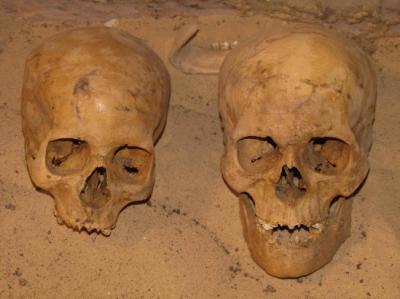
The ancient Egyptians did not live in such good conditions and were not surrounded by such opulence as was thought up to now, but, rather, suffered from hunger and malnutrition, a whole range of infectious diseases and an extremely high infant mortality rate. Furthermore, the governors of Aswan, on the border with Sudan, as well as their families, interbred with the black peoples of the neighbouring country.
These are some of the conclusions drawn from the Qubbet el-Hawa research project, carried out by the University of Jaen, in which anthropologists from the University of Granada have participated, as well as the Supreme Council of Antiquities of the Arab Republic of Egypt.
It involves excavating tomb no. 33 of the Qubbet el-Hawa necropolis, right opposite the modern-day city of Aswan, about 1000 km. south of Cairo. The tomb was constructed during the 12th Dynasty (1939-1760 BC), to house the corpse of one of the region of Aswan's leading dignitaries, whose identity is still unknown.
The site was later re-used at least three times (18th, 22nd and 27th Dynasties), is one of the largest in the necropolis and has a huge archaeological potential, since it houses at least one chamber that remains intact, containing three decorated wooden sarcophagi.
Over 200 mummies
Scientists from the UGR's Laboratory of Physical Anthropology, the director of which is Prof. Miguel Botella Lopez, have just returned from Egypt. They have been taking part in the field work to carry out the anthropological analysis of the bones of the mummies unearthed in the excavation, as well as calculating the number of individuals belonging to the more recent occupations of the tomb (New Kingdom, 3rd Intermediate Period and Late Dynastic Period). The researchers have found over 200 skeletons and mummies in tomb no. 33.
The initial results of their work have led to some very interesting conclusions and have revealed new data not only about the ancient Egyptians physical characteristics, but also about the living conditions at that time. As Prof. Botella explains, "although the cultural level of the age was extraordinary, the anthropological analysis of the human remains reveals the population in general and the governors – the highest social class – lived in conditions in which their health was very precarious, on the edge of survival".
According to the UGR anthropologists, life expectancy barely reached 30, "since they suffered from many problems of malnutrition and severe gastrointestinal disorders, due to drinking the polluted waters of the Nile". This is revealed by the fact that the bones of the children had no marks on them, "which demonstrates that they died from some serious infectious disease". Furthermore, the researchers have unearthed in the tomb a large number of mummies belonging to young adults of between 17 and 25 years old.
First mention of the pygmies
Miguel Botella points out that the tombs of the Qubbet el-Hawa necropolis contain inscriptions that are "of great historical importance, not only for Egypt, but for the whole of Humanity". Thus, in the tomb of Governor Herjuf (2200 BC), the inscriptions describe the three journeys he made to central Africa, during one of which he brought back a pygmy; this is supposedly the oldest mention made of this ethnic group.
Other inscriptions tell of Egypt's relations with the neighbouring region of Nubia (present-day Sudan) over a period of almost 1000 years. For this reason, Qubbet el-Hawa is one of the most important archaeological sites in Egypt, not only due to the discoveries already made, but also for the amount of information it contains about health and illness, and intercultural relations in ancient times.
INFORMATION:
For more information on the Qubbet el-Hawa project, go to: http://www.ujaen.es/investiga/qubbetelhawa/index.php
These are some of the conclusions drawn from the Qubbet el-Hawa research project, carried out by the University of Jaen, in which anthropologists from the University of Granada have participated, as well as the Supreme Council of Antiquities of the Arab Republic of Egypt.
It involves excavating tomb no. 33 of the Qubbet el-Hawa necropolis, right opposite the modern-day city of Aswan, about 1000 km. south of Cairo. The tomb was constructed during the 12th Dynasty (1939-1760 BC), to house the corpse of one of the region of Aswan's leading dignitaries, whose identity is still unknown.
The site was later re-used at least three times (18th, 22nd and 27th Dynasties), is one of the largest in the necropolis and has a huge archaeological potential, since it houses at least one chamber that remains intact, containing three decorated wooden sarcophagi.
Over 200 mummies
Scientists from the UGR's Laboratory of Physical Anthropology, the director of which is Prof. Miguel Botella Lopez, have just returned from Egypt. They have been taking part in the field work to carry out the anthropological analysis of the bones of the mummies unearthed in the excavation, as well as calculating the number of individuals belonging to the more recent occupations of the tomb (New Kingdom, 3rd Intermediate Period and Late Dynastic Period). The researchers have found over 200 skeletons and mummies in tomb no. 33.
The initial results of their work have led to some very interesting conclusions and have revealed new data not only about the ancient Egyptians physical characteristics, but also about the living conditions at that time. As Prof. Botella explains, "although the cultural level of the age was extraordinary, the anthropological analysis of the human remains reveals the population in general and the governors – the highest social class – lived in conditions in which their health was very precarious, on the edge of survival".
According to the UGR anthropologists, life expectancy barely reached 30, "since they suffered from many problems of malnutrition and severe gastrointestinal disorders, due to drinking the polluted waters of the Nile". This is revealed by the fact that the bones of the children had no marks on them, "which demonstrates that they died from some serious infectious disease". Furthermore, the researchers have unearthed in the tomb a large number of mummies belonging to young adults of between 17 and 25 years old.
First mention of the pygmies
Miguel Botella points out that the tombs of the Qubbet el-Hawa necropolis contain inscriptions that are "of great historical importance, not only for Egypt, but for the whole of Humanity". Thus, in the tomb of Governor Herjuf (2200 BC), the inscriptions describe the three journeys he made to central Africa, during one of which he brought back a pygmy; this is supposedly the oldest mention made of this ethnic group.
Other inscriptions tell of Egypt's relations with the neighbouring region of Nubia (present-day Sudan) over a period of almost 1000 years. For this reason, Qubbet el-Hawa is one of the most important archaeological sites in Egypt, not only due to the discoveries already made, but also for the amount of information it contains about health and illness, and intercultural relations in ancient times.
INFORMATION:
For more information on the Qubbet el-Hawa project, go to: http://www.ujaen.es/investiga/qubbetelhawa/index.php