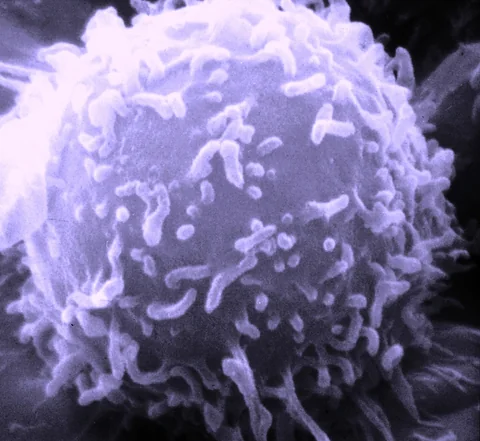
A transplant experiment can follow the descendants of individual blood-forming cells. The size of the experiment and the identity of its recipients are essential to interpreting the result.
- The researchers transplanted human cord-blood cell populations into mice, not into patients.
- There were five primary recipient mice per conditioning group; secondary-recipient groups had different sizes.
- Conditioning changed aspects of blood-cell output in this model. The findings do not establish which regimen is best for a person.
- Paper date
- 17 November 2026
- Recipients
- Mice
- Primary comparison
- Five mice per group
Original publication: 17 Nov 2026 · The date above refers to this brief.
Recipient mice in the reported comparisons
mice
Following a cell population across stages
Start
Separate and mark human cord-blood cell populations.
Follow
Observe blood-cell contributions in primary mouse recipients.
Challenge again
Study output after a secondary transplant into other mice.
What was being tracked?
Blood-forming stem cells and multipotent progenitor cells can both produce descendants in several blood-cell lineages. The researchers marked subsets of human cord-blood cells and followed their descendants after transplantation into mice. Tracking a clone means following the output associated with a marked starting cell, not tracking an individual patient.
Source 1 ↗The small groups behind the findings
The primary experiment had five mice per conditioning group. A separate secondary-transplant analysis collected data from 17 mice in the busulfan group, 11 unconditioned mice and six irradiated mice. The second set of counts describes recipient animals, not additional human donors or a clinical trial.
Source 1 ↗Output is not the same as engraftment
The researchers observed differences in the magnitude and composition of human blood-cell output under different conditioning conditions, while their reported bone-marrow and spleen engraftment measures were not detectably altered by conditioning. A measurement can change in one tissue while another remains similar. A study with small groups cannot rule out every difference.
Source 1 ↗A second transplant answers another question
In secondary transplantation, cells recovered from a first recipient are introduced into another recipient. This tests persistence under another experimental challenge. The paper reports reduced overall output and increased clonal diversity in secondary recipients. That is a feature of this mouse system, not an estimate of durability for patients.
Source 1 ↗What comes next?
A mouse environment supports only some features of human blood formation, and the researchers note that mouse and human lifespans differ. Larger preclinical comparisons and appropriate human research would be needed before any clinical conclusions. Our related bone-repair story also distinguishes human-derived cells from experiments performed in mice.
Source 1 ↗Follow the recipient and the measurement
Publisher HTML: abstract, selected Results, Figure 1 and Figure 2 captions, and study limitations, accessed through a research-search interface. Publisher metadata and abstract also checked. Supplements, source-data files, code and clinical records were not independently audited. No publisher figure reproduced.
01Was this a human transplant trial?
- What was observed
- The researchers transplanted human cord-blood cell populations into mouse recipients.
- Where the conclusion stops
- Human-derived cells do not make the recipients human patients.
Source 1 · Publisher Results and Figure 1 caption
02Did every outcome respond to conditioning in the same way?
- What was observed
- The study reports changes in blood-cell output but no detectable difference in the reported bone-marrow and spleen engraftment measures.
- Where the conclusion stops
- Small groups limit precision; no detected difference is not proof of equivalence.
Source 1 · Publisher Results, blood cell production
Numbers you can inspect
| Measure | Value & unit | Origin & method |
|---|---|---|
| Primary recipients per group | 5 mice | Reported Five primary recipient mice per conditioning group. Source 1 · Publisher Figure 1a caption |
| Secondary busulfan recipients | 17 mice | Reported Secondary recipients in the busulfan group. Source 1 · Publisher Figure 1a caption |
| Secondary unconditioned recipients | 11 mice | Reported Secondary recipients in the unconditioned group. Source 1 · Publisher Figure 1a caption |
| Secondary irradiated recipients | 6 mice | Reported Secondary recipients in the irradiated group. Source 1 · Publisher Figure 1a caption |
| Primary comparison follow-up | 5 months | Reported Follow-up for the specified Figure 2 primary comparison. Source 1 · Publisher Figure 2 caption |
| Secondary comparison follow-up | 12 months | Reported Follow-up after the secondary transplant in Figure 2. Source 1 · Publisher Figure 2 caption |
Compare the actual experiments
These studies answer different questions. Read the unit and endpoint before comparing results.
| Study | Unit & setting | Readout | Interpretation boundary |
|---|---|---|---|
| Primary transplant Source 1 · Publisher Figure 1 and 2 | Recipient mice and tracked clones | Blood-cell output and tissue engraftment | Mice are not human transplant recipients. |
| Secondary transplant Source 1 · Publisher Figure 1a and Figure 2 | A separate group of recipient mice | Clonal output after a second challenge | Group sizes and follow-up differ from the primary stage. |
The export includes claims, available numbers, methods and source locations. It contains our reading notes and published summaries; it is not raw participant data or an independent reanalysis.
Evidence update · 17 Nov 2026
First publication. Reported observations, arithmetic and proposed follow-up questions are separated. No raw-data reanalysis. AI source check; no human editorial or clinical review.
How the two stages differ
| Reading question | What the paper reports | What remains open |
|---|---|---|
| Primary recipients | Five mice per conditioning group | Small experimental groups |
| Secondary, busulfan | 17 recipient mice | A later, separate transplant stage |
| Secondary, unconditioned | 11 recipient mice | Not 11 human patients |
| Secondary, irradiated | Six recipient mice | Different group size affects precision |
Original Press-News reading framework. Follow-up questions are our interpretation, not experiments performed by the authors.
Your questions, answered
Were the recipients people?
No. The human cells were studied in mouse recipients.
Does unchanged engraftment prove conditioning has no effect?
No. The reported measures did not show a detectable difference, and small groups limit precision.
Is a clone the same as a donor?
No. A clone represents descendants associated with a marked starting cell.
Should a patient change their transplant plan?
This laboratory study cannot answer that individual clinical question.
Limits of this interpretation
- The transplant recipients were mice, not patients.
- The primary groups were small; absence of a detected difference is not proof that no difference exists.
- Secondary recipients and cell clones are different units from the donors of the starting human cells.
- Conditioning comparisons in this model do not determine a clinical regimen.
Sources & transparency
- Snodgrass, Eerdeng, Condie et al. (2026): Tracking human HSCs and MPPs in mice reveals distinct clonal dynamics and responses to pre-transplant conditioning
Publisher HTML: abstract, selected Results, Figure 1 and Figure 2 captions, and study limitations, accessed through a research-search interface. Publisher metadata and abstract also checked. Supplements, source-data files, code and clinical records were not independently audited. No publisher figure reproduced. · Accessed 17 Nov 2026
DOI: 10.1038/s41536-026-00522-6
Prepared and source-checked with AI. Press-news Team is the collective publication byline, not a medical reviewer. No human editorial or clinical review has taken place. This educational article examines research methods and laboratory or observational findings, not individual diagnosis or treatment. We did not conduct these experiments or reanalyse raw data. Reported results, our interpretation and proposed future tests are separated. Source-access limits are recorded below. Photographs are illustrative.
Source check: AI source check — selected primary results, captions and study boundaries
Clinical review: Not applicable to this educational guide
Suggest a correction