A genetic association can point to a stretch of DNA without explaining which cell uses it or under what conditions. A tissue atlas adds a second question: where is that part of the genome accessible to the machinery that regulates gene activity? That context can help researchers choose the next experiment.
- Research published
- Nature Genetics · 25 September 2026
- Tissue locations
- Terminal ileum; ascending colon
- Readout
- Single-cell chromatin accessibility
Original publication: 25 Sep 2026 · The date above refers to this brief.
People contributing to the intestinal atlas
Participants
The finding in brief
Zhao and colleagues analysed 71 biopsies from 23 people with Crohn’s disease and 16 controls, retaining 178,030 cell profiles. Their atlas catalogued 557,310 candidate regulatory elements and linked fine-mapped risk signals to 30 variants within such regions. It highlights cell-specific biological context; it is not a diagnostic test or treatment trial.
Source 1 ↗Accessible DNA is a clue about regulation
DNA is packaged with proteins into chromatin. An accessibility measurement asks which regions are comparatively available to molecular machinery in a particular cell. A candidate regulatory element is a possible control region worth investigating, not a switch whose effect has necessarily been proven.
Our companion human brain atlas examines RNA messages. This intestinal study asks a different measurement question. Knowing which message is present and knowing which DNA region is accessible can be complementary, but neither measurement should silently stand in for the other. Their relationship needs a defined hypothesis and suitable matched experiments.
Why the tissue location and cell type matter
Imagine comparing two tissue samples: one contains more immune cells, while the other contains more structural cells. An average molecular difference might reflect that mixture, a change within a cell type, or both. Separating cells makes the comparison more informative, but it also creates many smaller comparisons that must be handled carefully.
For your reading notebook, record the tissue site, condition, inclusion criteria and unit of analysis. A large number of cells does not create an equally large number of independent people. Several samples from one person share a history. These details determine which comparisons an atlas can support and where an apparent difference may have another explanation.
From a risk signal to a causal experiment
A genetic signal and an accessible region can narrow the search. They do not by themselves prove which gene is affected, whether the change increases or decreases its activity, or what happens when the region is altered. Our table separates those steps.
We would look for a targeted test of the proposed region in a relevant cell model, a measurement of the expected downstream effect, and independent confirmation. Such a test must also distinguish a process contributing to disease from a process responding to inflammation. The direction of an association alone cannot settle that distinction.
The hope: a more precise research agenda
The practical value of an atlas is that it can make a broad question more specific: which cells, which genomic region and which biological condition deserve testing together? That can improve the design of follow-up experiments and make disagreements between studies easier to investigate.
Our proposed next step would combine genetic perturbation with complementary measurements in independently collected material. If a proposed mechanism is reproducible, it can then inform a separate application study. Identifying a candidate region is an early part of that route. It does not establish that changing the region would improve symptoms, or that a person should change treatment.
What each step adds to a genetic clue
| Step | Question answered | Still needs testing |
|---|---|---|
| Genetic association | Which region is linked statistically to a trait? | Cause and affected biological process |
| Cellular context | Where might that region be relevant? | Whether a candidate region controls the proposed gene |
| Targeted perturbation | Does changing it alter the predicted process? | Robustness and unintended effects |
| Application study | Does an intervention improve a defined outcome? | Benefits and harms in the intended population |
Our interpretation framework. This atlas does not complete every step.
Your questions, answered
Is a candidate regulatory element a newly discovered gene?
No. A regulatory candidate and a protein-coding gene are different things. A candidate region may help control gene activity, but its target and function require evidence.
Does the atlas predict my chance of developing Crohn’s disease?
No individual prediction tool is evaluated in this report. A tissue reference and a calibrated risk-prediction service would need different validation.
Why compare cells if many come from the same person?
Cells provide biological detail; people provide independent sampling at the participant level. A suitable analysis needs to account for their relationship rather than treating every cell as a separately recruited participant.
What would turn a candidate into a convincing mechanism?
A specific prediction, targeted manipulation in a suitable model, the expected downstream measurement and reproducible results. A proposed patient benefit requires an additional level of evaluation.
Limits of this interpretation
- Observational tissue comparisons cannot establish which changes cause disease and which respond to inflammation.
- Candidate regulatory regions are not validated treatment targets merely because they appear in an atlas.
- We checked selected published material, not full supplements or participant-level metadata.
Sources & transparency
- Zhao, Zhou, Mu et al. (2026): Single-cell analysis of chromatin accessibility in the human intestine identifies regulatory programs and clarifies genetic associations in Crohn’s disease
Publisher HTML abstract, study-design caption and selected atlas results checked. Full supplements and patient-level metadata were not independently assessed. Short factual account plus an original reading framework and cohort chart; no journal figure or patient data reproduced. · Accessed 30 Sep 2026
DOI: 10.1038/s41588-026-02755-z
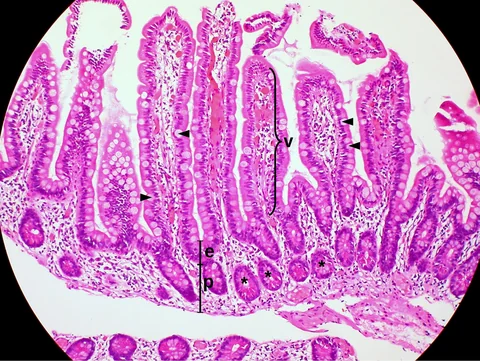
Prepared and source-checked with AI on 30 September 2026. Press-news Team is our collective publication byline, not a claim of medical credentials or human review. No human editorial or clinical review has taken place. We did not conduct the experiments or reanalyse the raw data. We distinguish reported findings from our own explanations and proposed follow-up questions. Access limits are listed with each source. This article explains basic research and research tools; it does not evaluate an individual’s treatment. The photograph is illustrative.
Source check: AI source check — primary research, dates and selected results
Clinical review: Not applicable to this educational guide
Suggest a correction