The immune system has to restrict a virus without causing excessive damage. In one mouse infection model, researchers found evidence that suppressing an immune response at the wrong place and time can also be harmful.
- The researchers compared mice infected with vesicular stomatitis virus, not people with a respiratory or neurological infection.
- In one intervention comparison, all 12 mice given an inhibitor near the brain survived the observation period; the infected control group contained 14 mice.
- A result in this model does not establish a treatment, dose, route or safety profile for people.
- Paper date
- 20 November 2026
- Model
- VSV infection in mice
- Intervention
- Local research experiment
Original publication: 20 Nov 2026 · The date above refers to this brief.
One weight-based comparison in Figure 1
mice
From observation to a more demanding test
Observe
Compare immune-cell patterns in mice with different outcomes.
Intervene
Test genetic changes or an inhibitor in separate mouse experiments.
Validate later
Reproduce across settings and investigate safety before clinical conclusions.
What the researchers observed
After infecting mice through the nose with vesicular stomatitis virus (VSV), the researchers studied immune activity in the olfactory bulb, a brain region involved in smell. Mice with more severe outcomes had more CXCR2-positive myeloid cells resembling immune-suppressive cells in that region. The observation links a cell population to a particular experimental setting; it does not establish how every human viral infection behaves.
Source 1 ↗A weight threshold, not a diagnostic test
The study divided infected mice into recovering and non-recovering groups by comparing their body weight on days five and six after infection. In one Figure 1 group, eight of 23 infected mice were classified as recovering and 15 as non-recovering; three uninfected mice were shown separately. The authors selected the 97% cutoff after examining weight and survival in their model. That selection is a reason to ask for independent validation before treating the threshold as predictive.
Source 1 ↗Two interventions, two comparisons
One experiment used mice with a conditional genetic change; a separate experiment used a CXCR2 inhibitor delivered locally near the brain after infection. In the genetic survival figure there were 38 infected control mice and 42 infected conditional-knockout mice. The local-inhibitor survival figure used 14 infected control mice and 12 infected treated mice. These are different experiments and their group sizes should not be pooled as if they were one trial.
Source 1 ↗What the intervention result means
The paper reports that all 12 locally treated mice survived the reported observation period. This is a result in a small animal group, not a percentage chance of benefit for a patient. The authors also describe a different outcome when the inhibitor was administered through a systemic route. The reviewed sections do not establish clinical effectiveness, long-term safety or an appropriate human dose.
Source 1 ↗A useful next question
The authors used labeling experiments to investigate whether some relevant cells can originate near the skull as well as from circulation. Replication in other models and careful testing of timing, tissue location and adverse effects would be needed before any human relevance could be assessed. A different cell population, virus or stage of infection could produce a different balance.
What belongs to which mouse experiment?
Publisher HTML: abstract, selected Results, Figure 1, 3 and 6 captions and Methods, accessed through a research-search interface. Publisher metadata and abstract also checked. Supplements, source-data files, code and clinical records were not independently audited. No publisher figure reproduced.
01Is this evidence of a human antiviral treatment?
- What was observed
- The intervention and survival results described here are from VSV-infected mice.
- Where the conclusion stops
- The study does not establish benefit or safety in people.
Source 1 · Publisher Results and Figure 6 caption
02Is the 97% weight threshold independently validated?
- What was observed
- The Methods describe choosing it after examining weight and survival in the mouse model.
- Where the conclusion stops
- The selected sections do not establish prospective validation in a separate cohort.
Source 1 · Publisher Methods, definition of groups
Numbers you can inspect
| Measure | Value & unit | Origin & method |
|---|---|---|
| Infected mice in Figure 1 | 23 mice | Reported Figure 1 weight-grouping comparison; includes the two infected subgroups below. Source 1 · Publisher Figure 1 caption |
| Recovering subgroup | 8 mice | Reported Weight-classified infected subgroup in Figure 1. Source 1 · Publisher Figure 1 caption |
| Non-recovering subgroup | 15 mice | Reported Weight-classified infected subgroup in Figure 1. Source 1 · Publisher Figure 1 caption |
| Uninfected comparison group | 3 mice | Reported Separate uninfected controls in Figure 1. Source 1 · Publisher Figure 1 caption |
| Infected controls, genetic survival figure | 38 mice | Reported Infected control animals in Figure 3 survival comparison. Source 1 · Publisher Figure 3 caption |
| Infected conditional knockouts | 42 mice | Reported Infected conditional-knockout animals in Figure 3 survival comparison. Source 1 · Publisher Figure 3 caption |
| Infected controls, inhibitor survival figure | 14 mice | Reported Infected controls in the distinct local-inhibitor experiment. Source 1 · Publisher Figure 6 caption |
| Infected inhibitor group | 12 mice | Reported Local inhibitor group in the Figure 6 survival comparison; authors report all survived during observation. Source 1 · Publisher Results and Figure 6 caption |
Compare the actual experiments
These studies answer different questions. Read the unit and endpoint before comparing results.
| Study | Unit & setting | Readout | Interpretation boundary |
|---|---|---|---|
| Weight classification Source 1 · Publisher Methods and Figure 1 caption | One infected mouse cohort | Weight change from day 5 to day 6 | The cutoff was selected in the studied experimental model. |
| Local inhibitor survival Source 1 · Publisher Results and Figure 6 caption | A separate mouse intervention comparison | Survival over the reported observation period | Does not establish human clinical efficacy or safety. |
The export includes claims, available numbers, methods and source locations. It contains our reading notes and published summaries; it is not raw participant data or an independent reanalysis.
Evidence update · 21 Nov 2026
First publication. Reported observations, arithmetic and proposed follow-up questions are separated. No raw-data reanalysis. AI source check; no human editorial or clinical review.
Separate the experiments before comparing their numbers
| Reading question | What the paper reports | What remains open |
|---|---|---|
| Figure 1 grouping | 23 infected mice: 8 recovering and 15 non-recovering; 3 uninfected controls | Classification uses a threshold derived within the model |
| Figure 3 genetic experiment | 38 infected controls and 42 infected conditional-knockout mice in the survival plot | Not the same animals or intervention as Figure 6 |
| Figure 6 inhibitor experiment | 14 infected controls and 12 locally treated infected mice in the survival plot | All 12 treated mice survived the reported observation period; not a human result |
| Human application | Not tested by these mouse experiments | Clinical benefit, harms and generalizability are unknown |
Original Press-News reading framework. Follow-up questions are our interpretation, not experiments performed by the authors.
Your questions, answered
Was this a human trial?
No. The intervention experiments described here involved mice infected with VSV.
Did all treated mice survive?
The authors report survival throughout the observation period for all 12 inhibitor-treated mice in one local-administration experiment. That does not establish a human treatment effect.
Are the 38 and 42 mice the same groups as the 14 and 12?
No. Those counts belong to separate genetic and inhibitor experiments.
Can the 97% weight cutoff predict illness in people?
No. It was selected for grouping mice in this experimental model and has not been established as a human diagnostic rule.
Limits of this interpretation
- VSV infection in mice is not a clinical trial and should not be generalized to all viruses.
- The weight-based grouping threshold was selected using outcomes in this experimental system; the reviewed sections do not establish independent prospective validation.
- The inhibitor comparison involved small groups, a specific administration route and a limited observation period.
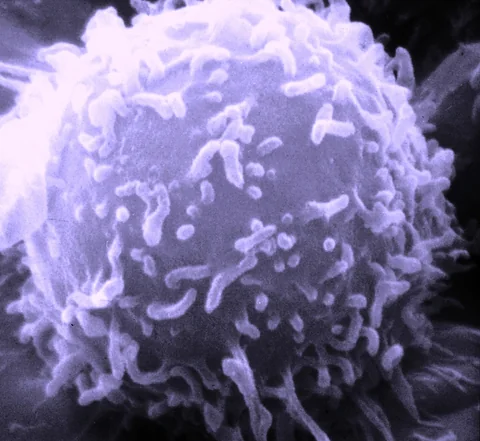
- Images of an unrelated lymphocyte illustrate immune cells generally, not the myeloid cells or experiment in this paper.
Sources & transparency
- Satomi, Saito, Satou et al. (2026): Local niche-derived immunosuppressive CXCR2+ cells impair antiviral immunity
Publisher HTML: abstract, selected Results, Figure 1, 3 and 6 captions and Methods, accessed through a research-search interface. Publisher metadata and abstract also checked. Supplements, source-data files, code and clinical records were not independently audited. No publisher figure reproduced. · Accessed 21 Nov 2026
DOI: 10.1038/s41467-026-78910-1
Prepared and source-checked with AI. Press-news Team is the collective publication byline, not a medical reviewer. No human editorial or clinical review has taken place. This educational article examines research methods and laboratory or observational findings, not individual diagnosis or treatment. We did not conduct these experiments or reanalyse raw data. Reported results, our interpretation and proposed future tests are separated. Source-access limits are recorded below. Photographs are illustrative.
Source check: AI source check — selected primary results, captions and study boundaries
Clinical review: Not applicable to this educational guide
Suggest a correction