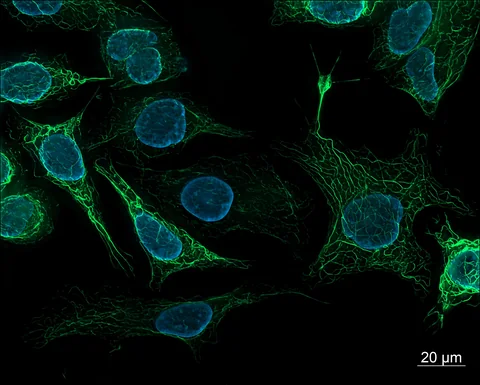
Knowing what molecules are present is different from knowing where they operate. A new labeling approach tackles that spatial problem. For a reader, the useful habit is to ask what a tag records—and which biological claim still needs a separate experiment.
- A nearby molecule is a candidate neighbor, not automatically a binding partner.
- A labeling tool needs controls for location, activation and background.
- Multiple measurement types become useful when their questions stay distinct.
- Publication
- Nature Chemical Biology · 30 September 2026
- Method
- D-amino-acid-activated peroxidase chemistry
- Demonstrations
- Living model systems
- Access
- Public abstract and selected captions; main text not fully read
Original publication: 30 Sep 2026 · The date above refers to this brief.
What the new method does
Liu and colleagues describe PRADA, a system in which an engineered oxidase uses D-amino acids to activate localized peroxidase chemistry. The authors report protein and RNA labeling in living models and a sequencing approach to examine RNA folding. An application in a mouse xenograft explores mitochondrial molecular organization.
We checked the public abstract and selected captions and availability statements. The subscription main text was not fully accessible, so this article explains the measurement idea rather than certifying all of the method’s performance claims.
Source 1 ↗An address is not a handshake
Suppose a directory lists the people present in a room during a short interval. It suggests possible encounters, but it does not establish who spoke to whom. A proximity label can raise a comparable question about molecular neighbors. The analogy is ours; it is not a literal description of the chemistry.
To make a stronger interaction claim, ask for evidence suited to that interaction. To make a function claim, ask whether a targeted change alters the predicted process. The table separates those steps so an attractive spatial map does not become a mechanism by wording alone.
The control set determines what a label means
A proposed labeling experiment should distinguish the intended local signal from background and from effects of the activation procedure itself. Useful questions include where the labeling machinery is positioned, how long it is active and what is detected without activation.
Our suggested reading checklist also asks whether the tagged system still behaves as intended. An instrument can reveal something real while changing the thing being observed. A control need not prove the technique perfect; it should establish which interpretation is justified under a specified set of conditions.
Sequence, shape and abundance answer different questions
A list of RNA messages, their abundance and their folded structures are distinct descriptions. A sequence identifies an instruction; a structural measurement concerns how that instruction is physically arranged under the measured conditions. Neither alone establishes every downstream function.
This connects to our earlier mRNA reading-frame article through a general principle: writing an instruction and measuring how molecular machinery handles it are different tasks. Here we focus on the spatial measurement. We are not claiming that the two papers test the same RNA designs or mechanisms.
What would make the next application convincing?
We would look for reproducible maps in a defined system, transparent background controls and an independent way to check key candidates. The most useful next study might test a small number of specific predictions rather than generate the largest possible catalog.
The long-term opportunity is to connect molecular neighborhoods with processes that can be changed and measured. The immediate value is a new way to formulate such questions. A discovery tool is not a diagnostic service, and a mitochondrial map does not on its own establish a treatment effect.
From location to a testable biological claim
| What you see | What it can tell you | What to ask next |
|---|---|---|
| Molecular list | Which signals were recovered | What background and detection limits apply? |
| Proximity label | Which molecules were near the labeling site | Does a separate assay support direct interaction? |
| RNA structure signal | A structural feature under the tested conditions | Does a targeted change affect function? |
| Functional perturbation | Whether changing a candidate changes an outcome | Are alternative explanations controlled? |
Our original reading framework. Questions and proposed checks are not reported experimental results.
Your questions, answered
Does proximity prove direct binding?
No. Physical neighborhood and a specific binding interaction are different claims. The latter needs evidence suited to the interaction.
Why disclose that the main text was not fully read?
Detailed performance and limitations cannot be independently evaluated from an abstract alone. The scope note lets readers judge the strength of this account.
Is a molecular map a diagnostic test?
Not by itself. A clinical test needs a defined use, comparison and validation in the relevant people.
What can a reader do with the paper now?
Identify the biological question, labeling location, activation window and control set. Then choose a candidate claim that an independent experiment could check.
Limits of this interpretation
- The subscription main text was not fully read; this is a method-reading account based on specified public material.
- Labeling proximity does not prove interaction or causation.
- Raw data and code were not independently evaluated.
Sources & transparency
- Liu, Han, Wang et al. (2026): Multiomic proximity labeling in vivo by D-amino-acid-activated peroxidase reaction
Public publisher abstract, figure headings, selected extended-data captions and data/code-availability statements checked. Main article is subscription content and was not fully read. Methods, raw datasets and code not independently assessed. · Accessed 30 Sep 2026
DOI: 10.1038/s41589-026-02336-5
Prepared and source-checked with AI; source access recorded on 2026-09-30 (UTC). Press-news Team is our collective publication byline, not a medical reviewer. No human editorial or clinical review has taken place. We did not conduct these experiments or reanalyse their raw data. Reported findings, our explanations and proposed follow-up tests are distinguished. Access limits appear with each source. This is an educational account of basic research and research methods, not an individual diagnosis or treatment recommendation. Photographs are illustrative.
Source check: AI source check — primary publications, selected results and access limits
Clinical review: Not applicable to this educational guide
Suggest a correction