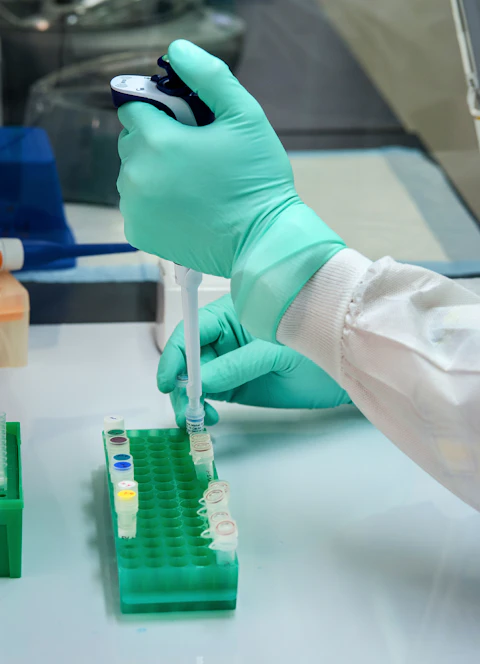
A molecule associated with one cellular role can appear in an unexpected location. That surprise becomes scientifically useful when different measurements agree—and when the next experiment can distinguish a passenger from a driver of the process.
- A fluorescent signal needs a chemical identity and an appropriate control.
- Timing can sharpen a hypothesis without proving causation.
- A candidate bacterial process is not automatically a validated treatment target.
- Publication
- Nature Communications · 30 September 2026
- Organism
- Chlamydia trachomatis
- Approach
- Imaging, metabolic tracking and lipidomics
- Focus
- Lipid location and developmental transitions
Original publication: 30 Sep 2026 · The date above refers to this brief.
What the investigators observed
Rühling and colleagues report sphingolipid-derived signals near condensed bacterial DNA in the infectious elementary-body stage. The signals were released before DNA decondensation during the transition toward replicating reticulate bodies. Imaging, metabolic tracking and lipidomics point to analogue-derived sphingomyelin associated with this pattern.
The abstract frames a possible role in stage-specific DNA condensation. That is a biological hypothesis supported by several observations, not proof that changing the lipid would prevent infection or be safe in a person.
Source 1 ↗Why three measurement types are more informative than one
An image can show where a signal appears. A chemical analysis can help identify what generates the signal. A time-resolved observation can show how the pattern relates to a transition. They are complementary questions, not three identical votes for the same conclusion.
Our reading method is to name the question answered by each assay. If one measurement cannot establish identity, look for a separate identity check. If another cannot establish location, look for an appropriate spatial observation. Agreement becomes more informative when the weaknesses of the methods are different.
A labeled analogue needs its own interpretation
A tag or analogue can make a difficult molecule trackable. It also creates a comparison between the measured signal and the native process the researcher wants to understand. The useful question is how well that comparison has been checked under the relevant conditions.
When reading such a report, look for background controls, possible conversion into other molecular forms and evidence that the probe has not substantially changed the process. This is a general measurement checklist. It is not a claim that we independently inspected every control or chemical spectrum in the present work.
What timing adds—and what it leaves open
If a change appears before another event, the order can constrain an explanation. It does not rule out a shared upstream trigger, a measurement artifact or a process that is necessary only in certain conditions. A sequence of pictures becomes stronger when paired with a specific intervention.
Our proposed next test would change the candidate process, preserve suitable controls and measure the predicted downstream transition. A rescue or alternative perturbation could help distinguish a specific mechanism from general disruption. The paper’s observations motivate those questions; we are not presenting our proposal as a completed experiment.
Connect the result to other lipid and barrier stories
Our mouse-brain lipid atlas follows molecular location in a very different system. The mucus-material and phage articles examine different ways to study bacterial behavior. Their useful connection is the need to keep location, function and a proposed application separate.
For this bacterial finding, the immediate opportunity is a more precise developmental hypothesis. A later application would require its own evidence, including effects beyond the target process. Readers gain more by following that sequence than by turning every unexpected molecular location into a treatment headline.
What each kind of evidence contributes
| What you see | What it can tell you | What to ask next |
|---|---|---|
| Spatial image | Location of a detectable signal | Could preparation or background explain it? |
| Chemical identification | Which molecular forms are present | Does the identity match the imaged signal? |
| Time course | Order of measured changes | Could another process drive both? |
| Targeted change | A causal prediction under tested conditions | Is the effect specific and reproducible? |
Our original reading framework. Questions and proposed checks are not reported experimental results.
Your questions, answered
Does a lipid near DNA necessarily control DNA?
No. Location suggests a question about function; a targeted test is needed to assess that question.
Does this suggest a new infection treatment I can use?
No. This is an educational account of bacterial cell biology, not a treatment evaluation.
Why use a molecular analogue?
It can make a molecule trackable. Readers should then ask how the signal relates to the native molecule and whether the probe changes the process.
What makes the next experiment informative?
A clear prediction, a targeted change and a readout capable of distinguishing a specific developmental effect from general damage.
Limits of this interpretation
- The source describes an association and possible role, not a validated clinical target.
- Only the publisher-indexed abstract and bibliographic details were checked.
- Source images, chemical spectra and perturbation data were not independently assessed.
Sources & transparency
- Rühling, Wagner, Epprecht et al. (2026): Sphingolipids associate with the chlamydial nucleoid and mark developmental transitions in Chlamydia trachomatis
Publisher-indexed abstract and publication details checked. Direct full HTML retrieval failed. Microscopy source images, lipid-identification spectra and perturbation experiments not independently assessed. · Accessed 30 Sep 2026
DOI: 10.1038/s41467-026-77974-3
Prepared and source-checked with AI; source access recorded on 2026-09-30 (UTC). Press-news Team is our collective publication byline, not a medical reviewer. No human editorial or clinical review has taken place. We did not conduct these experiments or reanalyse their raw data. Reported findings, our explanations and proposed follow-up tests are distinguished. Access limits appear with each source. This is an educational account of basic research and research methods, not an individual diagnosis or treatment recommendation. Photographs are illustrative.
Source check: AI source check — primary publications, selected results and access limits
Clinical review: Not applicable to this educational guide
Suggest a correction