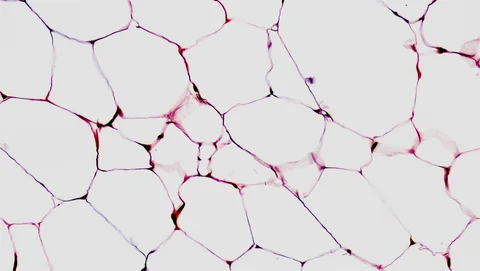
A gene is only the beginning of a protein’s story. Its messenger RNA must also be processed and maintained. A new study asks what happens to fat tissue when one part of that process is disrupted.
- The human genetic observation and the mouse knockout are different experiments.
- Six carriers in the initial human comparison are too few to turn the variant into a personal prediction.
- Restoring a laboratory signal is evidence about a mechanism, not an established treatment.
- Paper date
- 29 October 2026
- Systems
- Human genetic comparison, cell experiments and mice
- Focus
- RNA processing and adipose biology
Original publication: 29 Oct 2026 · The date above refers to this brief.
A 24-week mouse comparison—not a human weight-loss result
mean fat mass as a percentage of body weight
From a rare observation to a testable pathway
Observe
Keep the number of human carriers and group size visible.
Perturb
Identify the cell or mouse system used to challenge the mechanism.
Translate
Ask what independent human evidence would be required next.
The proposed link
Chen and colleagues investigate Star-PAP, a protein involved in processing messenger RNA. Their cellular experiments connect it to the stability of insulin-receptor mRNA. In mice with Star-PAP removed from fat cells, the authors report progressive loss of adipose tissue and disrupted metabolic measurements. Restoring insulin-receptor expression partially improves some experimental outcomes.
Source 1 ↗A small human observation is not the mouse experiment
The paper reports a rare Star-PAP variant in six of 2,161 lean controls and none of 1,944 people in the obesity group of the initial cohort. Our arithmetic gives about 0.28% in that lean group. The same paper describes additional human and experimental analyses, but six initial carriers cannot establish that the variant protects an individual from obesity or causes a particular condition.
The animal knockout removes a gene in a selected tissue; carrying a rare human variant is a different genetic situation. Combining them into a single claim about personal risk would hide both the small human count and the different interventions.
Source 1 ↗Read the mouse graph with its labels attached
For one normal-chow comparison at 24 weeks, the paper reports mean fat mass of 12.45% of body weight in controls and 7.13% in the adipose-specific knockout group. The caption gives 15 control and nine knockout male mice for this comparison. Our subtraction is 5.32 percentage points. These are group summaries in a mouse model, not a percentage of people helped or a human weight-loss result.
Source 1 ↗Why a partial rescue matters
A rescue experiment asks whether restoring a component can reverse part of a disrupted outcome. Partial improvement can strengthen the proposed pathway while also showing that the measured effects are not all accounted for by one step. It does not prove that the same intervention works in a person or that a different molecule will reproduce the effect.
The paper includes a separate pyruvate-related laboratory experiment. Its result should remain attached to that setting; it is not evidence that taking a supplement treats insulin resistance or changes body fat in people.
Source 1 ↗What would make the human link more informative?
Our proposed next questions are whether the association appears in independent, adequately described populations; how frequently the variant occurs; and whether the same functional effect is observed in relevant human tissue. Null or inconsistent findings would matter as much as a replication. We have not reanalysed the cohort or examined participant records.
Connect the levels of evidence
Our earlier article about AnkB in brown fat also separates a molecular change from the whole-animal trade-offs it produces. Together, the studies show why a result about fat-cell biology should retain the model, tissue, age and endpoint. Their interventions differ and their numerical results should not be pooled.
The human count, mouse groups and measurement must travel together
Selected accepted primary PDF: human variant and mouse body-composition Results and Fig. 1 caption on p.3; insulin-receptor mRNA and restoration Results. Fig. 1 caption visually inspected. This accepted version may receive further edits. Publisher HTML metadata and abstract also checked. Supplements, source-data files, code and clinical records were not independently audited. No publisher figure reproduced.
01How common was the observed variant in the initial comparison?
- What was observed
- Six of 2,161 lean controls carried it; none of 1,944 obesity cases did.
- Where the conclusion stops
- A rare observation does not establish protection or individual risk.
Source 1 · Accepted PDF p.3; Fig. 1a,c and initial Results
02What is the chart endpoint?
- What was observed
- Reported mean fat mass as a percentage of body weight in two 24-week male-mouse groups.
- Where the conclusion stops
- A mouse body-composition difference is not a human intervention result.
Source 1 · Accepted PDF p.3; Results and Fig. 1j caption
Numbers you can inspect
| Measure | Value & unit | Origin & method |
|---|---|---|
| Lean controls in initial cohort | 2161 people | Reported Human comparison denominator, not number of carriers. Source 1 · PDF p.3; Fig. 1c caption |
| Obesity cases in initial cohort | 1944 people | Reported Separate human comparison denominator. Source 1 · PDF p.3; Fig. 1c caption |
| Carriers among lean controls | 6 people | Reported Rare observation in the initial cohort. Source 1 · PDF p.3; Fig. 1a caption |
| Carrier proportion in lean controls | 0.28 percent, approximately | Calculated round(6 / 2161 * 100, 2); not a protective effect estimate. Source 1 · PDF p.3 counts; Press-News arithmetic |
| 24-week control mean | 12.45 percent of body weight | Reported Mean mouse fat mass; not a patient outcome. Source 1 · PDF p.3; initial Results and Fig. 1j |
| 24-week knockout mean | 7.13 percent of body weight | Reported Separate male-mouse group mean. Source 1 · PDF p.3; initial Results and Fig. 1j |
| Difference in mouse group means | 5.32 percentage points | Calculated 12.45 - 7.13; not relative risk reduction. Source 1 · PDF p.3 values; Press-News arithmetic |
| Control group size at 24 weeks | 15 male mice | Reported Fig. 1j control denominator only. Source 1 · PDF p.3; Fig. 1j caption |
| Knockout group size at 24 weeks | 9 male mice | Reported Fig. 1j knockout denominator only. Source 1 · PDF p.3; Fig. 1j caption |
Compare the actual experiments
These studies answer different questions. Read the unit and endpoint before comparing results.
| Study | Unit & setting | Readout | Interpretation boundary |
|---|---|---|---|
| Human genetic observation Source 1 · PDF p.3; initial Results and Fig. 1c | People in the initial lean/obesity comparison | Rare-variant counts | Association with few carriers cannot prove individual protection or causality. |
| Adipose-specific knockout Source 1 · PDF p.3; Fig. 1 and mechanism Results | Male mouse groups at defined ages | Fat mass, RNA and metabolic readouts | A tissue-specific knockout is not the same exposure as a human variant. |
The export includes claims, available numbers, methods and source locations. It contains our reading notes and published summaries; it is not raw participant data or an independent reanalysis.
Evidence update · 30 Oct 2026
First publication. Reported observations, arithmetic and proposed follow-up questions are separated. No raw-data reanalysis. AI source check; no human editorial or clinical review.
Do not merge these three experiments
| Reading question | Evidence to retain | What remains open |
|---|---|---|
| What was observed in people? | Variant counts and cohort definitions | Replication and the meaning of a rare association |
| What was manipulated in cells? | RNA or receptor-related readout | Whether the same mechanism holds in human tissue |
| What changed in mice? | Tissue-specific knockout, sex, age and fat-mass endpoint | Effect of a human variant or intervention |
| What did restoration show? | Which outcome improved and by how much | Whether any clinical treatment is safe or effective |
Original Press-News reading framework. Follow-up questions are our interpretation, not experiments performed by the authors.
Your questions, answered
Does this variant guarantee that someone will be lean?
No. The initial observation has six carriers and does not support an individual prediction.
Did the mouse experiment test the same thing as the human comparison?
No. The mice discussed in the chart have a tissue-specific gene knockout; the human result concerns a rare variant.
What does the 5.32 figure mean?
It is our subtraction of two reported 24-week mouse group means, in percentage points of body weight—not a human treatment effect.
Should people take pyruvate based on this study?
The paper reports a separate laboratory result; it does not establish a supplement as a treatment for people.
Limits of this interpretation
- The initial human comparison includes only six reported variant carriers.
- Human association, cell-level RNA measurements and mouse gene deletion are different evidence layers.
- A 24-week male-mouse group comparison is not a clinical weight-loss outcome.
- Supplementary genetic data, participant records and raw laboratory measurements were not independently audited.
Sources & transparency
- Chen, Zhao, Chen et al. (2026): Stabilization of insulin receptor mRNA by Star-PAP in metabolic homeostasis
Selected accepted primary PDF: human variant and mouse body-composition Results and Fig. 1 caption on p.3; insulin-receptor mRNA and restoration Results. Fig. 1 caption visually inspected. This accepted version may receive further edits. Publisher HTML metadata and abstract also checked. Supplements, source-data files, code and clinical records were not independently audited. No publisher figure reproduced. · Accessed 30 Oct 2026
DOI: 10.1038/s41467-026-78465-1
Prepared and source-checked with AI. Press-news Team is the collective publication byline, not a medical reviewer. No human editorial or clinical review has taken place. This educational article examines research methods and laboratory or observational findings, not individual diagnosis or treatment. We did not conduct these experiments or reanalyse raw data. Reported results, our interpretation and proposed future tests are separated. Source-access limits are recorded below. Photographs are illustrative.
Source check: AI source check — selected primary PDF results, captions and study boundaries
Clinical review: Not applicable to this educational guide
Suggest a correction