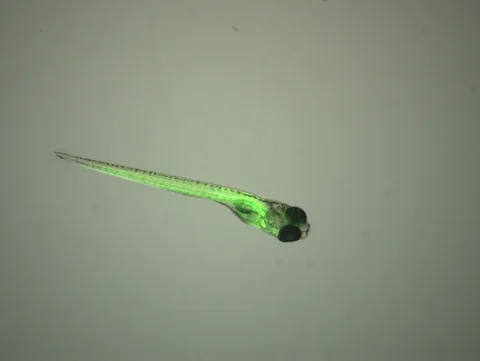
A screen can narrow thousands of possibilities without showing that any is a medicine. A new study demonstrates several steps between a behavioural signal in fish and a candidate for further research.
- The initial larval-zebrafish screen examined 12,000 compounds and reported 69 primary hits.
- Researchers selected 29 of those hits for retesting; 28 reproduced the selected larval response in that retest.
- A later candidate was studied in fish, mice and selected human tissue outside the body; the work does not establish safety or efficacy in patients.
- Paper date
- 16 November 2026
- Initial screen
- 12,000 compounds
- Primary hits
- 69 compounds
Original publication: 16 Nov 2026 · The date above refers to this brief.
A screening funnel with changing questions
Screen
Compare larval-fish responses across a compound library.
Retest
Examine selected hits and use additional animal and laboratory readouts.
Translate
Investigate reproducibility and safety before considering any clinical study.
Why start with a behavioural screen?
The researchers looked for compounds that produced a pattern of larval-zebrafish responses resembling a reference anaesthetic. This is a way to identify candidates for further investigation. Similar behaviour is an experimental signal, not proof that a substance will produce safe anaesthesia in a person.
Source 1 ↗From a large library to selected hits
The initial screen included 12,000 compounds, of which 69 met the authors’ primary-hit criterion. Our calculation is 69 divided by 12,000, about 0.6% of that particular library. That fraction depends on the library, readout and threshold; it is not the probability that a candidate becomes an approved medicine.
Source 1 ↗The retest used a selected subset
The team selected 29 primary hits representing different chemical clusters. In the larval retest, 28 of the 29 reproduced the reported response, or about 96.6% by our calculation. These 29 were selected from the hits, so the percentage is neither the success rate among all 12,000 compounds nor evidence of clinical effectiveness.
Source 1 ↗Different models answer different questions
The authors then examined selected compounds in adult zebrafish and studied a later optimized candidate, nidradine, in mice and other laboratory assays. The paper also describes selected human tissue studied outside the body. These models offer complementary signals, but none establishes safety, effectiveness or an appropriate dose in patients.
Source 1 ↗A response is not a complete safety profile
The paper reports behavioural and mechanistic findings in its models and compares selected readouts with established anaesthetics. Differences in one experimental measure cannot settle all possible cardiovascular, respiratory, neurological or other risks in people. The findings should not be used to change clinical care.
Source 1 ↗What comes next?
Independent replication and further preclinical assessment would be needed before any possible clinical investigation. The authors disclose a pending patent application related to the candidate and named inventors. Our companion analysis of the amyloid screen similarly distinguishes a laboratory hit from a treatment.
The retest percentage belongs to a selected subset
Accepted primary PDF: abstract, Results, Fig. 1 p. 3, selected follow-up results and competing interests. The Fig. 1 page was visually inspected; the accepted version may be edited. Publisher metadata and abstract also checked. Supplements, source-data files, code and clinical records were not independently audited. No publisher figure reproduced.
01What does 69 refer to?
- What was observed
- The authors report 69 primary hits among 12,000 screened compounds.
- Where the conclusion stops
- A primary hit is an experimental signal, not a medicine shown to work in patients.
Source 1 · Accepted PDF Results p. 2
02Were 28 of all 12,000 compounds proven effective?
- What was observed
- The authors report that 28 of 29 selected primary hits reproduced the larval response in retesting.
- Where the conclusion stops
- The 29 were selected for retest; the response is not a patient outcome.
Source 1 · Accepted PDF Results and Fig. 1 pp. 2–3
Numbers you can inspect
| Measure | Value & unit | Origin & method |
|---|---|---|
| Compounds in initial screen | 12000 compounds | Reported Library size in the larval-zebrafish screen. Source 1 · Accepted PDF abstract p. 1 |
| Primary screening hits | 69 compounds | Reported Compounds meeting the authors’ primary-hit criterion. Source 1 · Accepted PDF Results p. 2 |
| Primary hit fraction | 0.575 percent | Calculated 69 divided by 12,000 times 100; about 0.6% when rounded. Source 1 · Accepted PDF Results p. 2 |
| Selected compounds retested | 29 compounds | Reported Selected from 69 primary hits. Source 1 · Accepted PDF Results p. 2 |
| Retest responses reproduced | 28 compounds | Reported 28 of the selected 29 reproduced the reported larval response. Source 1 · Accepted PDF Results p. 2 |
| Selected retest fraction | 96.6 percent | Calculated 28 divided by 29 times 100, rounded to one decimal place. Source 1 · Accepted PDF Results p. 2 |
Compare the actual experiments
These studies answer different questions. Read the unit and endpoint before comparing results.
| Study | Unit & setting | Readout | Interpretation boundary |
|---|---|---|---|
| Initial larval screen Source 1 · Accepted PDF abstract and Results pp. 1–2 | 12,000 compounds | Reference-like behavioural signal | Primary hits are not approved treatments. |
| Selected retest and later models Source 1 · Accepted PDF Results and Fig. 1 pp. 2–3 | 29 selected primary hits, then further selected candidates | Larval response and separate animal-model readouts | The groups and endpoints change across stages. |
The export includes claims, available numbers, methods and source locations. It contains our reading notes and published summaries; it is not raw participant data or an independent reanalysis.
Evidence update · 17 Nov 2026
First publication. Reported observations, arithmetic and proposed follow-up questions are separated. No raw-data reanalysis. AI source check; no human editorial or clinical review.
Follow the denominator through the screen
| Reading question | What the paper reports | What remains open |
|---|---|---|
| Initial library | 12,000 compounds screened | Not 12,000 patients |
| Primary hits | 69 met the screen criterion | An initial signal is not an approved drug |
| Retested subset | 29 selected hits; 28 reproduced the selected larval response | A selected subset, not the whole library |
| Further models | Adult fish, mice and selected tissue assays | No human treatment efficacy or safety established |
Original Press-News reading framework. Follow-up questions are our interpretation, not experiments performed by the authors.
Your questions, answered
Did 12,000 people receive a drug?
No. The number refers to compounds in a larval-zebrafish screen.
Does 28 out of 29 mean the candidate works in 96.6% of patients?
No. The count concerns a selected retest subset and a fish behaviour readout.
Was human tissue involved?
The paper describes selected human tissue studied outside the body; that is not a clinical treatment trial.
Is a patent disclosed?
Yes. The authors disclose a pending patent application related to the candidate and related compounds.
Limits of this interpretation
- The screen and later experiments use selected laboratory models, not a human clinical trial.
- The 29 retested compounds were selected from primary hits and are not representative of the entire library.
- Selected human tissue outside the body is not a test of whole-person safety.
- The accepted manuscript may change; a related patent application is disclosed.
Sources & transparency
- McCarroll, Weinrich, Marinas et al. (2026): Phenotypic discovery of GABAA receptor-mediated general anesthetics with analgesic activity
Accepted primary PDF: abstract, Results, Fig. 1 p. 3, selected follow-up results and competing interests. The Fig. 1 page was visually inspected; the accepted version may be edited. Publisher metadata and abstract also checked. Supplements, source-data files, code and clinical records were not independently audited. No publisher figure reproduced. · Accessed 17 Nov 2026
DOI: 10.1038/s41467-026-79384-x
Prepared and source-checked with AI. Press-news Team is the collective publication byline, not a medical reviewer. No human editorial or clinical review has taken place. This educational article examines research methods and laboratory or observational findings, not individual diagnosis or treatment. We did not conduct these experiments or reanalyse raw data. Reported results, our interpretation and proposed future tests are separated. Source-access limits are recorded below. Photographs are illustrative.
Source check: AI source check — selected primary PDF results, captions and study boundaries
Clinical review: Not applicable to this educational guide
Suggest a correction