COVID-19 drug prospects boosted by discovery of short form of coronavirus's 'entry point'
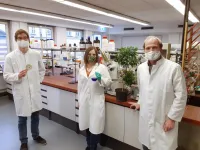
A shadow over the promising inhaled interferon beta COVID-19 therapy has been cleared with the discovery that although it appears to increase levels of ACE2 protein - coronavirus' key entry point into nose and lung cells - it predominantly increases levels of a short version of that protein, which the virus cannot bind to. The virus that causes COVID-19, known as SARS-CoV-2, enters nose and lung cells through binding of its spike protein to the cell surface protein angiotensin converting enzyme 2 (ACE2). Now a new, short, form of ACE2 has been identified by Professor Jane Lucas, Professor Donna Davies, Dr Gabrielle Wheway and Dr Vito Mennella at the University of Southampton and University Hospital Southampton NHS Foundation Trust. The study, published in Nature Genetics, shows ...
Read the release