Machine-learning models of matter beyond interatomic potentials
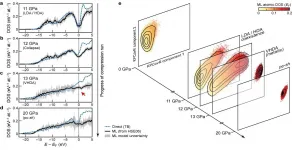
Combining electronic structure calculations and machine learning (ML) techniques has become a common approach in the atomistic modelling of matter. Using the two techniques together has allowed researchers, for instance, to create models that use atomic coordinates as the only inputs to inexpensively predict any property that can be computed by the first-principles calculations that had been used to train them. While the earliest and by now most advanced efforts have focused on using predictions of total energies and atomic forces to construct interatomic potentials, more recent efforts have targeted additional properties of crystals and molecules such as ionization energies, NMR chemical shieldings, dielectric response properties and charge density. In the paper "Learning ...
Read the release