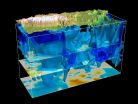
Raising groundwater keeps valleys from sinking: Santa Clara Valley, Calif.
Boulder, Colo., USA - California and other parts of the western U.S. are experiencing extended severe drought conditions. Varying groundwater levels in valleys throughout the state, balanced by water imported, for instance, via the State Water Project and the federal Central Valley Project make understanding the state's underlying hydrologic framework all the more important. This paper by R.T. (Randy) Hanson of the U.S. Geological Survey focuses on California's Santa Clara Valley. In the introduction to his paper, Hanson provides a succinct history of the area, as paraphrased ...
Read the release