Collisions with robots -- without risk of injury
Published 2014-07-08 · Original archive entry · Explore research explainers
Everybody has experienced this: You aren't careful for just one moment and suddenly you run into the edge of a table. At first, it hurts. A little later, a bruise starts to appear. What falls into the category of "nothing bad, but aggravating" in the case of a table, takes on a new dimension when the colliding partner is a robot, because such a collision can injure humans seriously. That is why these mechanical assistants usually still work behind protective barriers. Since some applications require humans and robots to work hand-in-hand, though, their cooperation has become one of the foci of robotics research worldwide. Where exactly does the threshold between harmless contact and an injury lie, though?
Minor Impacts, Major Findings
How much force does it take for an impact to leave a bruise on different body parts? When do humans suffer permanent injuries? Nobody has been able to say precisely. There are no extensive studies on the subject. Collision geometry, i.e. the geometry of the colliding objects, also has great influence on the severity of injuries from a collision. Researchers at the Fraunhofer Institute for Factory Operation and Automation IFF in Magdeburg are exploring wholly uncharted terrain with a new study: They are systematically studying the thresholds of biomechanical loads resulting from collisions between robots and humans.
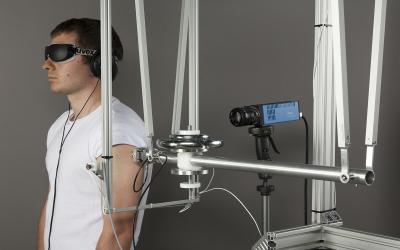
The researchers' approach: They load a pendulum with different weights, pull it back and allow it to hit against different body parts of the participants of the study. A special sensor film on the pendulum's impact face measures the pressure distribution upon impact. A force sensor, also located on the impact face, measures the characteristics of the contact force, the maximum force applied and the action time. "This enables us to measure every relevant parameter such as force, pressure distribution, impact velocity, momentum and energy," says Dr. Norbert Elkmann, business unit manager at the Fraunhofer IFF.
On the medical side, the study is being supported by the Department of Forensic Medicine, the Dermatology Clinic, the Trauma Surgery Clinic and the Department of Neuroradiology of Otto von Guericke University Hospital Magdeburg. The Otto von Guericke University Ethics Commission has given the study its approval. Test discontinuation criteria are incipient swelling or bruising or when subjects reach their pain threshold.
In the pilot phase, the researchers first developed the measurement system and refined the methodology – together with medical professionals. They are now producing the first findings with several subjects in a preliminary stage. Afterward, the researchers will decide how many participants will be needed in the study to obtain representative results. The researchers from the Fraunhofer IFF will present their initial findings at the International Conference on Robotics and Automation ICRA in Hong Kong in June of 2014.
Their findings will also benefit criminal investigative agencies and medical examiners: Whenever victims of violent crimes come to officials or physicians and their subdermal hematomas are hard to see, the intensity of the trauma can hardly be determined. Victims as well as physicians would be helped greatly if medical examiners were able to fall back on pertinent studies.
The study will also have a value for the consumer sector: After all, robots are now commonplace in many households. They vacuum, mop the floor or mow the lawn. Robots will likely take over even many more jobs in households in the future but only if humans are safely protected against injuries from collisions with them. The Fraunhofer IFF is obtaining fundamental data in its study, the results of which will be incorporated in international standards.
INFORMATION: END
Minor Impacts, Major Findings
How much force does it take for an impact to leave a bruise on different body parts? When do humans suffer permanent injuries? Nobody has been able to say precisely. There are no extensive studies on the subject. Collision geometry, i.e. the geometry of the colliding objects, also has great influence on the severity of injuries from a collision. Researchers at the Fraunhofer Institute for Factory Operation and Automation IFF in Magdeburg are exploring wholly uncharted terrain with a new study: They are systematically studying the thresholds of biomechanical loads resulting from collisions between robots and humans.
The researchers' approach: They load a pendulum with different weights, pull it back and allow it to hit against different body parts of the participants of the study. A special sensor film on the pendulum's impact face measures the pressure distribution upon impact. A force sensor, also located on the impact face, measures the characteristics of the contact force, the maximum force applied and the action time. "This enables us to measure every relevant parameter such as force, pressure distribution, impact velocity, momentum and energy," says Dr. Norbert Elkmann, business unit manager at the Fraunhofer IFF.
On the medical side, the study is being supported by the Department of Forensic Medicine, the Dermatology Clinic, the Trauma Surgery Clinic and the Department of Neuroradiology of Otto von Guericke University Hospital Magdeburg. The Otto von Guericke University Ethics Commission has given the study its approval. Test discontinuation criteria are incipient swelling or bruising or when subjects reach their pain threshold.
In the pilot phase, the researchers first developed the measurement system and refined the methodology – together with medical professionals. They are now producing the first findings with several subjects in a preliminary stage. Afterward, the researchers will decide how many participants will be needed in the study to obtain representative results. The researchers from the Fraunhofer IFF will present their initial findings at the International Conference on Robotics and Automation ICRA in Hong Kong in June of 2014.
Their findings will also benefit criminal investigative agencies and medical examiners: Whenever victims of violent crimes come to officials or physicians and their subdermal hematomas are hard to see, the intensity of the trauma can hardly be determined. Victims as well as physicians would be helped greatly if medical examiners were able to fall back on pertinent studies.
The study will also have a value for the consumer sector: After all, robots are now commonplace in many households. They vacuum, mop the floor or mow the lawn. Robots will likely take over even many more jobs in households in the future but only if humans are safely protected against injuries from collisions with them. The Fraunhofer IFF is obtaining fundamental data in its study, the results of which will be incorporated in international standards.
INFORMATION: END