Inhibiting impact of dust aerosols on eastern Pacific tropical cyclones from the perspective of energy transmission
Published 2021-03-25 · Original archive entry · Explore research explainers
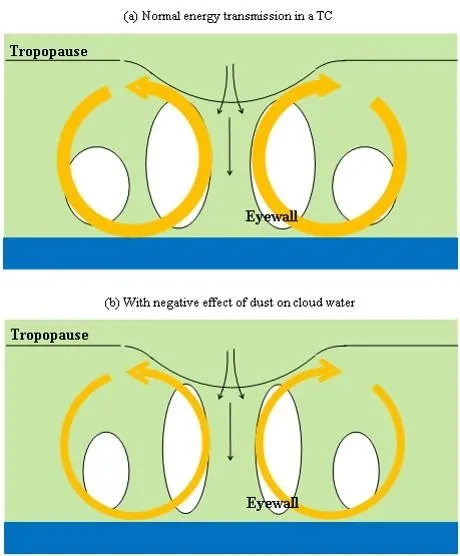
The thermodynamic state of the tropical atmosphere plays an important role in the development of tropical cyclone (TC) intensity. A TC imports thermodynamic energy from ocean-air heat and moisture fluxes and exports heat aloft at the much colder upper troposphere, through a radially and vertically directed overturning circulation in a TC. The work done through this cycle drives the TC's winds.
A negative response of cloud water in the lower troposphere to dust aerosol optical depth (AOD) has recently been reported in Atmospheric and Oceanic Science Letters (https://doi.org/10.1016/j.aosl.2020.100028) by Dr. Zhenxi Zhang from the Inner Mongolia University of Technology, Hohhot, China, by analyzing MERRA-2 reanalysis data and GCM simulations from CMIP6.
"The explanation of this response could be that dust aerosols absorb solar radiation, promoting the evaporation of clouds. In principle, this aerosol-driven vaporization modification could affect the enthalpy of the air surrounding a tropical cyclone", explains Dr. Zhang.
According to Zhang's study, a negative association between eastern Pacific TC intensity in offshore regions and dust AOD for the years 1980-2019 was also found. "The changes in TC intensity related to dust AOD conditions should be a consequence of the anomalous enthalpy of the air surrounding a TC caused by the negative effect of dust on cloud water", concludes Zhang.
A negative response of cloud water in the lower troposphere to dust aerosol optical depth (AOD) has recently been reported in Atmospheric and Oceanic Science Letters (https://doi.org/10.1016/j.aosl.2020.100028) by Dr. Zhenxi Zhang from the Inner Mongolia University of Technology, Hohhot, China, by analyzing MERRA-2 reanalysis data and GCM simulations from CMIP6.
"The explanation of this response could be that dust aerosols absorb solar radiation, promoting the evaporation of clouds. In principle, this aerosol-driven vaporization modification could affect the enthalpy of the air surrounding a tropical cyclone", explains Dr. Zhang.
According to Zhang's study, a negative association between eastern Pacific TC intensity in offshore regions and dust AOD for the years 1980-2019 was also found. "The changes in TC intensity related to dust AOD conditions should be a consequence of the anomalous enthalpy of the air surrounding a TC caused by the negative effect of dust on cloud water", concludes Zhang.
INFORMATION: