Biochar particle size found to shape disease control in crops
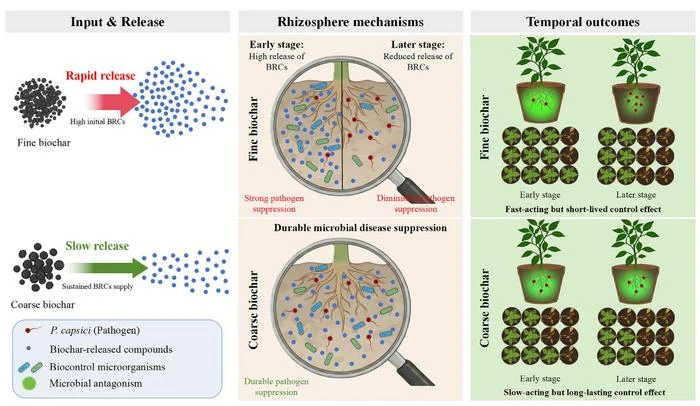
A new study reveals that not all biochar works the same way in protecting crops from disease. Researchers have discovered that the particle size of biochar determines how effectively and how long it can suppress soil-borne pathogens, offering new insights for sustainable agriculture.
Biochar, a carbon-rich material produced from plant biomass, has gained attention for improving soil health and reducing plant diseases. However, until now, scientists did not fully understand how physical properties such as particle size influence its performance.
In this study, researchers investigated how fine and coarse biochar affect pepper plants suffering from Phytophthora blight, a devastating disease caused by the pathogen Phytophthora capsici. Their findings show that particle size controls the timing and durability of disease suppression by regulating how biochar releases nutrients and organic compounds into the soil.
“Our results demonstrate that biochar is not a one-size-fits-all solution,” said the study’s lead author. “Fine biochar acts quickly but loses effectiveness over time, while coarse biochar provides a slower yet more sustained protective effect.”
Through greenhouse experiments, the team found that fine biochar significantly reduced disease severity during the early stages of plant growth. This rapid protection was linked to the quick release of minerals and labile organic carbon, which stimulated beneficial soil microbes and suppressed the pathogen. However, as these compounds were depleted, the protective effect weakened.
In contrast, coarse biochar released its compounds more gradually. While its initial impact was less pronounced, it maintained stronger disease suppression over time. This sustained release supported long-term increases in beneficial bacteria and fungi, which continued to inhibit the pathogen.
The researchers identified key microbial groups, including Pseudomonas, Trichoderma, and Penicillium, that played important roles in suppressing disease. These organisms thrived when biochar released nutrients into the soil, enhancing microbial competition against the pathogen.
“Our findings highlight that biochar works through dynamic interactions with soil microbes,” the authors explained. “By controlling how nutrients are released, particle size shapes the entire microbial ecosystem and its ability to fight disease.”
Importantly, the study showed that electrical conductivity, representing mineral release, and labile organic carbon were the main drivers of microbial activity and disease suppression. These components fueled microbial growth and increased antagonistic interactions against the pathogen, ultimately reducing its abundance.
The research provides a new perspective on how to optimize biochar use in agriculture. Rather than applying a single type of biochar, farmers and land managers may benefit from tailoring particle size to specific goals, such as rapid disease control or long-term soil health improvement.
“This work opens the door to precision biochar applications,” said the researchers. “By selecting the right particle size, we can design more effective and sustainable strategies to protect crops.”
As global agriculture faces increasing pressure from soil degradation and plant diseases, such insights are critical for developing environmentally friendly alternatives to chemical pesticides. Biochar, already valued for its carbon storage potential, may also become a powerful tool for managing plant health.
The study offers practical guidance for improving crop resilience while advancing sustainable farming practices, demonstrating that even small physical differences in materials can have major impacts on agricultural outcomes.
===
Journal Reference: Wang, G., Ji, J., Lu, C. et al. Particle size influences biochar-mediated control of pepper Phytophthora blight: linking released compounds to soil microbial disease suppression. Biochar 8, 44 (2026).
https://doi.org/10.1007/s42773-025-00566-9
===
About Biochar
Biochar (e-ISSN: 2524-7867) is the first journal dedicated exclusively to biochar research, spanning agronomy, environmental science, and materials science. It publishes original studies on biochar production, processing, and applications—such as bioenergy, environmental remediation, soil enhancement, climate mitigation, water treatment, and sustainability analysis. The journal serves as an innovative and professional platform for global researchers to share advances in this rapidly expanding field.
Follow us on Facebook, X, and Bluesky.
END
Biochar, a carbon-rich material produced from plant biomass, has gained attention for improving soil health and reducing plant diseases. However, until now, scientists did not fully understand how physical properties such as particle size influence its performance.
In this study, researchers investigated how fine and coarse biochar affect pepper plants suffering from Phytophthora blight, a devastating disease caused by the pathogen Phytophthora capsici. Their findings show that particle size controls the timing and durability of disease suppression by regulating how biochar releases nutrients and organic compounds into the soil.
“Our results demonstrate that biochar is not a one-size-fits-all solution,” said the study’s lead author. “Fine biochar acts quickly but loses effectiveness over time, while coarse biochar provides a slower yet more sustained protective effect.”
Through greenhouse experiments, the team found that fine biochar significantly reduced disease severity during the early stages of plant growth. This rapid protection was linked to the quick release of minerals and labile organic carbon, which stimulated beneficial soil microbes and suppressed the pathogen. However, as these compounds were depleted, the protective effect weakened.
In contrast, coarse biochar released its compounds more gradually. While its initial impact was less pronounced, it maintained stronger disease suppression over time. This sustained release supported long-term increases in beneficial bacteria and fungi, which continued to inhibit the pathogen.
The researchers identified key microbial groups, including Pseudomonas, Trichoderma, and Penicillium, that played important roles in suppressing disease. These organisms thrived when biochar released nutrients into the soil, enhancing microbial competition against the pathogen.
“Our findings highlight that biochar works through dynamic interactions with soil microbes,” the authors explained. “By controlling how nutrients are released, particle size shapes the entire microbial ecosystem and its ability to fight disease.”
Importantly, the study showed that electrical conductivity, representing mineral release, and labile organic carbon were the main drivers of microbial activity and disease suppression. These components fueled microbial growth and increased antagonistic interactions against the pathogen, ultimately reducing its abundance.
The research provides a new perspective on how to optimize biochar use in agriculture. Rather than applying a single type of biochar, farmers and land managers may benefit from tailoring particle size to specific goals, such as rapid disease control or long-term soil health improvement.
“This work opens the door to precision biochar applications,” said the researchers. “By selecting the right particle size, we can design more effective and sustainable strategies to protect crops.”
As global agriculture faces increasing pressure from soil degradation and plant diseases, such insights are critical for developing environmentally friendly alternatives to chemical pesticides. Biochar, already valued for its carbon storage potential, may also become a powerful tool for managing plant health.
The study offers practical guidance for improving crop resilience while advancing sustainable farming practices, demonstrating that even small physical differences in materials can have major impacts on agricultural outcomes.
===
Journal Reference: Wang, G., Ji, J., Lu, C. et al. Particle size influences biochar-mediated control of pepper Phytophthora blight: linking released compounds to soil microbial disease suppression. Biochar 8, 44 (2026).
https://doi.org/10.1007/s42773-025-00566-9
===
About Biochar
Biochar (e-ISSN: 2524-7867) is the first journal dedicated exclusively to biochar research, spanning agronomy, environmental science, and materials science. It publishes original studies on biochar production, processing, and applications—such as bioenergy, environmental remediation, soil enhancement, climate mitigation, water treatment, and sustainability analysis. The journal serves as an innovative and professional platform for global researchers to share advances in this rapidly expanding field.
Follow us on Facebook, X, and Bluesky.
END