Biomed engineering student at NJIT shines a light on rare colon cancer
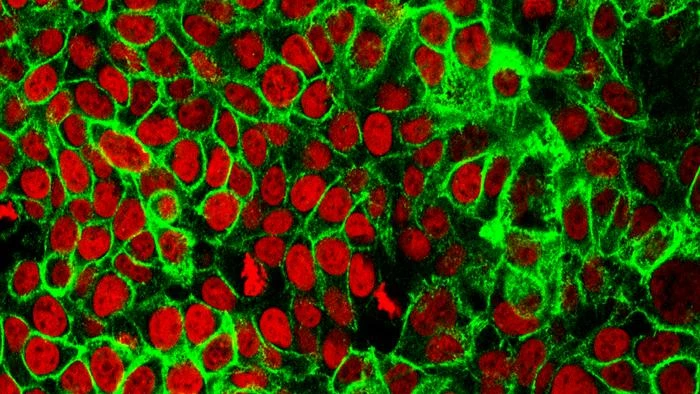
Colon cancer is one of the most common cancers in the U.S., with more than 100,000 cases diagnosed each year. But some people develop a highly aggressive form of colon cancer that is extremely rare, making up 0.02% to 0.1% of all colon cancers. Known as squamous cell carcinoma (SCC) of the colon, it originates in squamous cells, a type of epithelial cell. Epithelial cells line internal and external body tissues, but squamous cells are not normally found in the colon or rectum. Symptoms of colorectal SCC resemble those of other colon cancers but do not appear until later stages of the disease, making it harder to treat.
Case reports describing this type of SCC are also scarce. With fewer than 100 cases described in medical literature, doctors' knowledge of this rare cancer is limited and progress has faltered in developing standardized methods for diagnosing and treating colorectal SCC.
An NJIT student is hoping to change that.
Eesha Oza '28 is pursuing a BS in biomedical engineering at NJIT's Newark College of Engineering, part of an accelerated 7-year BS/MD program offered by NJIT and the Rutgers New Jersey Medical School. Oza, a freshman at NJIT and an Albert Dorman Honors College Scholar, is lead author of a study about SCC, published Feb. 10 in the journal Frontiers in Oncology. Oza and her co-authors describe a case report of a 72−year−old woman who was diagnosed with SCC and responded successfully to treatment. But when Oza consulted other SCC case reports as part of her background research, "I was really shocked at how fragmented and disjointed the existing data was," she says. "Most of the publications were very short, very isolated single-patient case reports with not much unified understanding on how this cancer develops and what is the best way we can treat it."
In rare diseases such as SCC of the colon, the infrequency of cases makes it harder for doctors to create a standardized approach to patient care, Oza explains.
"It's dealt with in different ways based on how the cancer is manifesting for that specific patient," she says. "I don't think there's anyone to blame for the fact that it's fragmented — but it is."
Their study is an important step in collecting and reviewing existing data on this rare cancer, to help medical professionals recognize and diagnose it more quickly. Over time, this could establish evidence-based treatment strategies that improve outcomes for colon cancer patients, the authors reported.
Surgeons removed the tumor and followed up with 12 rounds of chemotherapy. Subsequent examinations and colonoscopies showed no signs of recurring cancer. More than 12 years after the patient's diagnosis, she remained cancer-free.
Highlighting the woman's case was just one part of the study. To understand her cancer in the context of other known examples of SCC, the researchers analyzed 62 SCC cases from 1955 to 2025, searching for patterns in disease presentation, diagnosis, therapies and outcomes.
"One of the main things I noticed was the importance of imaging," Oza says, referring to technologies such as contrast−enhanced computed tomography (CT) and positron emission tomography (PET) which identify early-stage tumors and exclude other pathologies. "That's very important for physicians to be able to get a broader look at the cancer itself and how it's spread."
The researchers also noted that surgery was usually the primary treatment for SCC of the colon, with chemotherapy increasingly utilized in later stages of the disease.
However, scientists have yet to learn what causes this rare malignancy, as colon tissue does not typically contain squamous cells. While there are some hypotheses, "there hasn't been a single explanation that's been definitively proven," Oza says."That inherently makes diagnosis harder.
For colon cancer, early detection is critical. With an early diagnosis, patients' five-year survival rate is about 90%. However, if the cancer spreads to other organs, the prognosis is less hopeful. Once colon cancers invade nearby organs, the survival rate drops to around 73%. If the cancer metastasizes to more distant organs, the rate of survival plummets to approximately 16%. While there is still much about SCC of the colon and other rare cancers that scientists don't yet fully understand, comparing and analyzing case reports may illuminate a path forward.
"By noticing these patterns, we can tailor the treatment for individual patients, but also make sure that it aligns properly in the broader context of the cancer and successes and failures that we've seen," Oza says.
END
Case reports describing this type of SCC are also scarce. With fewer than 100 cases described in medical literature, doctors' knowledge of this rare cancer is limited and progress has faltered in developing standardized methods for diagnosing and treating colorectal SCC.
An NJIT student is hoping to change that.
Eesha Oza '28 is pursuing a BS in biomedical engineering at NJIT's Newark College of Engineering, part of an accelerated 7-year BS/MD program offered by NJIT and the Rutgers New Jersey Medical School. Oza, a freshman at NJIT and an Albert Dorman Honors College Scholar, is lead author of a study about SCC, published Feb. 10 in the journal Frontiers in Oncology. Oza and her co-authors describe a case report of a 72−year−old woman who was diagnosed with SCC and responded successfully to treatment. But when Oza consulted other SCC case reports as part of her background research, "I was really shocked at how fragmented and disjointed the existing data was," she says. "Most of the publications were very short, very isolated single-patient case reports with not much unified understanding on how this cancer develops and what is the best way we can treat it."
In rare diseases such as SCC of the colon, the infrequency of cases makes it harder for doctors to create a standardized approach to patient care, Oza explains.
"It's dealt with in different ways based on how the cancer is manifesting for that specific patient," she says. "I don't think there's anyone to blame for the fact that it's fragmented — but it is."
Their study is an important step in collecting and reviewing existing data on this rare cancer, to help medical professionals recognize and diagnose it more quickly. Over time, this could establish evidence-based treatment strategies that improve outcomes for colon cancer patients, the authors reported.
The importance of imaging
Doctors diagnosed the 72-year-old woman with SCC after she sought medical treatment for abdominal pain, which had begun several weeks earlier and steadily worsened. They performed a colonoscopy — the woman had not previously undergone age-recommended screenings — and found a tumor on the left side of her colon. Imaging and further tests confirmed that cancer was the cause, rather than another form of colon disease, and identified the cancer as originating in squamous cells, unlike more common forms of colon cancer.Surgeons removed the tumor and followed up with 12 rounds of chemotherapy. Subsequent examinations and colonoscopies showed no signs of recurring cancer. More than 12 years after the patient's diagnosis, she remained cancer-free.
Highlighting the woman's case was just one part of the study. To understand her cancer in the context of other known examples of SCC, the researchers analyzed 62 SCC cases from 1955 to 2025, searching for patterns in disease presentation, diagnosis, therapies and outcomes.
"One of the main things I noticed was the importance of imaging," Oza says, referring to technologies such as contrast−enhanced computed tomography (CT) and positron emission tomography (PET) which identify early-stage tumors and exclude other pathologies. "That's very important for physicians to be able to get a broader look at the cancer itself and how it's spread."
The researchers also noted that surgery was usually the primary treatment for SCC of the colon, with chemotherapy increasingly utilized in later stages of the disease.
However, scientists have yet to learn what causes this rare malignancy, as colon tissue does not typically contain squamous cells. While there are some hypotheses, "there hasn't been a single explanation that's been definitively proven," Oza says."That inherently makes diagnosis harder.
For colon cancer, early detection is critical. With an early diagnosis, patients' five-year survival rate is about 90%. However, if the cancer spreads to other organs, the prognosis is less hopeful. Once colon cancers invade nearby organs, the survival rate drops to around 73%. If the cancer metastasizes to more distant organs, the rate of survival plummets to approximately 16%. While there is still much about SCC of the colon and other rare cancers that scientists don't yet fully understand, comparing and analyzing case reports may illuminate a path forward.
"By noticing these patterns, we can tailor the treatment for individual patients, but also make sure that it aligns properly in the broader context of the cancer and successes and failures that we've seen," Oza says.
END
Attachments