Engineered biochar and beneficial bacteria team up to boost crop growth
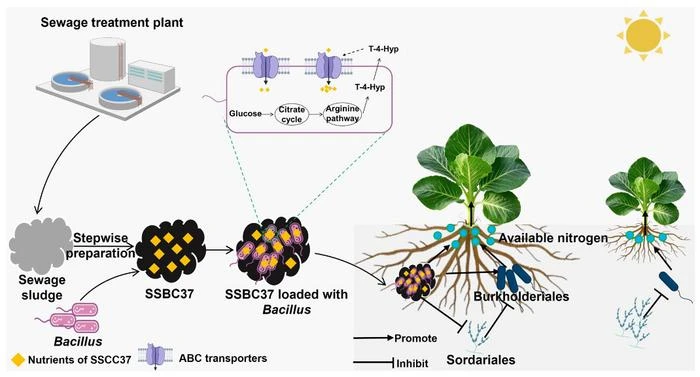
A new study has unveiled an innovative way to turn waste into a powerful tool for sustainable agriculture. Researchers have developed a specially engineered biochar made from sewage sludge that, when combined with beneficial bacteria, significantly enhances plant growth by improving how crops absorb nitrogen.
Biochar, a carbon-rich material produced by heating organic waste in low oxygen conditions, has long been recognized for its ability to improve soil health. However, its potential as a carrier for beneficial microbes has been limited by challenges in maintaining microbial survival and effectiveness in real-world soils. The new study addresses this issue by redesigning sewage sludge biochar into a more microbe-friendly material.
“Our goal was to create a biochar that not only supports beneficial microbes but actively enhances their function in the soil,” said the study’s corresponding author. “By combining engineered biochar with a plant growth-promoting bacterium, we achieved a synergistic effect that significantly boosts crop performance.”
The team developed a novel material called SSBC37 using a stepwise process. First, they extracted nutrient-rich dissolved compounds from low-temperature biochar. Then, they reprocessed the remaining material at a higher temperature to improve its structure. Finally, they reintroduced the extracted nutrients to create a balanced material that supports microbial growth while maintaining strong physical properties.
This engineered biochar was then loaded with Bacillus velezensis, a beneficial bacterium known for promoting plant growth. When applied to cabbage plants, the combined system increased aboveground dry biomass by up to nearly 40 percent compared to untreated plants. It also outperformed treatments using either the biochar or the bacteria alone.
The researchers found that the biochar provided both a habitat and a nutrient source for the bacteria. Specific compounds in the biochar stimulated bacterial metabolism, enabling the microbes to grow more efficiently and colonize plant roots. In turn, the bacteria altered the soil microbial community in ways that favored plant nutrition.
One key mechanism involved improved nitrogen cycling. The biochar-bacteria combination increased the abundance of beneficial soil microbes associated with nitrogen transformation. It also enhanced soil enzyme activity and led to higher levels of ammonium nitrogen, a form readily absorbed by plants. As a result, the cabbage plants showed greater nitrogen uptake and improved growth.
Importantly, the study also revealed how the introduced bacteria interact with native soil microbes. The beneficial bacteria suppressed certain fungal groups while promoting helpful bacterial populations, creating a more favorable rhizosphere environment for plant development.
“This work highlights the importance of designing biochar materials that work in harmony with soil microbiomes,” the authors noted. “By understanding these interactions, we can develop more effective biofertilizers that reduce reliance on chemical inputs.”
The findings offer a promising pathway for recycling sewage sludge, a growing global waste challenge, into high-value agricultural products. By transforming waste into a functional biochar that enhances microbial performance, the approach supports both environmental sustainability and food production.
As agriculture faces increasing pressure to reduce environmental impacts while maintaining productivity, innovations like this could play a key role. The study demonstrates that carefully engineered biochar, combined with beneficial microbes, can unlock new possibilities for sustainable crop management and soil health improvement.
===
Journal Reference: Liu, Z., Yu, B., Xu, Y. et al. Bacillus-functionalized sewage sludge biochar boosts cabbage growth through improved nitrogen assimilation. Biochar 8, 42 (2026).
https://doi.org/10.1007/s42773-025-00561-0
===
About Biochar
Biochar (e-ISSN: 2524-7867) is the first journal dedicated exclusively to biochar research, spanning agronomy, environmental science, and materials science. It publishes original studies on biochar production, processing, and applications—such as bioenergy, environmental remediation, soil enhancement, climate mitigation, water treatment, and sustainability analysis. The journal serves as an innovative and professional platform for global researchers to share advances in this rapidly expanding field.
Follow us on Facebook, X, and Bluesky.
END
Biochar, a carbon-rich material produced by heating organic waste in low oxygen conditions, has long been recognized for its ability to improve soil health. However, its potential as a carrier for beneficial microbes has been limited by challenges in maintaining microbial survival and effectiveness in real-world soils. The new study addresses this issue by redesigning sewage sludge biochar into a more microbe-friendly material.
“Our goal was to create a biochar that not only supports beneficial microbes but actively enhances their function in the soil,” said the study’s corresponding author. “By combining engineered biochar with a plant growth-promoting bacterium, we achieved a synergistic effect that significantly boosts crop performance.”
The team developed a novel material called SSBC37 using a stepwise process. First, they extracted nutrient-rich dissolved compounds from low-temperature biochar. Then, they reprocessed the remaining material at a higher temperature to improve its structure. Finally, they reintroduced the extracted nutrients to create a balanced material that supports microbial growth while maintaining strong physical properties.
This engineered biochar was then loaded with Bacillus velezensis, a beneficial bacterium known for promoting plant growth. When applied to cabbage plants, the combined system increased aboveground dry biomass by up to nearly 40 percent compared to untreated plants. It also outperformed treatments using either the biochar or the bacteria alone.
The researchers found that the biochar provided both a habitat and a nutrient source for the bacteria. Specific compounds in the biochar stimulated bacterial metabolism, enabling the microbes to grow more efficiently and colonize plant roots. In turn, the bacteria altered the soil microbial community in ways that favored plant nutrition.
One key mechanism involved improved nitrogen cycling. The biochar-bacteria combination increased the abundance of beneficial soil microbes associated with nitrogen transformation. It also enhanced soil enzyme activity and led to higher levels of ammonium nitrogen, a form readily absorbed by plants. As a result, the cabbage plants showed greater nitrogen uptake and improved growth.
Importantly, the study also revealed how the introduced bacteria interact with native soil microbes. The beneficial bacteria suppressed certain fungal groups while promoting helpful bacterial populations, creating a more favorable rhizosphere environment for plant development.
“This work highlights the importance of designing biochar materials that work in harmony with soil microbiomes,” the authors noted. “By understanding these interactions, we can develop more effective biofertilizers that reduce reliance on chemical inputs.”
The findings offer a promising pathway for recycling sewage sludge, a growing global waste challenge, into high-value agricultural products. By transforming waste into a functional biochar that enhances microbial performance, the approach supports both environmental sustainability and food production.
As agriculture faces increasing pressure to reduce environmental impacts while maintaining productivity, innovations like this could play a key role. The study demonstrates that carefully engineered biochar, combined with beneficial microbes, can unlock new possibilities for sustainable crop management and soil health improvement.
===
Journal Reference: Liu, Z., Yu, B., Xu, Y. et al. Bacillus-functionalized sewage sludge biochar boosts cabbage growth through improved nitrogen assimilation. Biochar 8, 42 (2026).
https://doi.org/10.1007/s42773-025-00561-0
===
About Biochar
Biochar (e-ISSN: 2524-7867) is the first journal dedicated exclusively to biochar research, spanning agronomy, environmental science, and materials science. It publishes original studies on biochar production, processing, and applications—such as bioenergy, environmental remediation, soil enhancement, climate mitigation, water treatment, and sustainability analysis. The journal serves as an innovative and professional platform for global researchers to share advances in this rapidly expanding field.
Follow us on Facebook, X, and Bluesky.
END