Aquatic plant reduces antibiotics in water and genetic damage in fish
A study conducted in the Piracicaba River in the state of São Paulo, Brazil, shows that the macrophyte Salvinia auriculata can act as a sink for these contaminants, reducing bioaccumulation and genotoxicity.
A study conducted by researchers at the Center for Nuclear Energy in Agriculture at the University of São Paulo (CENA-USP) and published in the journal Environmental Sciences Europe identified residues of different classes of antibiotics in the Piracicaba River, one of the main waterways in the interior of the state of São Paulo, Brazil. The study also assessed how these substances accumulate in fish and how an aquatic plant widely found in the region, Salvinia auriculata, can partially mitigate this accumulation.
Led by Patrícia Alexandre Evangelista and supported by FAPESP, the study combined environmental monitoring, bioaccumulation studies, genetic damage analyses in aquatic organisms, and phytoremediation experiments. This integrated approach enabled the researchers not only to map contamination but also discuss ecological risks and potential strategies for addressing a problem associated with both human and veterinary use of medications.
Samples were collected in the region of the Santa Maria da Serra dam, near the Barra Bonita reservoir, where pollutants from the entire Piracicaba River basin accumulate. This area receives contributions from treated urban sewage, domestic effluents, and activities associated with aquaculture and pig farming, as well as diffuse runoff from agriculture.
Water, sediment, and fish samples were analyzed during two periods: the rainy season and the dry season. In total, the monitoring included 12 antibiotics from widely used classes – tetracyclines, fluoroquinolones, sulfonamides, and phenols. “The results showed a clear pattern of seasonality. During the rainy season, most antibiotics had concentrations below detection limits. In the dry season, however, when water volume decreases and contaminants become concentrated, different compounds were detected,” says Evangelista.
Concentrations ranged from nanograms per liter in the water to micrograms per kilogram in the sediment. For example, fluoroquinolones such as enrofloxacin and sulfonamides were detected in the sediment at levels higher than those reported in comparable international studies. The sediment is rich in organic matter and nutrients, such as phosphorus, calcium, and magnesium. This composition allows the sediment to act as a reservoir for these compounds, with the potential for remobilization over time.
“One of the most significant findings of the study was the detection of chloramphenicol in lambari fish (Astyanax sp.) collected from local fishermen in the Barra Bonita region. Chloramphenicol is an antibiotic whose use in livestock is prohibited in Brazil precisely because of the risks associated with its toxicity,” the researcher states.
The substance was found in the fish only during the dry season, with concentrations in the range of tens of micrograms per kilogram. This is noteworthy because the fish species is widely sold and consumed locally, indicating a possible indirect route of human exposure through food.
Evangelista explains that the choice of chloramphenicol and enrofloxacin as the focus of the laboratory experiments was due to their environmental and health relevance. “Enrofloxacin is widely used in animal husbandry, including aquaculture, as well as in human medicine. Chloramphenicol, on the other hand, is still used in humans despite being banned for food-producing animals and serves as a historical marker of persistent contamination,” she explains.
In addition to mapping contamination, the study investigated whether Salvinia auriculata, a floating macrophyte often considered a water body pest, could help remove antibiotics from the environment.
In laboratory experiments, the plant was exposed to environmental and 100-times-higher concentrations of enrofloxacin and chloramphenicol using carbon-14-radiolabeled compounds. Using radiolabeled molecules allowed for precise tracking of the fate of the antibiotics in the water, plant, and fish.
“The results showed the high efficiency of Salvinia in removing enrofloxacin. In treatments with higher plant biomass, more than 95% of the antibiotic was removed from the water within a few days. The half-life of the compound dropped to about two to three days. In the case of chloramphenicol, removal was slower and partial. The plant was able to remove 30% to 45% of the antibiotic from the water, with half-lives ranging from 16 to 20 days, indicating the greater persistence of the compound in the environment,” the researcher reports.
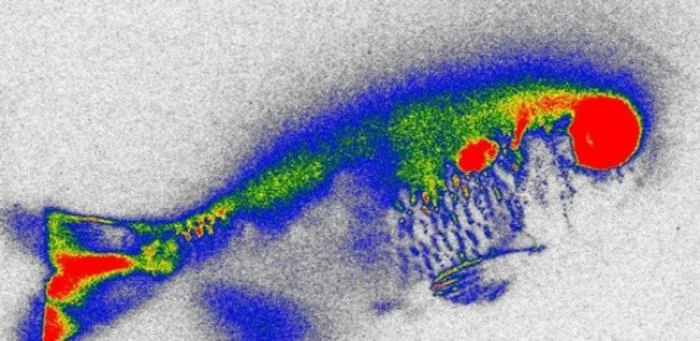
Autoradiography images revealed that in both cases, the antibiotics were concentrated primarily in the roots of the plant, suggesting that rhizofiltration and root absorption play a central role in the process.
One of the most complex aspects of the study concerns bioaccumulation in fish. Controlled experiments showed that reducing the antibiotic concentration in the water does not necessarily result in lower absorption by the organism.
For enrofloxacin, most of the compound remained dissolved in the water and was quickly eliminated by the lambari, with a half-life of about 21 days. The bioconcentration factor was low, indicating a lower tendency for accumulation in tissues. Chloramphenicol, on the other hand, exhibited different behavior. This antibiotic showed greater persistence in the organism, with a half-life exceeding 90 days and a high bioconcentration factor reflecting greater retention in fish tissues.
The presence of Salvinia auriculata altered this dynamic. While the plant significantly reduced the amount of antibiotic in the water, there was sometimes an increase in the absorption rate by the fish. One hypothesis is that the plant may partially transform the original compound, making it more bioavailable even at lower total concentrations.
“This shows that using plants as ‘sponges’ for contaminants is not a trivial matter. The presence of the macrophyte changes the entire system, including the way the organism comes into contact with the contaminant,” Evangelista notes.
Despite these complexities, significant results emerged from the genotoxic analyses. Chloramphenicol significantly increased DNA damage in the fish, as measured by the frequency of micronuclei and nuclear abnormalities in blood cells. When Salvinia auriculata was present in the system, however, this damage was reduced, approaching the levels observed in the control groups. For enrofloxacin, however, the presence of the plant did not lead to a significant reduction in genotoxic effects.
“The interpretation we propose is that, in the case of chloramphenicol, the plant may generate fewer genotoxic byproducts or release antioxidant compounds into the rhizosphere, reducing oxidative stress in the fish. On the other hand, enrofloxacin is chemically more stable and may produce persistent and potentially toxic metabolites whose action is not neutralized by the macrophyte,” the researcher comments.
Evangelista emphasizes that Salvinia auriculata should not be viewed as a simple or definitive solution to antibiotic pollution. The study highlights its potential and limitations. In addition to uncertainties regarding byproduct formation, there is the challenge of managing contaminated biomass. If not properly removed and treated, the plant can become a secondary source of pollution by reintroducing antibiotics into the environment.
Nevertheless, the results suggest that aquatic macrophytes could be incorporated into cost-effective, nature-based mitigation strategies, particularly in systems where advanced treatment technologies, such as ozonation or oxidative processes, are economically infeasible.
“The study shows that the problem is real, measurable, and complex. And any strategy to address it must consider not only the removal of the contaminant, but also its biological and ecological effects,” the researcher concludes.
“The detection of antibiotic residues in the water, sediments, and fish of the Piracicaba River shows just how harmful human activities can be. The resistance of microorganisms to antibiotics can lead to the emergence of superbugs in the environment. The research yielded positive results with low-cost environmental solutions and enabled a better understanding of the integrated functioning of aquatic ecosystems and the use of effective natural techniques for impact mitigation,” adds Valdemar Luiz Tornisielo, supervisor of Evangelista’s research and co-author of the article.
The radiolabeled molecules used in the study were provided by the International Atomic Energy Agency (IAEA).
About São Paulo Research Foundation (FAPESP)
The São Paulo Research Foundation (FAPESP) is a public institution with the mission of supporting scientific research in all fields of knowledge by awarding scholarships, fellowships and grants to investigators linked with higher education and research institutions in the State of São Paulo, Brazil. FAPESP is aware that the very best research can only be done by working with the best researchers internationally. Therefore, it has established partnerships with funding agencies, higher education, private companies, and research organizations in other countries known for the quality of their research and has been encouraging scientists funded by its grants to further develop their international collaboration. You can learn more about FAPESP at www.fapesp.br/en and visit FAPESP news agency at www.agencia.fapesp.br/en to keep updated with the latest scientific breakthroughs FAPESP helps achieve through its many programs, awards and research centers. You may also subscribe to FAPESP news agency at http://agencia.fapesp.br/subscribe.
END
Led by Patrícia Alexandre Evangelista and supported by FAPESP, the study combined environmental monitoring, bioaccumulation studies, genetic damage analyses in aquatic organisms, and phytoremediation experiments. This integrated approach enabled the researchers not only to map contamination but also discuss ecological risks and potential strategies for addressing a problem associated with both human and veterinary use of medications.
Samples were collected in the region of the Santa Maria da Serra dam, near the Barra Bonita reservoir, where pollutants from the entire Piracicaba River basin accumulate. This area receives contributions from treated urban sewage, domestic effluents, and activities associated with aquaculture and pig farming, as well as diffuse runoff from agriculture.
Water, sediment, and fish samples were analyzed during two periods: the rainy season and the dry season. In total, the monitoring included 12 antibiotics from widely used classes – tetracyclines, fluoroquinolones, sulfonamides, and phenols. “The results showed a clear pattern of seasonality. During the rainy season, most antibiotics had concentrations below detection limits. In the dry season, however, when water volume decreases and contaminants become concentrated, different compounds were detected,” says Evangelista.
Concentrations ranged from nanograms per liter in the water to micrograms per kilogram in the sediment. For example, fluoroquinolones such as enrofloxacin and sulfonamides were detected in the sediment at levels higher than those reported in comparable international studies. The sediment is rich in organic matter and nutrients, such as phosphorus, calcium, and magnesium. This composition allows the sediment to act as a reservoir for these compounds, with the potential for remobilization over time.
“One of the most significant findings of the study was the detection of chloramphenicol in lambari fish (Astyanax sp.) collected from local fishermen in the Barra Bonita region. Chloramphenicol is an antibiotic whose use in livestock is prohibited in Brazil precisely because of the risks associated with its toxicity,” the researcher states.
The substance was found in the fish only during the dry season, with concentrations in the range of tens of micrograms per kilogram. This is noteworthy because the fish species is widely sold and consumed locally, indicating a possible indirect route of human exposure through food.
Evangelista explains that the choice of chloramphenicol and enrofloxacin as the focus of the laboratory experiments was due to their environmental and health relevance. “Enrofloxacin is widely used in animal husbandry, including aquaculture, as well as in human medicine. Chloramphenicol, on the other hand, is still used in humans despite being banned for food-producing animals and serves as a historical marker of persistent contamination,” she explains.
In addition to mapping contamination, the study investigated whether Salvinia auriculata, a floating macrophyte often considered a water body pest, could help remove antibiotics from the environment.
In laboratory experiments, the plant was exposed to environmental and 100-times-higher concentrations of enrofloxacin and chloramphenicol using carbon-14-radiolabeled compounds. Using radiolabeled molecules allowed for precise tracking of the fate of the antibiotics in the water, plant, and fish.
“The results showed the high efficiency of Salvinia in removing enrofloxacin. In treatments with higher plant biomass, more than 95% of the antibiotic was removed from the water within a few days. The half-life of the compound dropped to about two to three days. In the case of chloramphenicol, removal was slower and partial. The plant was able to remove 30% to 45% of the antibiotic from the water, with half-lives ranging from 16 to 20 days, indicating the greater persistence of the compound in the environment,” the researcher reports.
Autoradiography images revealed that in both cases, the antibiotics were concentrated primarily in the roots of the plant, suggesting that rhizofiltration and root absorption play a central role in the process.
One of the most complex aspects of the study concerns bioaccumulation in fish. Controlled experiments showed that reducing the antibiotic concentration in the water does not necessarily result in lower absorption by the organism.
For enrofloxacin, most of the compound remained dissolved in the water and was quickly eliminated by the lambari, with a half-life of about 21 days. The bioconcentration factor was low, indicating a lower tendency for accumulation in tissues. Chloramphenicol, on the other hand, exhibited different behavior. This antibiotic showed greater persistence in the organism, with a half-life exceeding 90 days and a high bioconcentration factor reflecting greater retention in fish tissues.
The presence of Salvinia auriculata altered this dynamic. While the plant significantly reduced the amount of antibiotic in the water, there was sometimes an increase in the absorption rate by the fish. One hypothesis is that the plant may partially transform the original compound, making it more bioavailable even at lower total concentrations.
“This shows that using plants as ‘sponges’ for contaminants is not a trivial matter. The presence of the macrophyte changes the entire system, including the way the organism comes into contact with the contaminant,” Evangelista notes.
Despite these complexities, significant results emerged from the genotoxic analyses. Chloramphenicol significantly increased DNA damage in the fish, as measured by the frequency of micronuclei and nuclear abnormalities in blood cells. When Salvinia auriculata was present in the system, however, this damage was reduced, approaching the levels observed in the control groups. For enrofloxacin, however, the presence of the plant did not lead to a significant reduction in genotoxic effects.
“The interpretation we propose is that, in the case of chloramphenicol, the plant may generate fewer genotoxic byproducts or release antioxidant compounds into the rhizosphere, reducing oxidative stress in the fish. On the other hand, enrofloxacin is chemically more stable and may produce persistent and potentially toxic metabolites whose action is not neutralized by the macrophyte,” the researcher comments.
Evangelista emphasizes that Salvinia auriculata should not be viewed as a simple or definitive solution to antibiotic pollution. The study highlights its potential and limitations. In addition to uncertainties regarding byproduct formation, there is the challenge of managing contaminated biomass. If not properly removed and treated, the plant can become a secondary source of pollution by reintroducing antibiotics into the environment.
Nevertheless, the results suggest that aquatic macrophytes could be incorporated into cost-effective, nature-based mitigation strategies, particularly in systems where advanced treatment technologies, such as ozonation or oxidative processes, are economically infeasible.
“The study shows that the problem is real, measurable, and complex. And any strategy to address it must consider not only the removal of the contaminant, but also its biological and ecological effects,” the researcher concludes.
“The detection of antibiotic residues in the water, sediments, and fish of the Piracicaba River shows just how harmful human activities can be. The resistance of microorganisms to antibiotics can lead to the emergence of superbugs in the environment. The research yielded positive results with low-cost environmental solutions and enabled a better understanding of the integrated functioning of aquatic ecosystems and the use of effective natural techniques for impact mitigation,” adds Valdemar Luiz Tornisielo, supervisor of Evangelista’s research and co-author of the article.
The radiolabeled molecules used in the study were provided by the International Atomic Energy Agency (IAEA).
About São Paulo Research Foundation (FAPESP)
The São Paulo Research Foundation (FAPESP) is a public institution with the mission of supporting scientific research in all fields of knowledge by awarding scholarships, fellowships and grants to investigators linked with higher education and research institutions in the State of São Paulo, Brazil. FAPESP is aware that the very best research can only be done by working with the best researchers internationally. Therefore, it has established partnerships with funding agencies, higher education, private companies, and research organizations in other countries known for the quality of their research and has been encouraging scientists funded by its grants to further develop their international collaboration. You can learn more about FAPESP at www.fapesp.br/en and visit FAPESP news agency at www.agencia.fapesp.br/en to keep updated with the latest scientific breakthroughs FAPESP helps achieve through its many programs, awards and research centers. You may also subscribe to FAPESP news agency at http://agencia.fapesp.br/subscribe.
END