Replicating bacteria DNA relies on accordionlike folds to separate
Repulsive forces strengthened by SMC proteins key to process, Rice researchers find
When bacteria cells replicate, they do so a little differently than human cells do. They don’t undergo mitosis, a splitting that involves construction of spindles to carefully separate the DNA after replication. Instead, they use a process called binary fission, which is faster and allows them to separate their circular chromosomes as they are replicated. But the end result is the same: One cell turns into two cells, each with its own copy of the DNA chromosomes.
Rice University’s José Onuchic was interested in understanding what bacterial cells used to separate their DNA during replication, since they do not rely on external structures like human cells do.
“What we see with binary fission is that as the daughter DNA strand is being created, it starts to separate from the mother strand,” said Onuchic, the Harry C. and Olga K. Wiess Chair of Physics and corresponding author on the study. “This simultaneous process relies on interactions between the two copies of DNA, which is quite intriguing from a biophysics standpoint.”
His research team looked at Hi-C maps, which show how chromosomes are structured in 3D space. The researchers combined that data with a physical modeling approach that allowed them to delve into the replicating chromosomes.
“We knew that a highly conserved protein family called structural maintenance of chromosomes, or SMC, was involved,” said Sumitabha Brahmachari, first author on this paper and a research scientist in Onuchic’s lab. “What we wanted to understand was how it drives this separation of DNA copies.”
To do so, the researchers compared their chromosome models of bacteria with fully functional SMC proteins to bacteria that had a defective version of SMC. They created models of the bacteria’s chromosomes at each stage of replication, allowing them to compare how the chromosome structure changed over time with and without SMC.
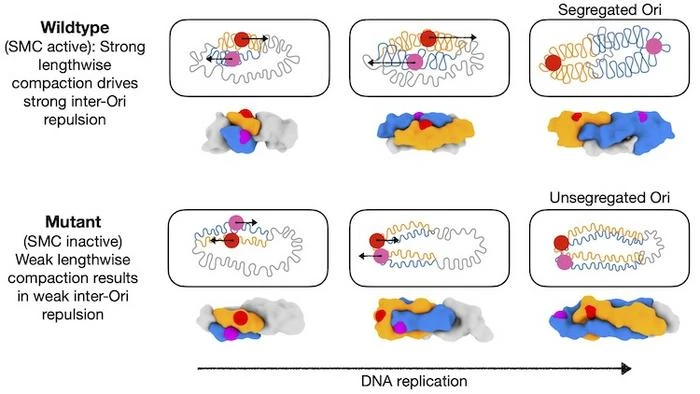
“We found that SMC helps the DNA separate by enabling lengthwise compaction, creating a repulsive force between the two copies,” Brahmachari said. “This generates a robust pathway to faithful DNA segregation.”
Each bacteria chromosome starts replicating at a place called an origin of replication, or ori. Imagine a circle with a dot on the top — the dot is the ori. In bacteria, DNA replication starts at the ori and goes down both sides of the circle at the same time.
If SMC is present during DNA replication, the replicating copy of DNA gets folded like an accordion. This is the lengthwise compaction Brahmachari observed, and it causes the two copies of DNA to repulse each other. The more replicated, compacted DNA there is, the more the two copies of DNA repulse each other, and the more their oris pull away from each other.
Once the replication is about halfway done, the model shows there’s so much repulsion that the replicating copy of DNA starts peeling off the original copy. By the time replication is finished, the two oris are on opposite sides of the cell. The cell can then split down the middle, neatly dividing into two cells, each with their own copy of the chromosome.
Without SMC, the repulsive forces between the two circles of DNA are still present, but they’re not nearly as strong. Instead of experiencing lengthwise compaction and peeling away from each other, the DNA copies collapse into flexible stringy states with their oris near each other. This prevents the DNA chromosomes from cleanly separating when the cell splits into two. Instead, the DNA could be damaged during the split, or one cell could end up with two copies of a chromosome while the other has none.
How does SMC enable this folding? That’s a question for further investigation — one of many, the researchers say. While this study provided a clear model of separation of the DNA, there’s still many questions left to answer, like understanding the stringy states described in the absence of SMC.
“Bacteria are very colony-orientated,” Onuchic said. “They’re trying to replicate as fast as they can to help grow the colony, relying on a complex set of forces to accomplish this at speed. Through SMC, we can now understand the framework of these forces. Now we can use this framework to ask more questions about this unique process.”
This work was supported by the National Science Foundation (PHY-2019745, PHY2210291, and PHY-2014141) and the Welch Foundation (C-1792).
END
Rice University’s José Onuchic was interested in understanding what bacterial cells used to separate their DNA during replication, since they do not rely on external structures like human cells do.
“What we see with binary fission is that as the daughter DNA strand is being created, it starts to separate from the mother strand,” said Onuchic, the Harry C. and Olga K. Wiess Chair of Physics and corresponding author on the study. “This simultaneous process relies on interactions between the two copies of DNA, which is quite intriguing from a biophysics standpoint.”
His research team looked at Hi-C maps, which show how chromosomes are structured in 3D space. The researchers combined that data with a physical modeling approach that allowed them to delve into the replicating chromosomes.
“We knew that a highly conserved protein family called structural maintenance of chromosomes, or SMC, was involved,” said Sumitabha Brahmachari, first author on this paper and a research scientist in Onuchic’s lab. “What we wanted to understand was how it drives this separation of DNA copies.”
To do so, the researchers compared their chromosome models of bacteria with fully functional SMC proteins to bacteria that had a defective version of SMC. They created models of the bacteria’s chromosomes at each stage of replication, allowing them to compare how the chromosome structure changed over time with and without SMC.
“We found that SMC helps the DNA separate by enabling lengthwise compaction, creating a repulsive force between the two copies,” Brahmachari said. “This generates a robust pathway to faithful DNA segregation.”
Each bacteria chromosome starts replicating at a place called an origin of replication, or ori. Imagine a circle with a dot on the top — the dot is the ori. In bacteria, DNA replication starts at the ori and goes down both sides of the circle at the same time.
If SMC is present during DNA replication, the replicating copy of DNA gets folded like an accordion. This is the lengthwise compaction Brahmachari observed, and it causes the two copies of DNA to repulse each other. The more replicated, compacted DNA there is, the more the two copies of DNA repulse each other, and the more their oris pull away from each other.
Once the replication is about halfway done, the model shows there’s so much repulsion that the replicating copy of DNA starts peeling off the original copy. By the time replication is finished, the two oris are on opposite sides of the cell. The cell can then split down the middle, neatly dividing into two cells, each with their own copy of the chromosome.
Without SMC, the repulsive forces between the two circles of DNA are still present, but they’re not nearly as strong. Instead of experiencing lengthwise compaction and peeling away from each other, the DNA copies collapse into flexible stringy states with their oris near each other. This prevents the DNA chromosomes from cleanly separating when the cell splits into two. Instead, the DNA could be damaged during the split, or one cell could end up with two copies of a chromosome while the other has none.
How does SMC enable this folding? That’s a question for further investigation — one of many, the researchers say. While this study provided a clear model of separation of the DNA, there’s still many questions left to answer, like understanding the stringy states described in the absence of SMC.
“Bacteria are very colony-orientated,” Onuchic said. “They’re trying to replicate as fast as they can to help grow the colony, relying on a complex set of forces to accomplish this at speed. Through SMC, we can now understand the framework of these forces. Now we can use this framework to ask more questions about this unique process.”
This work was supported by the National Science Foundation (PHY-2019745, PHY2210291, and PHY-2014141) and the Welch Foundation (C-1792).
END