How ants distinguish friend from foe
Researchers find that ants continually update their sense of nestmate identity and tolerance for outsiders, a discovery that opens the door to studying the neural circuits behind social recognition.
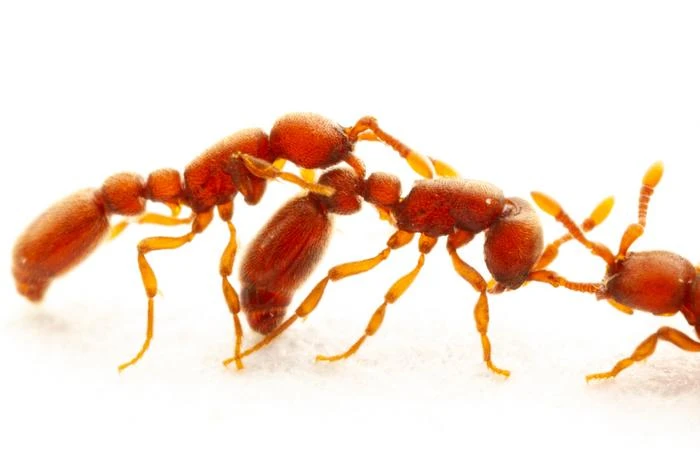
For ants, the ability to instantly distinguish nestmates from outsiders who might hijack the colony is crucial. Now, a new study shows that the system that ants use to determine who belongs in the colony is far more flexible than once thought.
The findings, published in Current Biology, demonstrate how clonal raider ants update their sense of nestmate identity throughout adulthood through repeated exposure, while still retaining an intrinsic recognition of their kin. The work, which reveals the mechanisms by which insiders learn to tolerate outsiders and outsiders learn to identify with insiders, also provides a behavioral foundation for future studies that will probe how the ant brain processes social odors.
"We've known for a long time that ants are very good at distinguishing between an ant from a different colony and one of their own, but less was known about how flexible this behavior is," says Daniel Kronauer, head of the Laboratory of Social Evolution and Behavior at Rockefeller. "This work is a first step toward figuring out, on a behavioral level, how ants make that distinction, and it will help inform future experiments into the neurobiological underpinnings of ant society."
Life as a superorganism
Ant colonies represent a major evolutionary shift, from solitary insects to highly cooperative societies in which thousands of individuals work together as superorganisms. Such precisely orchestrated collaboration has analogies elsewhere in biology: Whether it is cells in a multicellular organism, immune cells in the human body, or ants in a colony, the success of such systems depends on the ability to distinguish self from outsider. Immune cells must attack invading pathogens without harming the body itself; ants must recognize their nestmates while detecting and repelling social parasites that would infiltrate the nest.
Ants accomplish this with waxy chemical compounds coating their bodies. Diverse colonies use the same basic compounds but differ in the precise ratios, producing subtle odor signatures specific to each colony that ants learn to recognize early in life.
Scents, however, can change. "Perhaps the genetic composition of the colony changes; perhaps environmental influences change the colony odor; perhaps the ant colony encounters different neighbors and now needs to discriminate against ants from certain colonies more than others," Kronauer says. "Ants must have some way of updating this system."
Tiphaine Bailly, a postdoctoral associate in the Kronauer lab, suspected the system involved more learning than researchers had assumed. “We knew that ant societies depend on cooperation, and that recognizing who belongs to the colony and who does not is essential,” Bailly says. “Understanding how ants make this distinction would therefore help us uncover the mechanisms that maintain cooperation in complex societies.”
An ant's sense of self
Bailly and colleagues set out to determine how flexible nestmate recognition truly is, and under what conditions ants can learn to tolerate genetically distinct outsiders. For that they turned to the clonal raider ant (Ooceraea biroi). This unusual species reproduces asexually, allowing researchers to generate genetically identical ants from different lineages. By combining these lineages, the team could build mixed colonies and study how ants learn and update social cues.
The team worked with several genetically distinct clonal lines. Chemical analyses showed that colonies share the same set of chemical compounds but that each colony has a distinct scent by combing them in different ratios. The researchers then introduced single ants from other genotypes into standardized colonies and recorded aggressive behaviors such as biting. These baseline tests confirmed that ants consistently attacked foreign genotypes.
The researchers then asked whether the recognition rules can be changed. By placing young ants, whose chemical profiles were still faint, into foreign colonies, they found that prolonged exposure could reshape odor profile and behavior. After one month, these ants chemically resembled their foster colonies and showed no aggression toward them when tested separately—similar to ants born into the colony. But the shift had limits. Even ants separated from their kin since the egg stage still accepted ants with their own genotype, suggesting that experience may broaden recognition, but cannot replace an ant's sense of self.
Learned tolerance was also fragile. If contact between the newcomer and the foster colony was cut off, aggression returned within about a week. Over time, the ants' chemical profile also drifted back toward its original form, eventually causing their foster nestmates to attack them. At the same time, even brief, occasional encounters were enough to maintain tolerance, suggesting that the effect may involve longer-lasting olfactory memory rather than short-lived sensory desensitization, which typically fades within minutes or hours, since the ants maintained tolerance even after five days of complete separation.
The phenomenon echoed what is seen in the immune system, where repeated, low-level exposure to a foreign signal can gradually dampen defensive responses. For example, when patients are given small, controlled doses of a substance such as pollen, their immune system slowly learns to tolerate it instead of creating an allergic reaction. Ants appear to behave in a conceptually similar way: individuals consistently exposed to foreign colony odors gradually stopped treating them as threats, while occasional encounters were enough to keep that tolerance in place.
"It's a conceptual comparison, of course. At the molecular level, these things work quite differently," Kronauer explains. "But the evolution of an ant colony is similar to the transition from a single-celled to a multicellular organism, and it is interesting to think about the parallels between major transitions in evolution. These parallels may run deeper than we thought."
Together, the findings show that ants’ ability to distinguish nestmates from outsiders is flexible, though not unlimited. Ants can update their internal template of who belongs to the colony throughout adulthood while still retaining an intrinsic recognition of their own genotype. The result provides a critical behavioral foundation for future experiments that could reveal where in the brain this social learning occurs.
"Now we can combine the neurobiological tools with this behavioral system and image neural activity while an ant encounters a nestmate or a non-nestmate," Kronauer says. "With this foundation, we can finally begin to ask where learning and adaptation happens in the brain.”
END
The findings, published in Current Biology, demonstrate how clonal raider ants update their sense of nestmate identity throughout adulthood through repeated exposure, while still retaining an intrinsic recognition of their kin. The work, which reveals the mechanisms by which insiders learn to tolerate outsiders and outsiders learn to identify with insiders, also provides a behavioral foundation for future studies that will probe how the ant brain processes social odors.
"We've known for a long time that ants are very good at distinguishing between an ant from a different colony and one of their own, but less was known about how flexible this behavior is," says Daniel Kronauer, head of the Laboratory of Social Evolution and Behavior at Rockefeller. "This work is a first step toward figuring out, on a behavioral level, how ants make that distinction, and it will help inform future experiments into the neurobiological underpinnings of ant society."
Life as a superorganism
Ant colonies represent a major evolutionary shift, from solitary insects to highly cooperative societies in which thousands of individuals work together as superorganisms. Such precisely orchestrated collaboration has analogies elsewhere in biology: Whether it is cells in a multicellular organism, immune cells in the human body, or ants in a colony, the success of such systems depends on the ability to distinguish self from outsider. Immune cells must attack invading pathogens without harming the body itself; ants must recognize their nestmates while detecting and repelling social parasites that would infiltrate the nest.
Ants accomplish this with waxy chemical compounds coating their bodies. Diverse colonies use the same basic compounds but differ in the precise ratios, producing subtle odor signatures specific to each colony that ants learn to recognize early in life.
Scents, however, can change. "Perhaps the genetic composition of the colony changes; perhaps environmental influences change the colony odor; perhaps the ant colony encounters different neighbors and now needs to discriminate against ants from certain colonies more than others," Kronauer says. "Ants must have some way of updating this system."
Tiphaine Bailly, a postdoctoral associate in the Kronauer lab, suspected the system involved more learning than researchers had assumed. “We knew that ant societies depend on cooperation, and that recognizing who belongs to the colony and who does not is essential,” Bailly says. “Understanding how ants make this distinction would therefore help us uncover the mechanisms that maintain cooperation in complex societies.”
An ant's sense of self
Bailly and colleagues set out to determine how flexible nestmate recognition truly is, and under what conditions ants can learn to tolerate genetically distinct outsiders. For that they turned to the clonal raider ant (Ooceraea biroi). This unusual species reproduces asexually, allowing researchers to generate genetically identical ants from different lineages. By combining these lineages, the team could build mixed colonies and study how ants learn and update social cues.
The team worked with several genetically distinct clonal lines. Chemical analyses showed that colonies share the same set of chemical compounds but that each colony has a distinct scent by combing them in different ratios. The researchers then introduced single ants from other genotypes into standardized colonies and recorded aggressive behaviors such as biting. These baseline tests confirmed that ants consistently attacked foreign genotypes.
The researchers then asked whether the recognition rules can be changed. By placing young ants, whose chemical profiles were still faint, into foreign colonies, they found that prolonged exposure could reshape odor profile and behavior. After one month, these ants chemically resembled their foster colonies and showed no aggression toward them when tested separately—similar to ants born into the colony. But the shift had limits. Even ants separated from their kin since the egg stage still accepted ants with their own genotype, suggesting that experience may broaden recognition, but cannot replace an ant's sense of self.
Learned tolerance was also fragile. If contact between the newcomer and the foster colony was cut off, aggression returned within about a week. Over time, the ants' chemical profile also drifted back toward its original form, eventually causing their foster nestmates to attack them. At the same time, even brief, occasional encounters were enough to maintain tolerance, suggesting that the effect may involve longer-lasting olfactory memory rather than short-lived sensory desensitization, which typically fades within minutes or hours, since the ants maintained tolerance even after five days of complete separation.
The phenomenon echoed what is seen in the immune system, where repeated, low-level exposure to a foreign signal can gradually dampen defensive responses. For example, when patients are given small, controlled doses of a substance such as pollen, their immune system slowly learns to tolerate it instead of creating an allergic reaction. Ants appear to behave in a conceptually similar way: individuals consistently exposed to foreign colony odors gradually stopped treating them as threats, while occasional encounters were enough to keep that tolerance in place.
"It's a conceptual comparison, of course. At the molecular level, these things work quite differently," Kronauer explains. "But the evolution of an ant colony is similar to the transition from a single-celled to a multicellular organism, and it is interesting to think about the parallels between major transitions in evolution. These parallels may run deeper than we thought."
Together, the findings show that ants’ ability to distinguish nestmates from outsiders is flexible, though not unlimited. Ants can update their internal template of who belongs to the colony throughout adulthood while still retaining an intrinsic recognition of their own genotype. The result provides a critical behavioral foundation for future experiments that could reveal where in the brain this social learning occurs.
"Now we can combine the neurobiological tools with this behavioral system and image neural activity while an ant encounters a nestmate or a non-nestmate," Kronauer says. "With this foundation, we can finally begin to ask where learning and adaptation happens in the brain.”
END