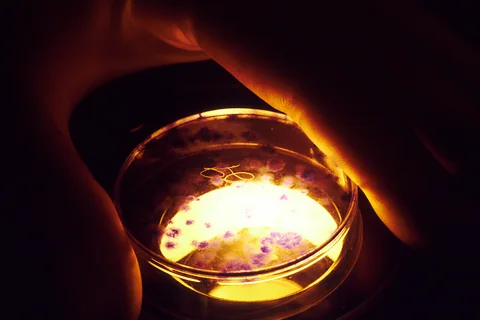
Some biological questions concern the meeting point between tissues, rather than one tissue in isolation. A new organoid system tackles that design problem. The useful promise is a more specific experimental comparison, not a miniature replacement for an entire person.
- A laboratory model can preserve a useful relationship without reproducing a whole organ.
- Developmental timing and cell identity belong in the same reading checklist.
- Screening signals need independent validation before they inform human risk.
- Publication
- Developmental Cell · online 18 September 2026
- Version
- In-press corrected proof
- Model
- Human peripheral–central neural organoids
- Access
- Publisher-indexed summary and selected introduction
Original publication: 18 Sep 2026 · The date above refers to this brief.
What the new system brings together
The researchers describe hPCOs, organoids in which peripheral sensory-ganglion-like and dorsal-spinal-cord-like domains develop together. The report examines developmental signaling, a genetic model of congenital insensitivity to pain and image-based assessment of developmental disruption.
These are laboratory modeling applications. The presence of human-derived cells does not establish whole-person physiology, and a screening signal is not a quantified risk for an individual pregnancy. We checked the publisher-indexed summary and selected introduction, not the complete experimental protocols.
Source 1 ↗What a dual model can ask that two isolated models cannot
If a question concerns a boundary or coordinated development, placing relevant domains in one system can make that relationship accessible. But the design still has to establish what the domains represent and how consistently they appear. The word connected should invite a measurement question.
Ask which connections are structural, which are functional and which are inferred from location. Being next to another domain does not establish every relationship expected in a living nervous system. The table offers a way to read that distinction without dismissing the value of a deliberately limited model.
Identity and timing are separate checks
A model might display a marker associated with a cell type while remaining unlike the mature cell in its behavior. Similarly, two domains might both be present but develop on a different timetable from the tissue relationship of interest. Useful validation should describe both identity and stage.
For a future organoid report, we would look for repeatable domain formation across preparations, the range of variation and a reference suited to the specific claim. A selected beautiful image does not show how often the intended structure forms or what the unsuccessful preparations look like.
A screening model needs positive and negative comparisons
A screen is useful when it discriminates among defined examples under a fixed rule. A noticeable image change alone leaves open whether the signal reflects the biological feature of interest, general injury or a preparation problem. Independent comparisons help make the distinction.
Our proposed evaluation would specify the image features in advance, test blinded new examples and include conditions expected not to produce the target effect. It would also describe concentration and exposure timing. These are suggested standards for interpreting a future screen; we are not reporting that all were assessed in this source.
The hope: fewer uninformative experiments
A good model can reveal a question worth pursuing or rule out a simple explanation before a more demanding study. Its benefit may be sharper experiments rather than immediate clinical use. That is a realistic, substantial contribution when its scope is clear.
This connects to the DNA-compartment story: both build selected context into a controllable system. Our laboratory-models guide compares what each keeps and what it leaves out. The next useful organoid result would make those boundaries measurable, including reproducibility across donors or laboratories when relevant.
Four checks before calling an organoid informative
| What you see | What it can tell you | What to ask next |
|---|---|---|
| Cell identity | Features of the intended domain | Which markers and functions support the identity? |
| Spatial relationship | Where domains form relative to one another | Is a functional connection demonstrated? |
| Developmental timing | When the relevant feature appears | Does the stage match the question? |
| Screening readout | A defined response to a test condition | How does it perform on blinded new examples? |
Our original reading framework. Questions and proposed checks are not reported experimental results.
Your questions, answered
Is an organoid a complete small organ?
It models selected tissue features. Its usefulness depends on which features are present, missing and relevant to the question.
Can this establish whether a medicine is safe in pregnancy?
An organoid signal alone cannot establish an individual or population risk. This article makes no drug-safety recommendation.
Why test more than one preparation?
A method needs to distinguish a repeatable feature from variation in how a particular sample developed.
What does the corrected-proof label mean here?
It is the publisher’s in-press version designation. Readers should track the DOI and version rather than assuming issue publication is the first online date.
Limits of this interpretation
- Only specified publisher-indexed material was checked; full protocols and screening performance were not assessed.
- A human-derived model is not a complete nervous system or whole-person exposure model.
- Developmental disruption in a model is not a quantified human risk estimate.
Sources & transparency
- Developmental Cell (2026): Self-organizing human dual neural organoids model regional disease defects and teratogenicity
Publisher-indexed summary, highlights and selected introduction checked. Available online 18 September 2026 as an in-press corrected proof. Direct full retrieval failed; detailed protocols, supplementary experiments and screening performance not independently assessed. No drug-safety recommendation is made. · Accessed 30 Sep 2026
DOI: 10.1016/j.devcel.2026.08.013
Prepared and source-checked with AI; source access recorded on 2026-09-30 (UTC). Press-news Team is our collective publication byline, not a medical reviewer. No human editorial or clinical review has taken place. We did not conduct these experiments or reanalyse their raw data. Reported findings, our explanations and proposed follow-up tests are distinguished. Access limits appear with each source. This is an educational account of basic research and research methods, not an individual diagnosis or treatment recommendation. Photographs are illustrative.
Source check: AI source check — primary publications, selected results and access limits
Clinical review: Not applicable to this educational guide
Suggest a correction