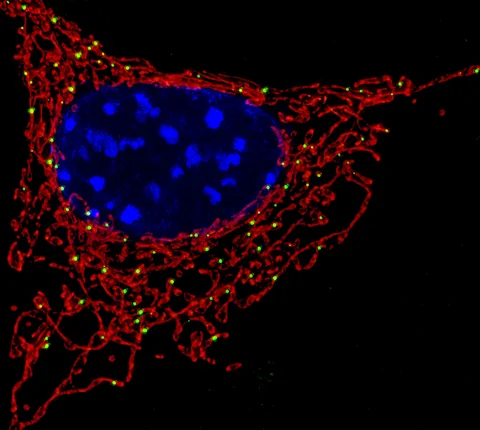
Moving in a direction requires more than movement. A cell must organize different activities in different places. A new accepted study investigates a feedback process that could help a relatively uniform membrane establish an active zone and a complementary quiet zone.
- A feedback explanation should make a prediction about a targeted change.
- A simulation becomes informative when its predictions face experiments.
- Similar-looking patterns across models need their boundaries documented.
- Publication
- Nature Communications · 30 September 2026
- Version
- Peer-reviewed accepted article; further edits possible
- Focus
- Cell polarity and membrane signaling
- Approach
- Mapping, perturbation and computational models
Original publication: 30 Sep 2026 · The date above refers to this brief.
The proposed organizing loop
Deng and colleagues studied amoebae, leukocytes, cancer cells and organoids. Their account links activated Ras and PIP5K through mutual inhibition and reinforcing feedback, generating complementary membrane zones. The reported evidence combines localization, optogenetic perturbation, molecular tracking and simulations.
We checked the publisher-indexed abstract and early-access notice. Detailed experiments and model code were not independently audited. The biological finding concerns cell organization; it does not establish a way to treat cancer or another condition.
Source 1 ↗How two negative influences can reinforce a state
Here is a deliberately simplified explanation of the logic, not a biochemical reconstruction. If A suppresses B and B suppresses A, a local increase in A can reduce the restraint B places on A. Under suitable conditions that can reinforce the local state. The actual outcome depends on the rest of the system.
A feedback diagram is therefore a hypothesis with conditions. To assess it, ask what is changed, where the change occurs and which response follows. A diagram without those tests can make a plausible story feel more complete than the evidence warrants.
From watching a pattern to changing it
A movie can show where activity appears, how it moves and whether regions differ. A perturbation can ask whether changing a proposed component changes that pattern as predicted. The two observations support different parts of the explanation.
Our suggested checklist starts with a predicted response, an appropriate control and a measurement that can register failure. Timing matters: changing a component before a pattern forms asks a different question from changing it after the pattern is established. Reporting both can expose which part of the proposed loop is actually being tested.
A convincing model must risk being wrong
A simulation can illustrate that a proposed mechanism is sufficient to generate an interesting pattern. That is valuable, but several mechanisms may generate similar pictures. A stronger comparison asks which observation could distinguish the proposed explanation from its alternatives.
Look for a prediction made before its test, a transparent parameter choice and a description of where the simulation fails. These are our criteria for reading computational support, not a claim that we reran this paper’s model. Readers can use the table to separate visual resemblance from a discriminating test.
Why this connects to organoids and brain dynamics
The organoid story asks how different regions organize within a model. The anesthesia story asks how local activity and coordination change across a larger system. The shared reading habit is to track spatial organization, time and the intervention that tests a proposed explanation.
That is a methodological connection, not a shared molecular cause. For future cell-polarity work, useful news would show how the same prediction holds—or breaks—across independently prepared systems and more realistic surroundings. A boundary described clearly can teach as much as another successful image.
Four kinds of support for a dynamic mechanism
| What you see | What it can tell you | What to ask next |
|---|---|---|
| Localization movie | Where and when a signal changes | Does it precede or follow the relevant event? |
| Targeted perturbation | Response to a controlled change | Was the expected response specified? |
| Molecular tracking | Behavior of a selected component | What is the observation and sampling limit? |
| Simulation | A mechanism capable of generating a pattern | Which prediction distinguishes alternatives? |
Our original reading framework. Questions and proposed checks are not reported experimental results.
Your questions, answered
Does polarity just mean a cell has a shape?
Shape and polarity are related but distinct descriptions. Polarity concerns different organization or activity in different parts of the cell.
Is this a cancer-treatment discovery?
This account concerns a basic cell-organizing mechanism. It does not evaluate a patient treatment.
Why mention the accepted-article version?
A permanent DOI can identify citable research while presentation and wording are still subject to edits before the final version.
What should I look for in a simulation claim?
An independently testable prediction, visible assumptions and a meaningful alternative explanation. A similar-looking output alone is a weaker test.
Limits of this interpretation
- Publisher early-access version remains subject to further edits.
- Detailed methods, model code and supplementary movies were not independently assessed.
- Mechanistic cell research does not establish patient benefits or an intervention’s safety.
Sources & transparency
- Deng, Banerjee, Matsuoka et al. (2026): PIP5K-Ras bistability triggers plasma membrane symmetry breaking to define cellular polarity and regulate migration
Publisher-indexed abstract, bibliographic details and early-access notice checked. Peer-reviewed accepted article, subject to further edits before the final version of record. Detailed methods, simulation code and supplementary movies not independently assessed. · Accessed 30 Sep 2026
DOI: 10.1038/s41467-026-77894-2
Prepared and source-checked with AI; source access recorded on 2026-09-30 (UTC). Press-news Team is our collective publication byline, not a medical reviewer. No human editorial or clinical review has taken place. We did not conduct these experiments or reanalyse their raw data. Reported findings, our explanations and proposed follow-up tests are distinguished. Access limits appear with each source. This is an educational account of basic research and research methods, not an individual diagnosis or treatment recommendation. Photographs are illustrative.
Source check: AI source check — primary publications, selected results and access limits
Clinical review: Not applicable to this educational guide
Suggest a correction