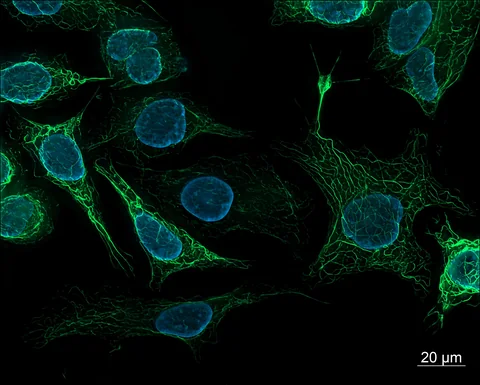
An experiment can be beautifully controlled and still miss an important part of the surroundings. A nucleus-inspired material offers a middle ground: enough complexity to ask a contextual question, while retaining knobs that researchers can deliberately turn.
- A model’s useful feature is the variable it lets researchers control.
- A protein’s behavior in one environment need not transfer unchanged to another.
- Droplets, images and independent experimental batches are different counting units.
- Publication
- Nature Communications · 30 September 2026
- System
- DNA-based nucleus-inspired compartments
- Protein
- FUS
- Question
- How context changes condensation
Original publication: 30 Sep 2026 · The date above refers to this brief.
What the paper reports
Fritzen and colleagues used programmable DNA compartments to examine FUS, a protein associated with neurodegeneration. Its distribution and condensation depended on nucleic-acid context, confinement and material properties. The authors report that ordinary dilute-solution affinity tests did not predict all behavior in the compartment system.
This is a physical model of selected nuclear features, not a replacement nucleus or a treatment experiment. The paper also notes that multiple compartments within one preparation are distinct observations but not independent experimental batches.
Source 1 ↗Why simpler is useful—and what it costs
A simple test makes a variable easier to change and interpret. That can clarify a mechanism which would be difficult to isolate inside a complete cell. Its cost is that the removed surroundings may matter. A good reading starts with both sides of that trade-off.
Ask which feature the model preserves and which one the claim requires. If the proposed explanation depends on confinement, a free solution may be an incomplete test. If it depends on a living regulatory response, a synthetic compartment may also be incomplete. More realistic is not automatically better for every question.
Crowding is a research variable, not just a backdrop
Our everyday analogy is a conversation in an empty hall versus a crowded workshop. The same objects and people can interact differently when movement, distance and access change. The analogy conveys context; it is not a quantitative explanation of a protein condensate.
For a paper about material behavior, useful comparisons change one environmental feature at a time and describe what else was held constant. A striking change is easier to interpret when concentration, observation time and preparation are visible. Otherwise several explanations may fit the same photograph.
Do not turn every droplet into an independent replicate
Counting many objects can characterize variability within a sample. It does not necessarily establish variability between separately prepared samples. When hundreds of images come from one preparation, the image count and the independent preparation count answer different questions.
The worked example in our laboratory-models guide makes this distinction explicit. A study can still gain useful detail from nested measurements; its analysis and claims should respect the nesting. Readers should look for a description of batches, compartments and repeated measurements before treating a large count as a large independent experiment.
The hope: test context before proposing a solution
We would look for a prediction that survives a separate preparation and then a suitable living-cell comparison. A contextual model earns its place when it helps explain an observation or choose a more informative experiment, not simply when it looks biological.
The study connects to organoid development through that principle. Both offer ways to build selected features of a more complicated system. Neither guarantees that all the missing features are irrelevant. The useful future result is a clear account of which behavior transfers, which does not, and why.
Choose the model for the question
| What you see | What it can tell you | What to ask next |
|---|---|---|
| Dilute solution | A controlled interaction in a simple environment | Which surrounding constraints are missing? |
| Synthetic compartment | A controllable physical context | Does the retained feature match the claim? |
| Living-cell comparison | Behavior within cellular regulation | Can the proposed variable be isolated? |
| Independent preparation | Reproducibility beyond one sample | How many batches and nested observations? |
Our original reading framework. Questions and proposed checks are not reported experimental results.
Your questions, answered
Are these artificial human nuclei?
They are nucleus-inspired DNA compartments for a physical research question, not complete human nuclei.
Does changing FUS condensation demonstrate a treatment?
No. Altering a laboratory material property does not establish benefits or harms in people.
Why can a test-tube result still be valuable?
It can isolate a variable and make a mechanism easier to test. Its scope depends on which features of the larger system it represents.
What count should I look for first?
Look for the independent preparation count and then the number of observations nested within each preparation. Both can be useful, but they are not interchangeable.
Limits of this interpretation
- Selected physical features do not reproduce every aspect of a living nucleus.
- Direct full HTML retrieval failed; selected publisher-indexed material was checked.
- No raw fluorescence-recovery traces or supplementary experiments were reanalysed.
Sources & transparency
- Fritzen, Samanta, Kuhr et al. (2026): Programmable DNA protonuclei reveal environmental context on protein phase separation
Publisher-indexed abstract, selected introduction/discussion and Statistics & Reproducibility text checked. Direct full HTML retrieval failed. Raw FRAP traces, supplementary files and individual compartment measurements not independently assessed. · Accessed 30 Sep 2026
DOI: 10.1038/s41467-026-78144-1
Prepared and source-checked with AI; source access recorded on 2026-09-30 (UTC). Press-news Team is our collective publication byline, not a medical reviewer. No human editorial or clinical review has taken place. We did not conduct these experiments or reanalyse their raw data. Reported findings, our explanations and proposed follow-up tests are distinguished. Access limits appear with each source. This is an educational account of basic research and research methods, not an individual diagnosis or treatment recommendation. Photographs are illustrative.
Source check: AI source check — primary publications, selected results and access limits
Clinical review: Not applicable to this educational guide
Suggest a correction