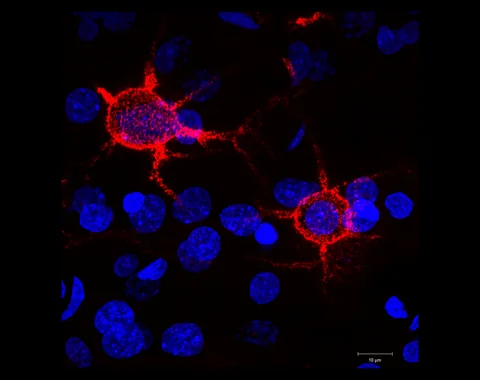
A connected nerve-and-muscle model can ask a more specific question than a dish of neurons:does a change in the neuron alter communication with muscle? The new study also shows why a recovered signal should not become a claim that every defect has disappeared.
- An axon and its cell body can have different RNA profiles.
- Structural innervation and functional signalling are distinct readouts.
- A rescue in a model does not establish patient benefit.
- Paper date
- 15 October 2026
- Model
- iPSC-derived motor neurons and muscle on a chip
- Scope
- FUS-associated ALS models; preclinical experiments
Original publication: 15 Oct 2026 · The date above refers to this brief.
Three boxes for a rescue claim
Specify
Name the model, perturbation and endpoint.
Retain
Record recovered and unchanged outcomes together.
Extend
Test the explanation in an independent background.
The result that needs a careful verb
De Jongh and colleagues analyse RNA in separate motor-neuron compartments and test SLITRK2 reduction in FUS-ALS models. Lowering SLITRK2 improves axonal defects and neuromuscular signalling in their human-cell system. It does not correct motor-neuron hypo-excitability or change neuromuscular-junction innervation in the reported comparison.
Source 1 ↗Why a functional connection adds information
Our reading separates three questions:a nerve reaches muscle, a junction is identified, and a stimulus produces a downstream response. Evidence for one cannot fill an unmeasured box in the others. The value of a connected model is that a candidate explanation can be challenged across compartments.
For a future study, we would place the input stimulus, neuronal response and muscle response on the same evidence sheet. That makes it easier to see where a perturbation acts, and whether an apparently recovered output could reflect a change in another part of the chain.
A rescue should retain the endpoints that did not change
Our proposed comparison includes an explicit unchanged column. A functional gain can be informative even when another defect remains. Recording both gives a follow-up experiment a sharper target than the phrase disease reversal.
A reader should also retain the genetic context. Evidence from FUS-associated models should not silently become a statement about every form of ALS. Additional genetic backgrounds and independent lines would test how far the mechanism travels; they would not be interchangeable technical repeats.
The controls a connected model makes possible
Our suggested next tests would compare matched neurons with the same muscle background, then vary muscle separately. A second way of reducing the candidate target and a targeted restoration experiment could help distinguish target-specific effects from consequences of the perturbation method. These are proposed questions, not extra results we have performed.
It would also be useful to report failed connections and excluded devices alongside the analysed ones. Otherwise, the best-performing devices could describe a selected subset rather than the reproducibility of the system.
Where the next useful discovery might be
The opportunity is to locate a correctable link in a chain of dysfunction, then learn which links remain. That is more informative than asking only whether an average molecular marker moves towards control. Our surrogate-outcomes guide provides a companion framework for that distinction.
The earlier dual-organoid article offers another comparison of coupled models. Both invite questions about component maturity, matching and the function demonstrated by a connection. Neither makes a chip or organoid equivalent to a whole person. This study is not a clinical test of SLITRK2 reduction, and no treatment decision follows from the model alone.
A rescue with an unchanged column
Selected accepted primary PDF: compartment-specific Results, SLITRK2 perturbations, iNMJ model and functional comparisons in Figs. 7–9; associated Results and Discussion. Figure 9 caption visually inspected. Accepted version may receive edits. Publisher HTML metadata and abstract also checked. Supplements, source-data files, code and clinical records were not audited. No publisher figure reproduced.
01What is rescued?
- What was observed
- Selected axonal defects and neuromuscular signalling after SLITRK2 reduction.
- Where the conclusion stops
- Laboratory model; does not establish clinical efficacy.
Source 1 · Accepted PDF Figs. 7–9 and corresponding Results
02What remains?
- What was observed
- Innervation and motor-neuron hypo-excitability are not corrected by the perturbation in the reported comparison.
- Where the conclusion stops
- Do not expand signalling rescue to complete disease reversal.
Source 1 · Accepted PDF Fig.9 and associated Results
Compare the actual experiments
These studies answer different questions. Read the unit and endpoint before comparing results.
| Study | Unit & setting | Readout | Interpretation boundary |
|---|---|---|---|
| Compartment-specific profiling Source 1 · Accepted PDF compartment-specific Results | iPSC-derived motor-neuron compartments | RNA and isoform differences | A molecular association needs perturbation evidence. |
| SLITRK2 reduction in connected cultures Source 1 · Accepted PDF Fig.9 and associated Results | Motor neurons and myotubes | Stimulus-linked neuromuscular signalling | Function and structure are separate endpoints. |
The export includes claims, available numbers, methods and source locations. It contains our reading notes and published summaries; it is not raw participant data or an independent reanalysis.
Evidence update · 19 Oct 2026
First publication. Reported observations, our calculations and proposed follow-up questions are distinguished. No raw data reanalysis. AI source check; no human editorial or clinical review.
What exactly was rescued?
| Observation | Keep beside it | Next useful question |
|---|---|---|
| An axonal measure improves | Which genetic background and comparator? | Does a second perturbation reproduce it? |
| Muscle signalling improves | Stimulus and neuronal response | Where in the connected chain did the change occur? |
| Innervation is unchanged | Structural endpoint beside function | Can transmission change without more connections? |
| Hypo-excitability remains | An explicitly unrecovered endpoint | Which separate mechanism might explain it? |
Original Press-News comparison framework. Proposed checks are our interpretation, not additional experiments reported by the authors.
Your questions, answered
Does this mean ALS has been reversed?
No. The reported rescue concerns selected readouts in an experimental cell model.
Why use nerve and muscle together?
A connected system permits measurement of a downstream functional response.
Did every neuronal abnormality improve?
No. Motor-neuron hypo-excitability was not corrected in the reported comparison.
What would add the most confidence?
Independent backgrounds and perturbations, with both recovered and unchanged endpoints reported.
Limits of this interpretation
- FUS-associated cell models do not cover all ALS biology.
- Structural and functional junction outcomes differ.
- Persistent neuronal hypo-excitability limits a complete-rescue interpretation.
- We did not audit raw recordings, supplements or line-level datasets.
Sources & transparency
- de Jongh, Wiersema, van Dijk et al. (2026): SLITRK2 knockdown rescues axonal and functional neuromuscular junction deficits in human iPSC-derived mutant FUS-ALS motor neurons
Selected accepted primary PDF: compartment-specific Results,SLITRK2 perturbations,iNMJ model and functional comparisons in Figs. 7–9; associated Results and Discussion. Figure 9 caption visually inspected. Accepted version may receive edits. Publisher HTML metadata and abstract also checked. Supplements, source-data files, code and clinical records were not audited. No publisher figure reproduced. · Accessed 19 Oct 2026
DOI: 10.1038/s41467-026-78419-7
Prepared and source-checked with AI. Press-news Team is a collective publication byline, not a medical reviewer. No human editorial or clinical review has taken place. This educational explainer examines experimental methods and basic or preclinical research; it does not provide individual diagnosis or treatment advice. We did not conduct these experiments or reanalyse raw data. Findings, interpretation and proposed future tests are separated. Source-access limits are recorded below. Photographs are illustrative.
Source check: AI source check — selected primary PDF results, captions and experimental boundaries
Clinical review: Not applicable to this educational guide
Suggest a correction