Focusing on field analysis
Microscopy systems using customized chips could expand on-site identification of pathogens
Published 2021-01-27 · Original archive entry · Explore research explainers
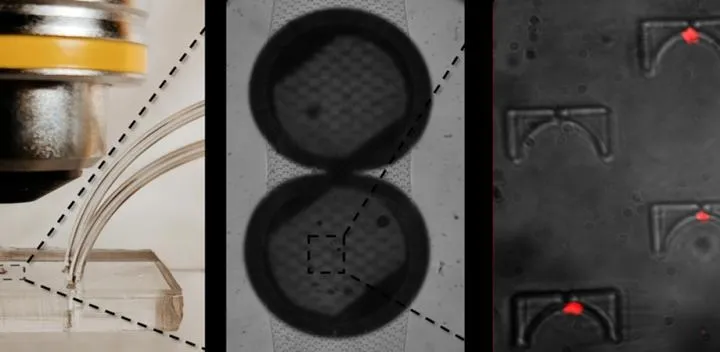
The development of cost-efficient, portable microscopy units would greatly expand their use in remote field locations and in places with fewer resources, potentially leading to easier on-site analysis of contaminants such as E. coli in water sources as well as other practical applications.
Current microscopy systems, like those used to image micro-organisms, are expensive because they are optimized for maximum resolution and minimal deformation of the images the systems produce. But some situations do not require such optimization--for instance, simply detecting the presence of pathogens in water. One potential approach to developing a low-cost portable microscopy system is to use transparent microspheres in combination with affordable low-magnification objective lenses to increase image resolution and sensitivity.
A group of researchers from Ecole Polytechnique Federale de Lausanne (EPFL) in Switzerland published a study on such an assembly composed of barium titanate spheres that are partially embedded in thin polymeric membranes. The result of their work, appearing in SPIE's new END
Current microscopy systems, like those used to image micro-organisms, are expensive because they are optimized for maximum resolution and minimal deformation of the images the systems produce. But some situations do not require such optimization--for instance, simply detecting the presence of pathogens in water. One potential approach to developing a low-cost portable microscopy system is to use transparent microspheres in combination with affordable low-magnification objective lenses to increase image resolution and sensitivity.
A group of researchers from Ecole Polytechnique Federale de Lausanne (EPFL) in Switzerland published a study on such an assembly composed of barium titanate spheres that are partially embedded in thin polymeric membranes. The result of their work, appearing in SPIE's new END