PRESS-NEWS.org - Press Release Distribution
PRESS RELEASES DISTRIBUTION

Simulating protein structures involved in memory formation
Computational model reveals details on how certain synaptic proteins organize into unique structures that are vital for learning and memory

Simulating protein structures involved in memory formation
2025-04-16
(Press-News.org)

Our brain’s remarkable ability to form and store memories has long fascinated scientists, yet most of the microscopic mechanisms behind memory and learning processes remain a mystery. Recent research points to the importance of biochemical reactions occurring at postsynaptic densities—specialized areas where neurons connect and communicate. These tiny junctions between brain cells are now thought to be crucial sites where proteins need to organize in specific ways to facilitate learning and memory formation.

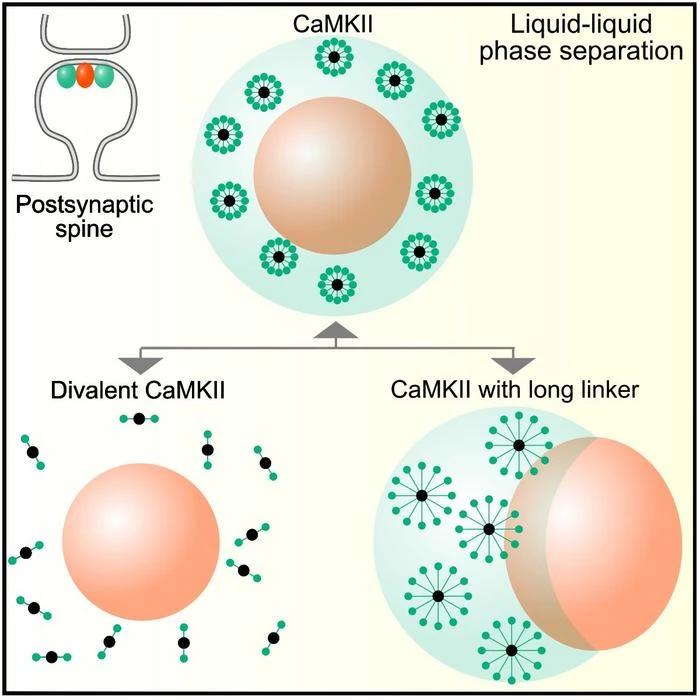
More specifically, a 2021 study revealed that memory-related proteins can bind together to form droplet-like structures at postsynaptic densities. What makes these structures particularly intriguing is their unique “droplet-inside-droplet” organization, which scientists believe may be fundamental to how our brains create lasting memories. However, understanding exactly how and why such complex protein arrangements form has remained a significant challenge in neuroscience.

Against this backdrop, a research team led by Researcher Vikas Pandey from the International Center for Brain Science (ICBS), Fujita Health University, Japan, has developed an innovative computational model that reproduces these intricate protein structures. Their paper, published online in Cell Reports on April 07, 2025, explores the mechanisms behind the formation of multilayered protein condensates. The study was co-authored by Dr. Tomohisa Hosokawa and Dr. Yasunori Hayashi from the Department of Pharmacology, Kyoto University Graduate School of Medicine, and Dr. Hidetoshi Urakubo from ICBS, Fujita Health University.

The researchers focused on four proteins found at synapses, with special attention to Ca²⁺/calmodulin-dependent protein kinase II (CaMKII)—a protein particularly abundant in postsynaptic densities. Using computational modeling techniques, they simulated how these proteins interact and organize themselves under various conditions. Their model successfully reproduced the formation of the above-mentioned “droplet-inside-droplet” structures observed in earlier experiments. Through simulations and detailed analyses of the physical forces and chemical interactions involved, the research team shed light on a process called liquid-liquid phase separation (LLPS); it involves proteins spontaneously organizing into condensates without membranes that sometimes resemble the organelles found inside cells.

Crucially, the researchers found that the distinctive “droplet-inside-droplet” structure appears as a result of competitive binding between the proteins and is significantly influenced by the shape of CaMKII, specifically its high valency (number of binding sites) and short linker length. These shape-related properties of CaMKII result in low surface tension and slow diffusion, allowing the protein condensates to remain stable for extended periods. This stability enables the sustained activation of downstream signaling pathways necessary for synaptic plasticity, which is the cellular basis for learning and memory. “Our results revealed new structure–function relationships for CaMKII as a synaptic memory unit. This is the first systematic and mechanistic study investigating the divergent structure of protein-regulated multiphase condensates,” highlights Dr. Pandey.

These findings could pave the way toward a better understanding of the possible mechanisms of memory formation in humans. However, the long-term implications of this research extend well beyond basic neuroscience.

Defects in synapse formation have been associated with numerous neurological and mental health conditions, including schizophrenia, autism spectrum disorders, Down syndrome, and Rett syndrome. “Overall, the computational model developed in this study could serve as an important platform for investigating these conditions, potentially leading to new diagnostic tools and therapeutic approaches,” explains Dr. Pandey.

Let us hope scientists continue to unravel the mysteries of how memories form at the molecular level, leading us to a more thorough comprehension of one of the brain’s most fundamental and complex functions.


***


Reference

DOI: 10.1016/j.celrep.2025.115504


About Fujita Health University
Fujita Health University (FHU) is a private medical university located in Aichi, Japan. Established in 1964, it houses one of the largest university hospitals in Japan. It’s 900 member faculty provides diverse learning and research opportunities to medical students worldwide. Guided by its founding philosophy of “Our creativity for the people” Fujita Health University believes that it’s students can shape the future through creativity and innovation. FHU has earned global recognition, ranking eighth among all universities and second among private universities in Japan in the 2020 Times Higher Education (THE) World University Rankings. The university ranked fourth worldwide in the 2024 THE University Impact Rankings for contributions to the “Good Health and Well-being” SDG (Sustainable Development Goals) of the United Nations (UN). In June 2021, the university made history as the first Japanese institution to host the THE Asia Universities Summit. In 2024, Fujita Health University was awarded the Forming Japan’s Peak Research Universities (J-PEAKS) Program by the Japanese government to establish an innovative academic drug discovery ecosystem and hub of a multi-university consortium for research and education.

Website: https://www.fujita-hu.ac.jp/en/index.html


About Dr. Vikas Pandey from Fujita Health University, Japan
Dr. Vikas Pandey obtained MS and PhD degrees from the Indian Institute of Technology, Bombay, India, in 2012 and 2017, respectively. He is currently a Special Research Fellow at Fujita Health University. His research interests revolve around systems biology, computational neuroscience, nonlinear dynamics, and mathematical biology. He has published many research papers on these topics.


Funding information
This project received funding from the Core Research for Evolutional Science and Technology (CREST), the Japan Science and Technology Agency (JST) (grant no. JPMJCR20E4), JSPS KAKENHI (JP19K06885, JP24H02317 and JP20K12062), Kobayashi foundation, ISHIZUE2024 of Kyoto University, Grant-in-Aid for Scientific Research JP18H05434, JP20K21462, and JP22K21353 from MEXT, Japan; the Uehara Memorial Foundation; the Naito Foundation; Research Foundation for Opto-Science and Technology; Novartis Foundation; the Takeda Science Foundation; and HFSP Research Grant RGP0020/2019.

END


[Attachments] See images for this press release:
Simulating protein structures involved in memory formation

ELSE PRESS RELEASES FROM THIS DATE:

Forward genetics approach reveals the factor responsible for carbon trade-off in leaves

Forward genetics approach reveals the factor responsible for carbon trade-off in leaves
2025-04-16
Plants store carbon in two primary forms: starch and triacylglycerols (TAGs). Starch is mainly stored in chloroplasts in leaves, where it serves as a readily available energy source, while TAGs are stored in seeds for long-term energy storage. Past studies have shown that a carbon trade-off exists between these two storage forms, implying that an increase in the levels of one form often reduces the levels of the other. Interestingly, attempts to increase TAG in leaves have led to a decrease in the levels of starch, suggesting ...

The most distant twin of the Milky Way ever observed

The most distant twin of the Milky Way ever observed
2025-04-16
An international team led by the University of Geneva (UNIGE) has discovered the most distant spiral galaxy candidate known to date. This ultra-massive system existed just one billion years after the Big Bang and already shows a remarkably mature structure, with a central old bulge, a large star-forming disk, and well-defined spiral arms. The discovery was made using data from the James Webb Space Telescope (JWST) and offers important insights into how galaxies can form and evolve so rapidly in the early Universe. The ...

New method to deliver cell therapies in critically ill patients on external lung support

New method to deliver cell therapies in critically ill patients on external lung support
2025-04-16
A multidisciplinary clinical team led by Professor Bernat Soria from the Institute of Bioengineering at the Miguel Hernández University of Elche (UMH, Spain) has developed a new method to deliver cell therapies in patients on extracorporeal membrane oxygenation (ECMO), a life support system used in cases of severe lung failure. The advance has been published in Stem Cell Research & Therapy (Springer Nature Group). The team has opted not to patent the technique in order to encourage its use in public health systems ...

Climate-related trauma can have lasting effects on decision-making, study finds

2025-04-16
A new study from University of California San Diego suggests that climate trauma — such as experiencing a devastating wildfire — can have lasting effects on cognitive function. The research, which focused on survivors of the 2018 Camp Fire in Northern California, found that individuals directly exposed to the disaster had difficulty making decisions that prioritize long-term benefits. The findings were recently published in Scientific Reports, part of the Nature portfolio of journals. “Our previous research has shown that survivors of California’s 2018 Camp Fire experience prolonged symptoms ...

Your cells can hear

Your cells can hear
2025-04-16
Kyoto, Japan -- There's a sensation that you experience -- near a plane taking off or a speaker bank at a concert -- from a sound so total that you feel it in your very being. When this happens, not only do your brain and ears perceive it, but your cells may also. Technically speaking, sound is a simple phenomenon, consisting of compressional mechanical waves transmitted through substances, which exists universally in the non-equilibrated material world. Sound is also a vital source of environmental information for living beings, while its capacity to induce physiological responses at the cell ...

Farm robot autonomously navigates, harvests among raised beds

Farm robot autonomously navigates, harvests among raised beds
2025-04-16
Strawberry fields forever will exist for the in-demand fruit, but the laborers who do the backbreaking work of harvesting them might continue to dwindle. While raised, high-bed cultivation somewhat eases the manual labor, the need for robots to help harvest strawberries, tomatoes, and other such produce is apparent. As a first step, Osaka Metropolitan University Assistant Professor Takuya Fujinaga has developed an algorithm for robots to autonomously drive in two modes: moving to a pre-designated destination and moving alongside ...

The bear in the (court)room: who decides on removing grizzly bears from the endangered species list?

The bear in the (court)room: who decides on removing grizzly bears from the endangered species list?
2025-04-16
By Dr Kelly Dunning The Endangered Species Act (ESA), now 50 years old, was once a rare beacon of bipartisan unity, signed into law by President Richard Nixon with near-unanimous political support. Its purpose was clear: protect imperiled species and enable their recovery using the best available science to do so. Yet, as our case study on the grizzly bear in the Greater Yellowstone Ecosystem reveals, wildlife management under the ESA has changed, becoming a political battleground where science is increasingly drowned out by partisan ideology, bureaucratic delays, power struggles, and competing political interests. ...

First study reveals neurotoxic potential of rose-scented citronellol at high exposure levels

First study reveals neurotoxic potential of rose-scented citronellol at high exposure levels
2025-04-16
Citronellol, a rose-scented compound commonly found in cosmetics and household products, has long been considered safe. However, a Korean research team has, for the first time, identified its potential to cause neurotoxicity when excessively exposed. A collaborative research team led by Dr. Myung Ae Bae at the Korea Research Institute of Chemical Technology (KRICT) and Professors Hae-Chul Park and Suhyun Kim at Korea University has discovered that high concentrations of citronellol can trigger neurological and behavioral toxicity. The study, published in the Journal ...

For a while, crocodile

For a while, crocodile
2025-04-16
Most people think of crocodylians as living fossils— stubbornly unchanged, prehistoric relics that have ruled the world’s swampiest corners for millions of years. But their evolutionary history tells a different story, according to new research led by the University of Central Oklahoma (UCO) and the University of Utah. Crocodylians are surviving members of a 230-million-year lineage called crocodylomorphs, a group that includes living crocodylians (i.e. crocodiles, alligators and gharials) and their many extinct ...

Scientists find evidence that overturns theories of the origin of water on Earth

Scientists find evidence that overturns theories of the origin of water on Earth
2025-04-16
Images available via link in the notes section University of Oxford researchers have helped overturn the popular theory that water on Earth originated from asteroids bombarding its surface; Scientists have analysed a meteorite analogous to the early Earth to understand the origin of hydrogen on our planet. The research team demonstrated that the material which built our planet was far richer in hydrogen than previously thought. The findings, which support the theory that the formation of habitable conditions on Earth did not rely on asteroids ...

LAST 30 PRESS RELEASES:

Scientists show how to predict world’s deadly scorpion hotspots

ASU researchers to lead AAAS panel on water insecurity in the United States

ASU professor Anne Stone to present at AAAS Conference in Phoenix on ancient origins of modern disease

Proposals for exploring viruses and skin as the next experimental quantum frontiers share US$30,000 science award

ASU researchers showcase scalable tech solutions for older adults living alone with cognitive decline at AAAS 2026

Scientists identify smooth regional trends in fruit fly survival strategies

Antipathy toward snakes? Your parents likely talked you into that at an early age

Sylvester Cancer Tip Sheet for Feb. 2026

Online exposure to medical misinformation concentrated among older adults

Telehealth improves access to genetic services for adult survivors of childhood cancers

Outdated mortality benchmarks risk missing early signs of famine and delay recognizing mass starvation

Newly discovered bacterium converts carbon dioxide into chemicals using electricity

Flipping and reversing mini-proteins could improve disease treatment

Scientists reveal major hidden source of atmospheric nitrogen pollution in fragile lake basin

Biochar emerges as a powerful tool for soil carbon neutrality and climate mitigation

Tiny cell messengers show big promise for safer protein and gene delivery

AMS releases statement regarding the decision to rescind EPA’s 2009 Endangerment Finding

Parents’ alcohol and drug use influences their children’s consumption, research shows

Modular assembly of chiral nitrogen-bridged rings achieved by palladium-catalyzed diastereoselective and enantioselective cascade cyclization reactions

Promoting civic engagement

AMS Science Preview: Hurricane slowdown, school snow days

Deforestation in the Amazon raises the surface temperature by 3 °C during the dry season

Model more accurately maps the impact of frost on corn crops

How did humans develop sharp vision? Lab-grown retinas show likely answer

Sour grapes? Taste, experience of sour foods depends on individual consumer

At AAAS, professor Krystal Tsosie argues the future of science must be Indigenous-led

From the lab to the living room: Decoding Parkinson’s patients movements in the real world

Research advances in porous materials, as highlighted in the 2025 Nobel Prize in Chemistry

Sally C. Morton, executive vice president of ASU Knowledge Enterprise, presents a bold and practical framework for moving research from discovery to real-world impact

Biochemical parameters in patients with diabetic nephropathy versus individuals with diabetes alone, non-diabetic nephropathy, and healthy controls

[Press-News.org] Simulating protein structures involved in memory formation
Computational model reveals details on how certain synaptic proteins organize into unique structures that are vital for learning and memory