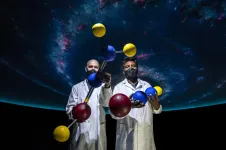
Uncovering exotic molecules of potential astrochemical interest
Looking at the night sky, one's thoughts might be drawn to astrochemistry. What molecules inhabit the vast spaces between the stars? Would we see the same molecules that surround us here on Earth? Or would some of them be more exotic--something rarely observed or even unknown? Recent research by a multinational team led by Prof. Robert Ko?os from the Institute of Physical Chemistry of the Polish Academy of Sciences has revealed an unusual molecule obtained and detected for the first time in laboratory conditions and also paved a smooth path to produce and further study another. Now that they can be seen and studied, they may prove worthy ...
Read the release