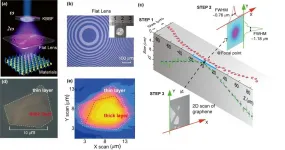
A vacuum-ultraviolet laser with submicrometer spot for spatially resolved photoemission spectroscopy
The rapid development of two-dimensional quantum materials, such as twisted bilayer graphene, monolayer copper superconductors, and quantum spin Hall materials, has demonstrated both important scientific implications and promising application potential. To characterize the electronic structure of these materials/devices, angle-resolved photoemission spectroscopy (ARPES) is commonly used to measure the energy and momentum of electrons photoemitted from samples illuminated by X-ray or vacuum ultraviolet (VUV) light sources. Although the X-ray-based spatially resolved ARPES has the highest spatial resolution (~100 nm) benefitting from the relatively short wavelength, its energy resolution is typically mediocre (>10 meV), ...
Read the release