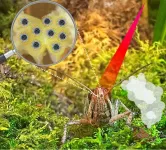
Locusts’ sense of smell boosted with custom-made nanoparticles
Our sensory systems are highly adaptable. A person who cannot see after turning off a light in the night slowly achieves superior power to see even small objects. Women often attain a heightened sense of smell during pregnancy. How can the same sensory system that was underperforming can also exceed the expectation based on its prior performance? Since nature has perfected its sensory systems over evolutionary time scales, an interdisciplinary team of researchers in the McKelvey School of Engineering at Washington University in St. Louis tapped into ...
Read the release