PRESS-NEWS.org - Press Release Distribution
PRESS RELEASES DISTRIBUTION

'Make like a bat': Study finds high frequencies help us find objects using echoes

'Make like a bat': Study finds high frequencies help us find objects using echoes
2015-05-08
(Press-News.org) The ability that some people have to use echoes to determine the position of an otherwise silent object, in a similar way to bats and dolphins, requires good high-pitch hearing in both ears, according to new research from the University of Southampton.

The study, published in Hearing Research, found that locating an object by listening to echoes, without moving the head, requires good hearing at high frequencies and in both ears. This builds on research published in 2013 by the team at the University's Institute of Sound and Vibration Research (ISVR) that demonstrated conclusively that some sighted and blind people could use echoes in this way. What wasn't clear until now was how important high-frequency hearing in both ears is.

Dr Daniel Rowan, lead author of the study, says: "We know that hearing echoes is very important in daily life for some blind people. Hearing loss, such as associated with getting older, usually reduces hearing at high frequencies in both ears. Some people can develop deafness in one ear. We wanted to get some insight into how much those particular forms of hearing loss might affect users of echoes to locate objects: our results suggest they would struggle."

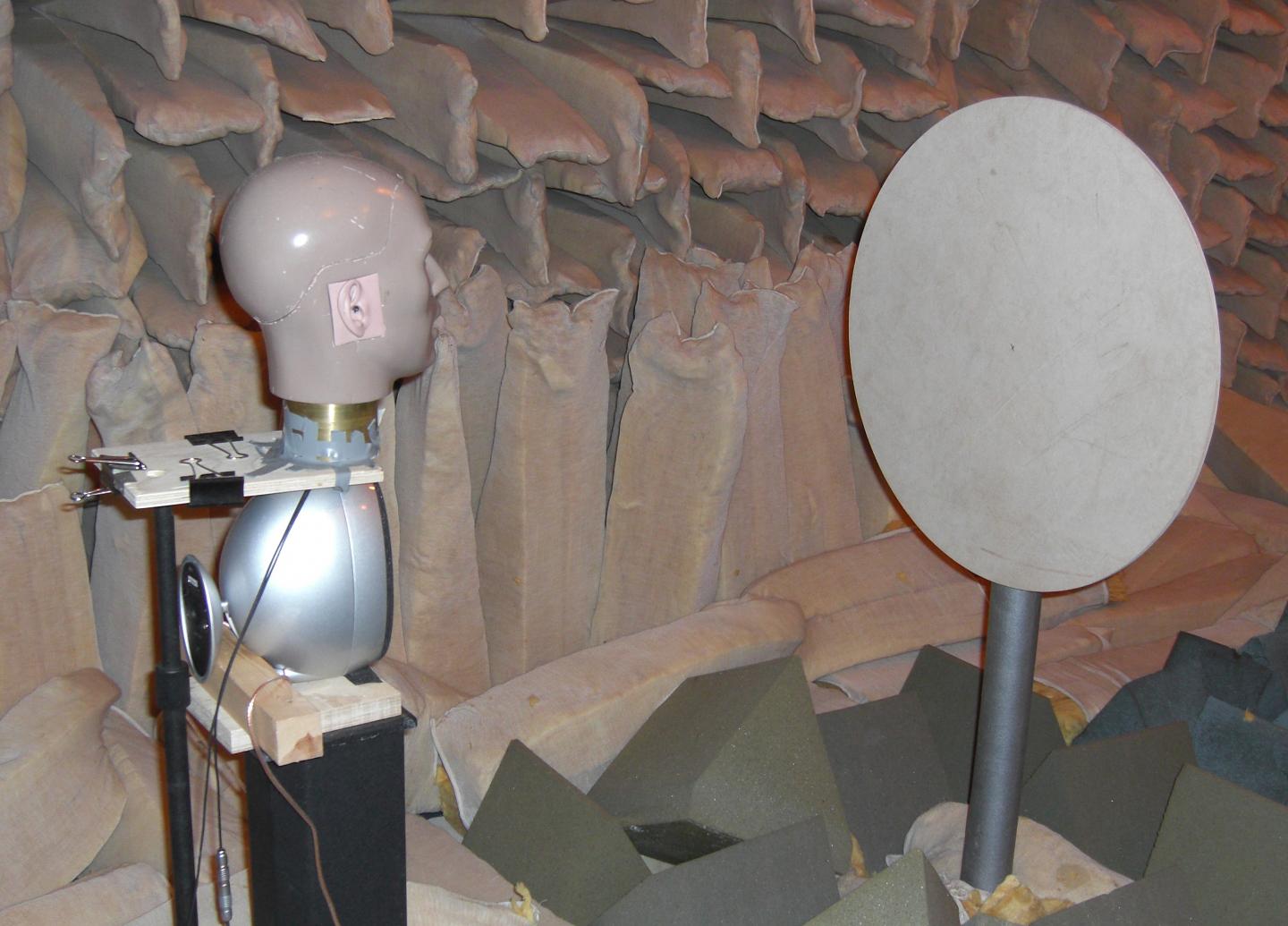
The researchers conducted a series of experiments with both sighted and blind people. In their most recent experiment, sighted people were asked if an object (in this case a flat MDF board) was to the left or right of them. The experiment used a 'virtual auditory space' technique originally created in ISVR's anechoic chamber, one of the quietest places on Earth, but reproduced for the participants over special earphones. This method allowed the researchers to remove audio and non-audio clues to the location of the object that are unrelated to echoes, such as the sounds and air movement associated with positioning the object.

Sounds were manipulated in various ways, simulating high-frequency hearing loss and single-sided deafness, as well as to check carefully that people were not finding cunning ways to use the echoes with one ear. People could locate the object accurately but only if they had good high-frequency hearing and in both ears.

Dr Rowan adds: "Hearing aid services tend to focus on how well a person can hear speech. Our research indicates that those services also need to take into account whether someone needs to hear echoes in their daily life. For example, they might need hearing aids in both ears, despite the emerging trend in some parts of the country to only fit one."

This work is currently being extended to detecting objects and using head movement to improve the localisation of objects. Initial results suggest a similar conclusion. A web-app will be launched later in the year for the public to try out the team's experiments themselves and see if they can 'make like a bat' too.

INFORMATION:


[Attachments] See images for this press release:
'Make like a bat': Study finds high frequencies help us find objects using echoes

ELSE PRESS RELEASES FROM THIS DATE:

Scientists at LSTM look at links between HAP and lung infections

2015-05-08
Scientists at LSTM have come a step closer to understanding why people exposed to household air pollution (HAP) are at higher risk of lung infections such as pneumonia and tuberculosis. Three billion people worldwide are exposed to HAP from the fuels they burn to cook, light and heat with at home. Frequently, charcoal, wood and food waste are burned and generate high concentrations of smoke particles. This exposure is associated with increased risk of pneumonia, particularly in low and middle income countries where bacterial pneumonia is the biggest cause of infant mortality. ...

Carnegie Mellon researchers find more sex doesn't lead to increased happiness

2015-05-08
PITTSBURGH-- Countless research and self-help books claim that having more sex will lead to increased happiness, based on the common finding that those having more sex are also happier. However, there are many reasons why one might observe this positive relationship between sex and happiness. Being happy in the first place, for example, might lead someone to have more sex (what researchers call 'reverse causality'), or being healthy might result in being both happier and having more sex. In the first study to examine the causal connection between sexual frequency and ...

River sediments, a dynamic reserve of pollutants

2015-05-08
This news release is available in Spanish. Metals are pollutants that have to be monitored in order to obtain a global overview of the quality of water systems, due to the fact that they remain in the environment. Although sediments act as a drain for pollutants, they can also act as a source of pollutants under certain environmental conditions (like changes in the composition of the water or movement of the sediments owing to a flood event). The UPV/EHU's Hydrology-Environment Group has conducted research on the River Deba and its tributaries to assess the influence ...

Populated Puget Sound sees stark shifts in marine fish species

Populated Puget Sound sees stark shifts in marine fish species
2015-05-08
The most populated areas of Puget Sound have experienced striking shifts in marine species, with declines in herring and smelt that have long provided food for other marine life and big increases in the catch of jellyfish, which contribute far less to the food chain, according to new research that tracks species over the last 40 years. The parallel trends of rising human population and declining forage fish such as herring and smelt indicate that human influences such as pollution and development may be eroding species that long dominated Puget Sound. In particular, the ...

It doesn't take a brain injury to have headache, dizziness and cognitive impairment

2015-05-08
Hamilton, ON (May 7, 2015) - A team of researchers based at McMaster University has developed a new understanding of post-concussion syndrome, answering questions that have been plaguing researchers in the field. Their study, published in the medical journal Brain, Behavior and Immunity, provides an explanation for why many people with even very trivial head injuries, or even injuries to other parts of their bodies, experience incapacitating post-concussion like syndromes. These symptoms include headaches, dizziness, cognitive impairment and other neuropsychiatric symptoms ...

Gene required for plant growth at warmer temperatures discovered

2015-05-08
Researchers have discovered a new gene that enables plants to regulate their growth in different temperatures. Published in PLoS Genetics today, the finding could lead to new ways of optimising plant growth when it comes to climate change. Associate Professor Sureshkumar Balasubramanian, from Monash University, along with colleagues in Spain, made the discovery after analysing natural populations of the model plant Arabidopsis thaliana, commonly known as thale cress. "Plants are highly sensitive to environmental changes and even small changes in temperature impact ...

Danish discovery accelerates targeted cancer treatment

2015-05-08
Danish researchers at the University of Copenhagen have discovered how to map more than one protein at a time, when proteins repair damaged DNA. It is a discovery that will help accelerate the process of developing better and gentler cancer treatments. The discovery has just been described in an article in the renowned scientific journal, Science. When DNA is damaged, several different proteins start pouring in to repair the damage; their types depend on the damage done. Up until now, it has been common practice to study one protein at a time, but by way of so-called ...

Enhanced dating site photos have mixed results for men and women

2015-05-08
Washington, DC (May 5, 2015) -- Dating apps like Tinder offer a quick look at a potential connection, with a simple swipe to either decline or accept the potential match. The stakes are high for putting the right picture in your profile. But does putting an enhanced picture of yourself increase the chance you'll make that match? Being cat-fished is a real risk and users have to take into consideration whether the picture of the person is "too hot to trust." A new study by researchers at the University of Connecticut found that enhanced photos of women viewed by men increased ...

Moving to a depressed neighborhood linked to weight gain

2015-05-08
Ann Arbor, MI, May 8, 2015 - Certain regions in the United States are characterized by a higher prevalence of obesity, which suggests that a person's socioeconomic, physical, and social environments can affect opportunities for healthy behaviors that might prevent excess weight gain. But what happens when people move from one neighborhood to another? A new study published in the American Journal of Preventive Medicine found that people who moved to more socioeconomically deprived neighborhoods gained additional weight. Researchers used data from the Dallas Heart Survey ...

Food industry achieved only baby steps to improve nutritional quality of foods advertised to kids

2015-05-08
Ann Arbor, MI, May 8, 2015 - Children are exposed to a considerable amount of televised food advertising: more than six ads accounting for about 2:21 minutes per hour during typical programming. Concerns about the role of televised food advertising as a contributor to childhood obesity led to the food industry adopting of a program of self-regulation. A new study published in the American Journal of Preventive Medicine evaluated the effectiveness of industry self-regulation and found that this program has achieved little improvement in the nutritional quality of foods advertised ...

LAST 30 PRESS RELEASES:

Breath carries clues to gut microbiome health

New study links altered cellular states to brain structure

Palaeontology: Ancient giant kangaroos could hop to it when they needed to

Decoded: How cancer cells protect themselves from the immune system

ISSCR develops roadmap to accelerate pluripotent stem cell-derived therapies to patients

New study shows gut microbiota directly regulates intestinal stem cell aging

Leading cancer deaths in people younger than 50 years

Rural hospital bypass by patients with commercial health insurance

Jumping giants: Fossils show giant prehistoric kangaroos could still hop

Missing Medicare data alters hospital penalties, study finds

Experimental therapy targets cancer’s bodyguards, turning foe to friend to eliminate tumors

Discovery illuminates how inflammatory bowel disease promotes colorectal cancer

Quality and quantity? The clinical significance of myosteatosis in various liver diseases

Expert consensus on clinical applications of fecal microbiota transplantation for chronic liver disease (2025 edition)

Insilico Medicine to present three abstracts at the 2026 Crohn’s & Colitis Congress highlighting clinical, preclinical safety, and efficacy data for ISM5411, a novel gut-restricted PHD1/2 inhibitor fo

New imaging technology detects early signs of heart disease through the skin

Resurrected ancient enzyme offers new window into early Earth and the search for life beyond it

People with obesity may have a higher risk of dementia

Insilico Medicine launches science MMAI gym to train frontier LLMs into pharmaceutical-grade scientific engines

5 pre-conference symposia scheduled ahead of International Stroke Conference 2026

To explain or not? Need for AI transparency depends on user expectation

Global prevalence, temporal trends, and associated mortality of bacterial infections in patients with liver cirrhosis

Scientists discover why some Central Pacific El Niños die quickly while others linger for years

CNU research explains how boosting consumer trust unlocks the $4 billion market for retired EV batteries

Reimagining proprioception: when biology meets technology

Chungnam National University study finds climate adaptation can ease migration pressures in Africa

A cigarette compound-induced tumor microenvironment promotes sorafenib resistance in hepatocellular carcinoma via the 14-3-3η-modified tumor-associated proteome

Brain network disorders study provides insights into the role of molecular chaperones in neurodegenerative diseases

Making blockchain fast enough for IoT networks

Chemotherapy rewires gut bacteria to curb metastasis

[Press-News.org] 'Make like a bat': Study finds high frequencies help us find objects using echoes