PRESS-NEWS.org - Press Release Distribution
PRESS RELEASES DISTRIBUTION

Injections or light irradiation?

Injections or light irradiation?
2021-03-15
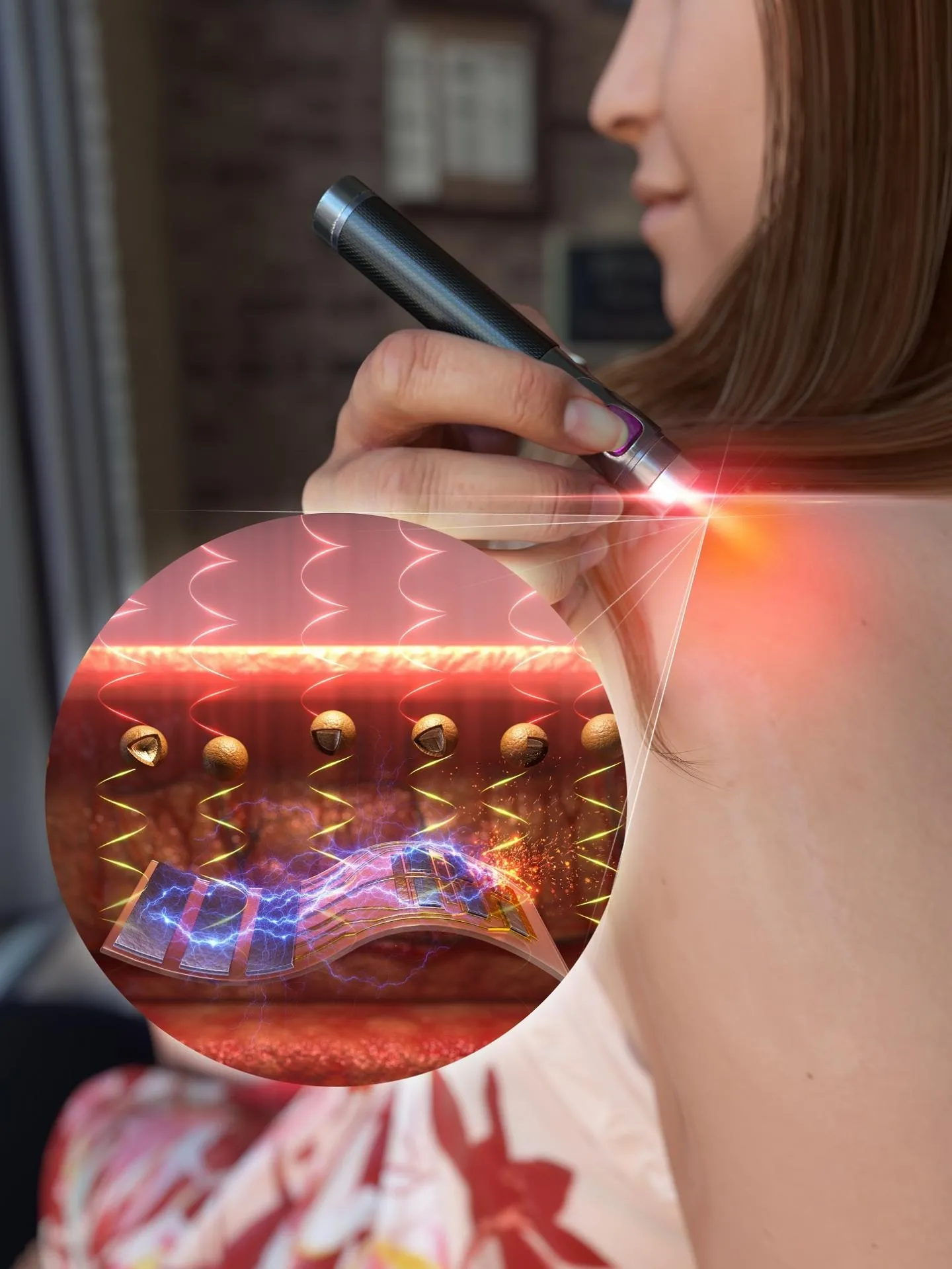
(Press-News.org) A new concept of on-demand drug delivery system has emerged in which the drugs are automatically released from in vivo medical devices simply by shining light on the skin. A research team led by Professor Sei Kwang Hahn of the Department of Materials Science and Engineering and Professor Kilwon Cho of the Department of Chemical Engineering at POSTECH have together developed an on-demand drug delivery system (DDS) using an organic photovoltaic cell coated with upconversion nanoparticles. This newly developed DDS allows nanoparticles to convert skin-penetrating near-infrared (NIR) light into visible light so that drug release can be controlled in medical devices installed in the body. These research findings were published in Nano Energy on March 1, 2021. For patients who need periodic drug injections as in the case of diabetes, DDSs that automatically administer drugs in lieu of repetitive shots are being researched and developed. However, its size and shape have been restricted due to limitations in power supply for operating such a device. The research team found the answer in solar power. Upconversion nanoparticles were used for the photovoltaic device to induce photovoltaic power generation with NIR light that can penetrate the skin. An organic photovoltaic cell coated with a core-shell structured upconversion nanoparticles was designed to operate a drug delivery system made of a mechanical and electronic system by generating an electric current upon irradiation of NIR light. When electricity is applied in this manner, the thin gold film sealing the drug reservoir melts and the drug is released. "The combination of a flexible photovoltaic cell and a drug delivery system enables on-demand drug release using light," explained Professor Sei Kwang Hahn. "The drug delivery system is activated using near-infrared light that is harmless to the human body and is highly skin-penetrating." He added, "Since this enables nimble control of drug release of medical devices inserted into the body by using near-infrared light, it is highly anticipated to contribute to the development of phototherapy technology using implantable medical devices."

INFORMATION:

This research was financially supported by the Global Frontier Program, the Engineering Research Center Program, and the Mid-career Researcher Program of the Korean Ministry of Science and ICT.


[Attachments] See images for this press release:
Injections or light irradiation?

ELSE PRESS RELEASES FROM THIS DATE:

Researchers present spontaneous sparse learning for PCM-based memristor neural networks

Researchers present spontaneous sparse learning for PCM-based memristor neural networks
2021-03-15
An international team of researchers, affiliated with UNIST has unveiled a novel technology that could improve the learning ability of artificial neural networks (ANNs). Professor Hongsik Jeong and his research team in the Department of Materials Science and Engineering at UNIST, in collaboration with researchers from Tsinghua University in China, proposed a new learning method to improve the learning ability of ANN chips by challenging its instability. Artificial neural network chips are capable of mimicking the structural, functional and biological features of human neural networks, and thus have been considered the technology of the future. In this study, the research team demonstrated the effectiveness of the proposed learning method ...

Enzymatic danse macabre of lung cancer

2021-03-15
A chromatin-regulating enzyme has been shown by in-depth interdisciplinary investigations to be a key driver of a common type of lung cancer. Drugs that target the enzyme could improve treatment and survival rates for this particular cancer. "Squamous cell carcinoma represents nearly one third of all lung cancers in humans," says KAUST structural biologist Lukasz Jaremko, who led the research along with colleagues at Stanford University and The University of Texas MD Anderson Cancer Center, U.S. "Our joint structural and dynamics investigations, including enzymatic activity studies, genetic analyses, and mouse model and human cell results, ...

Bacteria adapt syringe apparatus to changing conditions

Bacteria adapt syringe apparatus to changing conditions
2021-03-15
Basic, acidic, basic again: for pathogenic bacteria such as Salmonella, the human digestive tract is a sea change. So how do the bacteria manage to react to these changes? A team of researchers from the Max Planck Institute for Terrestrial Microbiology in Marburg led by Andreas Diepold has now provided a possible explanation: pathogenic bacteria can change components of their injection apparatus on the fly - like changing the tires on a moving car - to enable a rapid response. Some of the best-known human pathogens - from the plague bacterium Yersinia pestis to the diarrhea pathogen Salmonella - use a tiny hypodermic needle to inject disease-causing ...

How artificial intelligence can help curb traffic accidents in cities

2021-03-15
Despite pandemic-driven restrictions on movement, there were over 12,000 accidents in Madrid in 2020, leading to 31 fatalities. In Barcelona, there were more than 5,700 collisions, causing 14 deaths. Pedestrian and vehicle safety is a priority, which is why a research project at the Universitat Oberta de Catalunya (UOC) is harnessing artificial intelligence (AI) to make decisions that will make cities safer. The researchers have looked into the correlation between the complexity of certain urban areas and the likelihood of an accident occurring there. According to the researchers, the data they have gathered can be used to train neural networks to detect probable ...

A law to protect those who support victims of violence against women

A law to protect those who support victims of violence against women
2021-03-15
Last December, the Parliament of Catalonia unanimously approved the incorporation into its legislation of second-order violence against those who give their support to victims of violence against women. A recent study compiles testimonies of victims, and analyses this form of intimidation To tackle violence against women, it is essential for victims to have the support of those surrounding them and to prevent them from being isolated. But what happens if the people around them are not protected? The work of Jose Ramón Flecha García, founder of the Community of Research on Excellence for All (CREA), and various academic teams, has led to the approval in the Catalan parliament of the first legislation on the Second Order of Sexual Harassment (SOSH). The following point ...

Engineers combine AI and wearable cameras in self-walking robotic legs

Engineers combine AI and wearable cameras in self-walking robotic legs
2021-03-15
Robotics researchers are developing exoskeletons and prosthetic legs capable of thinking and moving on their own using sophisticated artificial intelligence (AI) technology. The system combines computer vision and deep-learning AI to mimic how able-bodied people walk by seeing their surroundings and adjusting their movements. "We're giving robotic legs vision so they can control themselves," said Brokoslaw Laschowski, a PhD candidate in systems design engineering who leads a University of Waterloo research project called ExoNet. Exoskeletons and prosthetic devices operated by motors already exist, but users must manually ...

New probe set unravels evolutionary history of second-most diverse group of land plants

New probe set unravels evolutionary history of second-most diverse group of land plants
2021-03-15
In 2016, a collaborative group of research and education specialists received funding from the National Science Foundation for the project 'Building a Comprehensive Evolutionary History of Flagellate Plants' -- also known as 'Genealogy of Flagellate Plants' (GoFlag). Members of the team have the ambitious goal of reconstructing the 470-million-year history of one of the most diverse groups of land plants on the planet. The first of several forthcoming publications from the project was published in a recent issue of Applications in Plant Sciences. In their inaugural article, the researchers report on the successful development of 451 nuclear target enrichment probes, which correspond to short, variable loci. By creating a standard ...

Model predicts urban development and greenhouses gasses will fuel urban floods

2021-03-15
When rain began falling in northern Georgia on Sept. 15, 2009, little did Atlantans know that they would bear witness to epic flooding throughout the city. Neighborhoods, like Peachtree Hills, were submerged; Georgia's busiest expressway was underwater, as were roads and bridges; untreated sewage mingled with rising flood waters; cars and people were swept away. Then-Georgia-governor, Sonny Perdue, declared a state of emergency. Moisture from the Gulf of Mexico fueled the flood of 2009. A decade later, Arizona State University researchers are asking whether a ...

'Reducing global warming matters for freshwater fish species'

2021-03-15
The habitats of freshwater fish species are threatened by global warming, mainly due to rising water temperatures. A 3.2-degree Celsius increase in global mean temperature would threaten more than half of the habitat for one third of all freshwater fish species. The number of species at risk is ten times smaller if warming is limited to 1.5 degrees. This is the conclusion of a study led by Radboud University, in collaboration with Utrecht University, PBL Netherlands Environmental Assessment Agency, Leiden University and others, and published in Nature Communications ...

Beta-blockers not likely to cause depression yet may contribute to sleep disturbances

2021-03-15
DALLAS, March 15, 2021 -- Beta-blockers treat various cardiovascular diseases and were not more likely to cause depression compared to other similar treatments, according to new research published today in Hypertension, an American Heart Association journal. While depression may occur during beta-blocker therapy, the research suggests beta-blockers are not the likely cause. Beta-blockers are a class of medications that reduce the heart rate, the heart's workload and the heart's output of blood, which, together, lower blood pressure. They are a common treatment for cardiovascular diseases, including heart failure, arrhythmias, chest pains and high blood pressure. Researchers have suspected ...

LAST 30 PRESS RELEASES:

Ketamine high NOT related to treatment success for people with alcohol problems, study finds

1 in 6 Medicare beneficiaries depend on telehealth for key medical care

Maps can encourage home radon testing in the right settings

Exploring the link between hearing loss and cognitive decline

Machine learning tool can predict serious transplant complications months earlier

Prevalence of over-the-counter and prescription medication use in the US

US child mental health care need, unmet needs, and difficulty accessing services

Incidental rotator cuff abnormalities on magnetic resonance imaging

Sensing local fibers in pancreatic tumors, cancer cells ‘choose’ to either grow or tolerate treatment

Barriers to mental health care leave many children behind, new data cautions

Cancer and inflammation: immunologic interplay, translational advances, and clinical strategies

Bioactive polyphenolic compounds and in vitro anti-degenerative property-based pharmacological propensities of some promising germplasms of Amaranthus hypochondriacus L.

AI-powered companionship: PolyU interfaculty scholar harnesses music and empathetic speech in robots to combat loneliness

Antarctica sits above Earth’s strongest “gravity hole.” Now we know how it got that way

Haircare products made with botanicals protects strands, adds shine

Enhanced pulmonary nodule detection and classification using artificial intelligence on LIDC-IDRI data

Using NBA, study finds that pay differences among top performers can erode cooperation

Korea University, Stanford University, and IESGA launch Water Sustainability Index to combat ESG greenwashing

Molecular glue discovery: large scale instead of lucky strike

Insulin resistance predictor highlights cancer connection

Explaining next-generation solar cells

Slippery ions create a smoother path to blue energy

Magnetic resonance imaging opens the door to better treatments for underdiagnosed atypical Parkinsonisms

National poll finds gaps in community preparedness for teen cardiac emergencies

One strategy to block both drug-resistant bacteria and influenza: new broad-spectrum infection prevention approach validated

Survey: 3 in 4 skip physical therapy homework, stunting progress

College students who spend hours on social media are more likely to be lonely – national US study

Evidence behind intermittent fasting for weight loss fails to match hype

How AI tools like DeepSeek are transforming emotional and mental health care of Chinese youth

Study finds link between sugary drinks and anxiety in young people

[Press-News.org] Injections or light irradiation?