Short duration of the Yixian Formation and 'Chinese Dinosaurs Pompeii'
Published 2021-04-14 · Original archive entry · Explore research explainers
The Early Cretaceous Jehol Biota, renowned for its exceptionally well preserved volcanic-influenced ecosystem, was buried in lacustrine and occasionally fluvial sediments in northern Hebei and western Liaoning, China. It includes large amount of evolutionarily significant taxonomy, e.g. feathered dinosaurs, early birds, mammals and flowering plants, representing one of the most diversified terrestrial biotas of the Mesozoic and providing exceptional windows into some major fundamental issues in earth and biological sciences, such as the origins of birds and angiosperm, and co-evolution of life and environments.
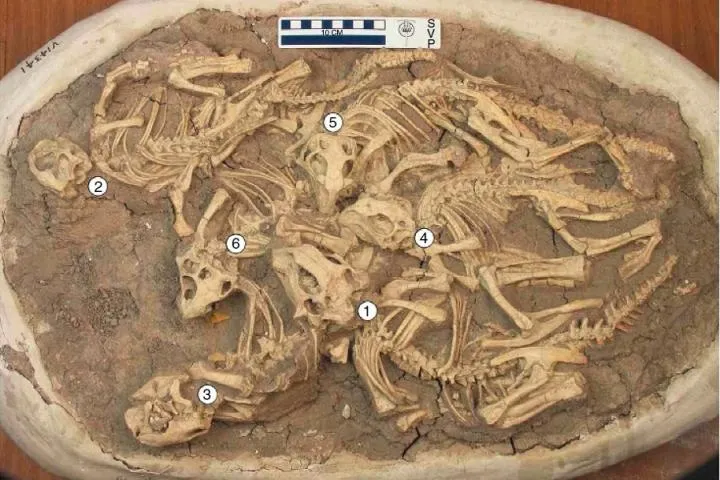
The evolutionary radiation of the Jehol Biota can be broadly divided to three phases, with the first phase limited to a small area in northern Hebei (Huajiying Formation), the second phase expanding to western Liaoning (Yixian Formation), and the third phase (Jiufotang Formation). Specifically, the Yixian Formation marks the greatest bio-diversification, and the Lujiatun Unit in its lowermost part preserves numerous three-dimensional dinosaurs fossils with gesture, often referred to as "Chinese Dinosaurs Pompeii" (Fig. 1). It is therefore crucial to precisely determine the timing and duration of the Yixian Formation. Despite considerable efforts in the past two decades attempting to achieve this goal, the published results (Fig. 2) are inconsistent, confusing and inadequate. The duration of the Yixian Formations and the relative temporal and stratigraphical sequences between Lujiatun (LJT) and Jiahsangou (JSG) Units remained controversial until recently.
Supported by the National Natural Science Foundation and Chinese Academy of Sciences, a group led by Prof. Yi-Gang Xu from the Guangzhou Institute of Geochemistry, CAS, in collaboration with Prof. Qing-Zhu Yin's team at the University of California at Davis has carried out high-precision geochronology study on the Yixian Formation, using U-Pb chemical abrasion-isotope dilution-isotope ratio mass spectrometry (CA-ID-IRMS) dating technique with a typical analytical precision END
The evolutionary radiation of the Jehol Biota can be broadly divided to three phases, with the first phase limited to a small area in northern Hebei (Huajiying Formation), the second phase expanding to western Liaoning (Yixian Formation), and the third phase (Jiufotang Formation). Specifically, the Yixian Formation marks the greatest bio-diversification, and the Lujiatun Unit in its lowermost part preserves numerous three-dimensional dinosaurs fossils with gesture, often referred to as "Chinese Dinosaurs Pompeii" (Fig. 1). It is therefore crucial to precisely determine the timing and duration of the Yixian Formation. Despite considerable efforts in the past two decades attempting to achieve this goal, the published results (Fig. 2) are inconsistent, confusing and inadequate. The duration of the Yixian Formations and the relative temporal and stratigraphical sequences between Lujiatun (LJT) and Jiahsangou (JSG) Units remained controversial until recently.
Supported by the National Natural Science Foundation and Chinese Academy of Sciences, a group led by Prof. Yi-Gang Xu from the Guangzhou Institute of Geochemistry, CAS, in collaboration with Prof. Qing-Zhu Yin's team at the University of California at Davis has carried out high-precision geochronology study on the Yixian Formation, using U-Pb chemical abrasion-isotope dilution-isotope ratio mass spectrometry (CA-ID-IRMS) dating technique with a typical analytical precision END