The perfect blend: Optimizing gas mixtures for hydrogen storage in clathrate hydrates
Scientists find optimal hydrogen-natural gas blend to trap hydrogen in cage-like molecules more effectively
Published 2021-05-17 · Original archive entry · Explore research explainers
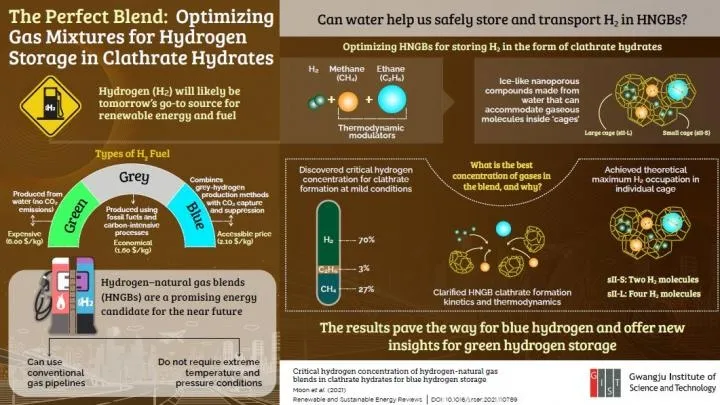
In our ongoing quest to transform into a more eco-friendly society, hydrogen (H2) is heralded as the clean fuel of tomorrow. Because H2 can be produced from water (H2O) without generating carbon emissions, developing H2-compatible technologies has become a top priority. However, the road ahead is bumpy, and many technical limitations must be ironed out. "Hydrogen is the smallest molecule in nature, and finding feasible ways to store it is a critical issue to realize a hydrogen economy," states Associate Professor Youngjune Park from the Gwangju Institute of Science and Technology (GIST) in Korea. Unlike hydrocarbons, pure H2 must be stored at an extremely high pressure (>100 atmospheres) or low temperature (20 °C). Naturally, this represents a huge economic barrier for H2 storage. But what if we could trap H2 inside ice-like crystals to make storage and transportation less demanding?
These molecular cages exist in nature and are called 'clathrate hydrates.' They are solid water-based compounds with cavities that can accommodate various molecules. Dr. Park's group at GIST has been researching the use of clathrate hydrates as vessels for H2 storage. However, the enclathration of pure H2 is still a slow process that also requires extreme temperature and pressure conditions.
In a recent study END
These molecular cages exist in nature and are called 'clathrate hydrates.' They are solid water-based compounds with cavities that can accommodate various molecules. Dr. Park's group at GIST has been researching the use of clathrate hydrates as vessels for H2 storage. However, the enclathration of pure H2 is still a slow process that also requires extreme temperature and pressure conditions.
In a recent study END